

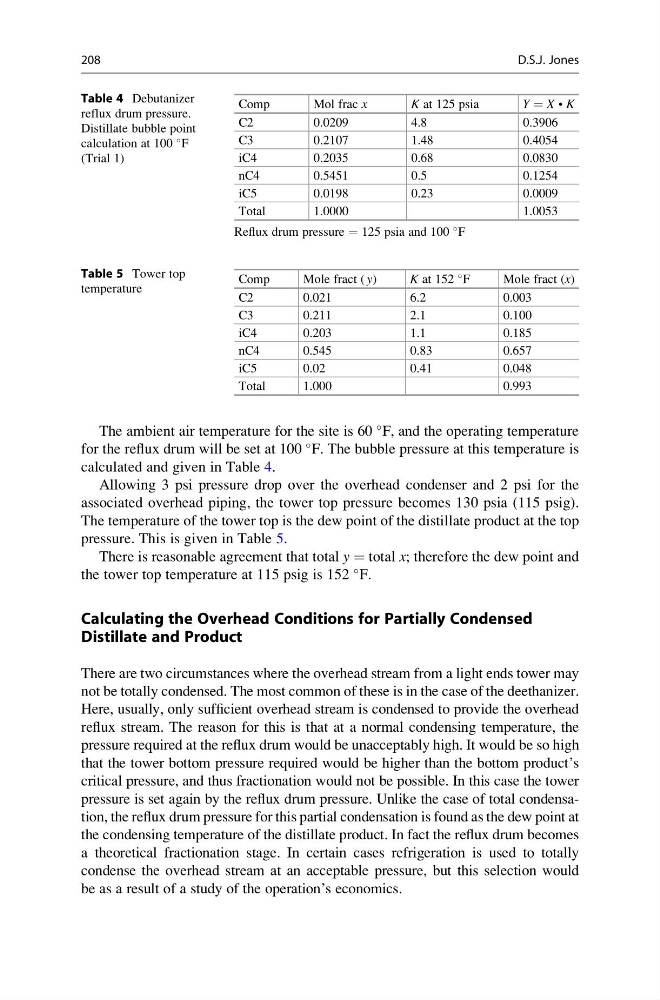
The ambient air temperature for the site is 60
F, and the operating temperature
for the reflux drum will be set at 100
F. The bubble pressure at this temperature is
calculated and given in Table 4.
Allowing 3 psi pressure drop over the overhead condenser and 2 psi for the
associated overhead piping, the tower top pressure becomes 130 psia (115 psig).
The temperature of the tower top is the dew point of the distillate product at the top
pressure. This is given in Table 5.
There is reasonable agreement that total y = total x; therefore the dew point and
the tower top temperature at 115 psig is 152
F.
Calculating the Overhead Conditions for Partially Condensed
Distillate and Product
There are two circumstances where the overhead stream from a light ends tower may
not be totally condensed. The most common of these is in the case of the deethanizer.
Here, usually, only sufficient overhead stream is condensed to provide the overhead
reflux stream. The reason for this is that at a normal condensing temperature, the
pressure required at the reflux drum would be unacceptably high. It would be so high
that the tower bottom pressure required would be higher than the bottom product’s
critical pressure, and thus fractionation would not be possible. In this case the tower
pressure is set again by the reflux drum pressure. Unlike the case of total condensation, the reflux drum pressure for this partial condensation is found as the dew point at
the condensing temperature of the distillate product. In fact the reflux drum becomes
a theoretical fractionation stage. In certain cases refrigeration is used to totally
condense the overhead stream at an acceptable pressure, but this selection would
be as a result of a study of the operation’s economics.
Table 4 Debutanizer
reflux drum pressure.
Distillate bubble point
calculation at 100
F
(Trial 1)
Comp
Mol frac x
Kat 125 psia
Y = X • K
C2
0.0209
4.8
0.3906
C3
0.2107
1.48
0.4054
iC4
0.2035
0.68
0.0830
nC4
0.5451
0.5
0.1254
iC5
0.0198
0.23
0.0009
Total
1.0000
1.0053
Reflux drum pressure = 125 psia and 100
F
Table 5 Tower top
temperature
Comp
Mole fract ( y)
K at 152
F
Mole fract (x)
C2
0.021
6.2
0.003
C3
0.211
2.1
0.100
iC4
0.203
1.1
0.185
nC4
0.545
0.83
0.657
iC5
0.02
0.41
0.048
Total
1.000
0.993
208
D.S.J. Jones
F, and the operating temperature
for the reflux drum will be set at 100
F. The bubble pressure at this temperature is
calculated and given in Table 4.
Allowing 3 psi pressure drop over the overhead condenser and 2 psi for the
associated overhead piping, the tower top pressure becomes 130 psia (115 psig).
The temperature of the tower top is the dew point of the distillate product at the top
pressure. This is given in Table 5.
There is reasonable agreement that total y = total x; therefore the dew point and
the tower top temperature at 115 psig is 152
F.
Calculating the Overhead Conditions for Partially Condensed
Distillate and Product
There are two circumstances where the overhead stream from a light ends tower may
not be totally condensed. The most common of these is in the case of the deethanizer.
Here, usually, only sufficient overhead stream is condensed to provide the overhead
reflux stream. The reason for this is that at a normal condensing temperature, the
pressure required at the reflux drum would be unacceptably high. It would be so high
that the tower bottom pressure required would be higher than the bottom product’s
critical pressure, and thus fractionation would not be possible. In this case the tower
pressure is set again by the reflux drum pressure. Unlike the case of total condensation, the reflux drum pressure for this partial condensation is found as the dew point at
the condensing temperature of the distillate product. In fact the reflux drum becomes
a theoretical fractionation stage. In certain cases refrigeration is used to totally
condense the overhead stream at an acceptable pressure, but this selection would
be as a result of a study of the operation’s economics.
Table 4 Debutanizer
reflux drum pressure.
Distillate bubble point
calculation at 100
F
(Trial 1)
Comp
Mol frac x
Kat 125 psia
Y = X • K
C2
0.0209
4.8
0.3906
C3
0.2107
1.48
0.4054
iC4
0.2035
0.68
0.0830
nC4
0.5451
0.5
0.1254
iC5
0.0198
0.23
0.0009
Total
1.0000
1.0053
Reflux drum pressure = 125 psia and 100
F
Table 5 Tower top
temperature
Comp
Mole fract ( y)
K at 152
F
Mole fract (x)
C2
0.021
6.2
0.003
C3
0.211
2.1
0.100
iC4
0.203
1.1
0.185
nC4
0.545
0.83
0.657
iC5
0.02
0.41
0.048
Total
1.000
0.993
208
D.S.J. Jones