

C
C
C
C
2H
2H
2H
2H
2H
2H
C
C
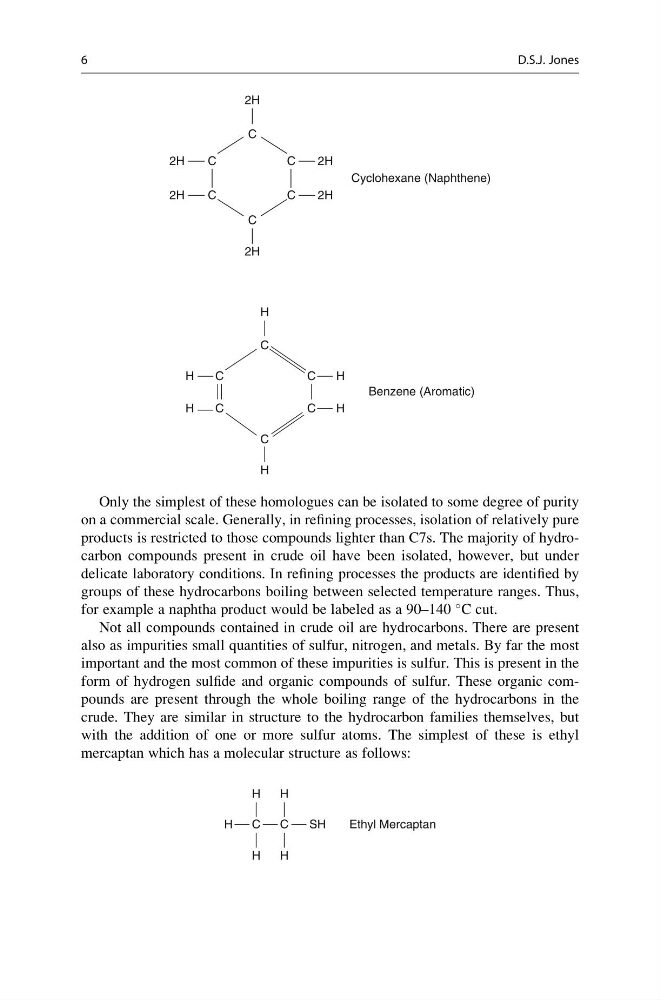
Cyclohexane (Naphthene)
C
H
H
Benzene (Aromatic)
C
C
C
C
C
H
H
H
H
Only the simplest of these homologues can be isolated to some degree of purity
on a commercial scale. Generally, in refining processes, isolation of relatively pure
products is restricted to those compounds lighter than C7s. The majority of hydrocarbon compounds present in crude oil have been isolated, however, but under
delicate laboratory conditions. In refining processes the products are identified by
groups of these hydrocarbons boiling between selected temperature ranges. Thus,
for example a naphtha product would be labeled as a 90–140
C cut.
Not all compounds contained in crude oil are hydrocarbons. There are present
also as impurities small quantities of sulfur, nitrogen, and metals. By far the most
important and the most common of these impurities is sulfur. This is present in the
form of hydrogen sulfide and organic compounds of sulfur. These organic compounds are present through the whole boiling range of the hydrocarbons in the
crude. They are similar in structure to the hydrocarbon families themselves, but
with the addition of one or more sulfur atoms. The simplest of these is ethyl
mercaptan which has a molecular structure as follows:
H
H
C
C
SH
Ethyl Mercaptan
H
H
H
6
D.S.J. Jones
C
C
C
2H
2H
2H
2H
2H
2H
C
C
Cyclohexane (Naphthene)
C
H
H
Benzene (Aromatic)
C
C
C
C
C
H
H
H
H
Only the simplest of these homologues can be isolated to some degree of purity
on a commercial scale. Generally, in refining processes, isolation of relatively pure
products is restricted to those compounds lighter than C7s. The majority of hydrocarbon compounds present in crude oil have been isolated, however, but under
delicate laboratory conditions. In refining processes the products are identified by
groups of these hydrocarbons boiling between selected temperature ranges. Thus,
for example a naphtha product would be labeled as a 90–140
C cut.
Not all compounds contained in crude oil are hydrocarbons. There are present
also as impurities small quantities of sulfur, nitrogen, and metals. By far the most
important and the most common of these impurities is sulfur. This is present in the
form of hydrogen sulfide and organic compounds of sulfur. These organic compounds are present through the whole boiling range of the hydrocarbons in the
crude. They are similar in structure to the hydrocarbon families themselves, but
with the addition of one or more sulfur atoms. The simplest of these is ethyl
mercaptan which has a molecular structure as follows:
H
H
C
C
SH
Ethyl Mercaptan
H
H
H
6
D.S.J. Jones