

The higher carbon number ranges of these sulfur compounds are thiophenes
which are found mostly in the heavy residuum range and disulfides found in the
middle distillate range of the crude. The sulfur from these heavier sulfur products
can only be removed by converting the sulfur to H 2 S in a hydrotreating process
operating under severe conditions of temperature and pressure and over a suitable
catalyst. The lighter sulfur compounds can be removed as mercaptans by extraction
with caustic soda or other suitable proprietary solvents or by other processes, like
hydrotreating.
Organic chloride compounds are also present in crude oil. These are not removed
as such but metallic protection is applied against corrosion by HCl in the primary
distillation processes. This protection is in the form of Monel lining in the sections
of the process most vulnerable to chloride attack. Injection of ammonia or amines is
also applied to neutralize the HCl in these sections of the equipment.
The most common metal impurities found in crude oils are nickel, vanadium,
and sodium. These are not very volatile and are found in the residuum or fuel oil
products of the crude oil. These are not removed as metals from the crude and
normally they are only a nuisance if they affect further processing of the oil or if
they are a deterrent to the saleability of the fuel product. For example, the metals
cause severe deterioration in the catalyst life of most catalytic processes. Also, high
concentrations of nickel and vanadium are unacceptable in fuel oils used in the
production of certain steels. The metals can be removed with the glutinous portion
of the fuel oil product called asphaltenes. The most common process used to
accomplish this is the extraction of the asphaltenes from the residue oils using
propane as solvent. Coking is also common for removal of these heavy components.
Nitrogen, the remaining impurity, is usually found as dissolved gas in the crude
or as amines or other nitrogen compounds in the heavier fractions. It is a problem
with certain processes, such as catalytic reforming and hydrocracking. Nitrogen is
removed along with the sulfur compounds by hydrotreating the feedstocks to these
processes.
Although the major families or homologues of hydrocarbons found in all crude
oils as described earlier are the paraffins, cyclic paraffins, and aromatics, there is a
fourth group. These are the unsaturated or olefinic hydrocarbons. They are not
naturally present in any great quantity in most crude oils, but are often produced in
significant quantities during the processing of the crude oil to refined products. This
occurs in those processes which subject the oil to high temperature for a relatively
long period of time. Under these conditions the saturated hydrocarbon molecules
break down, permanently losing one or more of the four atoms attached to the
quadrivalent carbon. The resulting hydrocarbon molecule is unstable and readily
combines with itself (forming double-bond links) or with similar molecules to form
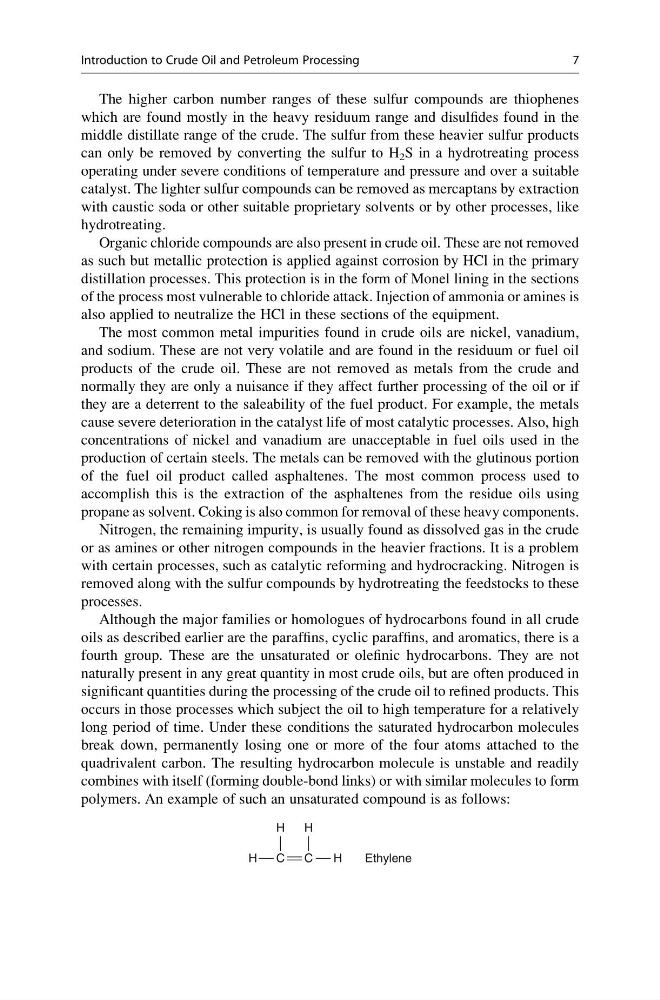
polymers. An example of such an unsaturated compound is as follows:
H
H
C
C
H
Ethylene
H
Introduction to Crude Oil and Petroleum Processing
7
which are found mostly in the heavy residuum range and disulfides found in the
middle distillate range of the crude. The sulfur from these heavier sulfur products
can only be removed by converting the sulfur to H 2 S in a hydrotreating process
operating under severe conditions of temperature and pressure and over a suitable
catalyst. The lighter sulfur compounds can be removed as mercaptans by extraction
with caustic soda or other suitable proprietary solvents or by other processes, like
hydrotreating.
Organic chloride compounds are also present in crude oil. These are not removed
as such but metallic protection is applied against corrosion by HCl in the primary
distillation processes. This protection is in the form of Monel lining in the sections
of the process most vulnerable to chloride attack. Injection of ammonia or amines is
also applied to neutralize the HCl in these sections of the equipment.
The most common metal impurities found in crude oils are nickel, vanadium,
and sodium. These are not very volatile and are found in the residuum or fuel oil
products of the crude oil. These are not removed as metals from the crude and
normally they are only a nuisance if they affect further processing of the oil or if
they are a deterrent to the saleability of the fuel product. For example, the metals
cause severe deterioration in the catalyst life of most catalytic processes. Also, high
concentrations of nickel and vanadium are unacceptable in fuel oils used in the
production of certain steels. The metals can be removed with the glutinous portion
of the fuel oil product called asphaltenes. The most common process used to
accomplish this is the extraction of the asphaltenes from the residue oils using
propane as solvent. Coking is also common for removal of these heavy components.
Nitrogen, the remaining impurity, is usually found as dissolved gas in the crude
or as amines or other nitrogen compounds in the heavier fractions. It is a problem
with certain processes, such as catalytic reforming and hydrocracking. Nitrogen is
removed along with the sulfur compounds by hydrotreating the feedstocks to these
processes.
Although the major families or homologues of hydrocarbons found in all crude
oils as described earlier are the paraffins, cyclic paraffins, and aromatics, there is a
fourth group. These are the unsaturated or olefinic hydrocarbons. They are not
naturally present in any great quantity in most crude oils, but are often produced in
significant quantities during the processing of the crude oil to refined products. This
occurs in those processes which subject the oil to high temperature for a relatively
long period of time. Under these conditions the saturated hydrocarbon molecules
break down, permanently losing one or more of the four atoms attached to the
quadrivalent carbon. The resulting hydrocarbon molecule is unstable and readily
combines with itself (forming double-bond links) or with similar molecules to form
polymers. An example of such an unsaturated compound is as follows:
H
H
C
C
H
Ethylene
H
Introduction to Crude Oil and Petroleum Processing
7