

sparked the second industrial revolution, with the establishment of the industrial
scene of today and its continuing development. The petroleum products from the
crude oil used initially for the energy required by the internal combustion engine
have mushroomed to become the basis and source of some of our chemical and
pharmaceutical products.
The development of the crude oil refining industry and the internal combustion
engine had influenced each other during the twentieth century. Other factors
have also contributed to accelerate the development of both. The major factors
are the increasing awareness of environmental contamination and the increasing
demand for faster travel which led to the development of the aircraft industry with
its need for higher-quality petroleum fuels. The purpose of this introductory
chapter is to describe and define some of the basic measures and parameters
used in the petroleum refining industry. These set the stage for the detailed
examination of the industry as a whole which is provided in other chapters of
this handbook.
The Composition and Characteristics of Crude Oil
Crude oil is a mixture of literally hundreds of hydrocarbon compounds ranging
in size from the smallest, methane, with only one carbon atom, to large
compounds containing 300 and more carbon atoms. A major portion of these
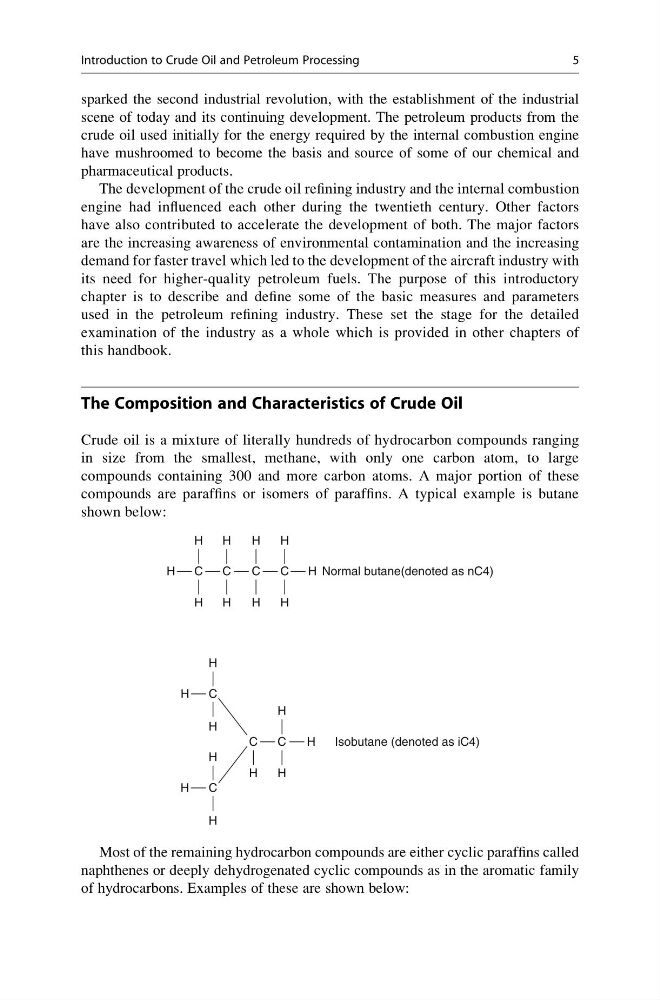
compounds are paraffins or isomers of paraffins. A typical example is butane
shown below:
H
H
H
C
C
C
C
H
H
H
H
H
H
H
Normal butane(denoted as nC4)
H
C
C
H
H
H
H
C
H
H
H
C
H
H
Isobutane (denoted as iC4)
Most of the remaining hydrocarbon compounds are either cyclic paraffins called
naphthenes or deeply dehydrogenated cyclic compounds as in the aromatic family
of hydrocarbons. Examples of these are shown below:
Introduction to Crude Oil and Petroleum Processing
5
scene of today and its continuing development. The petroleum products from the
crude oil used initially for the energy required by the internal combustion engine
have mushroomed to become the basis and source of some of our chemical and
pharmaceutical products.
The development of the crude oil refining industry and the internal combustion
engine had influenced each other during the twentieth century. Other factors
have also contributed to accelerate the development of both. The major factors
are the increasing awareness of environmental contamination and the increasing
demand for faster travel which led to the development of the aircraft industry with
its need for higher-quality petroleum fuels. The purpose of this introductory
chapter is to describe and define some of the basic measures and parameters
used in the petroleum refining industry. These set the stage for the detailed
examination of the industry as a whole which is provided in other chapters of
this handbook.
The Composition and Characteristics of Crude Oil
Crude oil is a mixture of literally hundreds of hydrocarbon compounds ranging
in size from the smallest, methane, with only one carbon atom, to large
compounds containing 300 and more carbon atoms. A major portion of these
compounds are paraffins or isomers of paraffins. A typical example is butane
shown below:
H
H
H
C
C
C
C
H
H
H
H
H
H
H
Normal butane(denoted as nC4)
H
C
C
H
H
H
H
C
H
H
H
C
H
H
Isobutane (denoted as iC4)
Most of the remaining hydrocarbon compounds are either cyclic paraffins called
naphthenes or deeply dehydrogenated cyclic compounds as in the aromatic family
of hydrocarbons. Examples of these are shown below:
Introduction to Crude Oil and Petroleum Processing
5