

As described earlier, vacuum distillation units handling reduced crude operate at
3–5 mmHg at the top of the tower and about 25–30 mmHg in the flash zone.
No steam is used for stripping. The oil can still crack of course if the cut point
desired is so high that excessively high flash temperature is required to meet it even
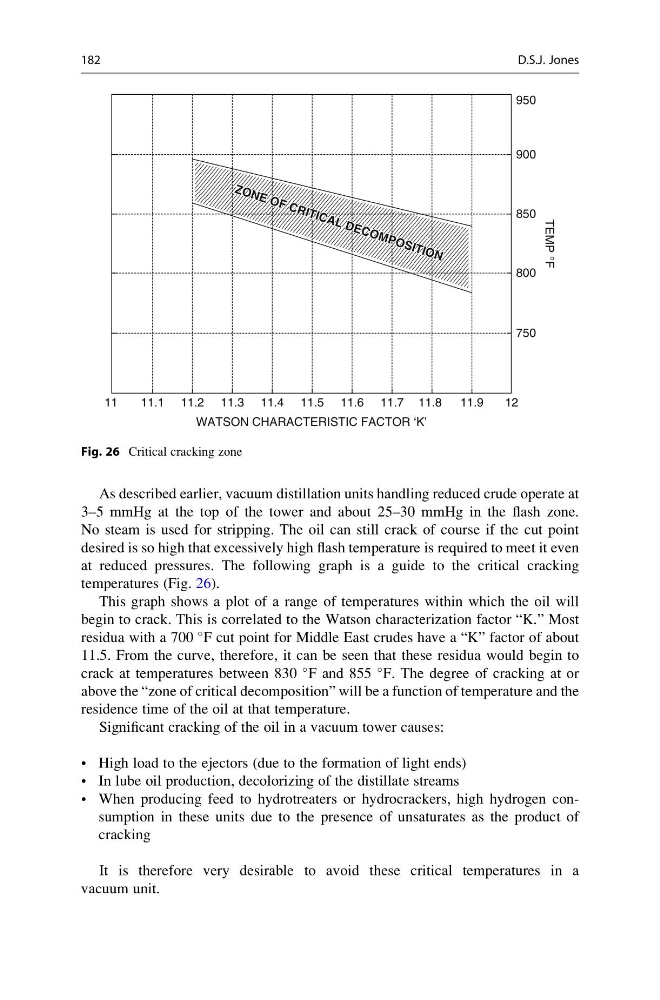
at reduced pressures. The following graph is a guide to the critical cracking
temperatures (Fig. 26).
This graph shows a plot of a range of temperatures within which the oil will
begin to crack. This is correlated to the Watson characterization factor “K.” Most
residua with a 700
F cut point for Middle East crudes have a “K” factor of about
11.5. From the curve, therefore, it can be seen that these residua would begin to
crack at temperatures between 830
F and 855
F. The degree of cracking at or
above the “zone of critical decomposition” will be a function of temperature and the
residence time of the oil at that temperature.
Significant cracking of the oil in a vacuum tower causes:
• High load to the ejectors (due to the formation of light ends)
• In lube oil production, decolorizing of the distillate streams
• When producing feed to hydrotreaters or hydrocrackers, high hydrogen consumption in these units due to the presence of unsaturates as the product of
cracking
It is therefore very desirable to avoid these critical temperatures in a
vacuum unit.
950
900
850
800
TEMP °F
750
12
11.9
11
11.1 11.2 11.3 11.4 11.5
WATSON CHARACTERISTIC FACTOR ‘K’
11.6 11.7 11.8
Z O N E O F C R IT IC A L D E C O M P O S IT IO N
Z O N E O F C R IT IC A L D E C O M P O S IT IO N
Z O N E O F C R IT IC A L D E C O M P O S IT IO N
Fig. 26 Critical cracking zone
182
D.S.J. Jones
3–5 mmHg at the top of the tower and about 25–30 mmHg in the flash zone.
No steam is used for stripping. The oil can still crack of course if the cut point
desired is so high that excessively high flash temperature is required to meet it even
at reduced pressures. The following graph is a guide to the critical cracking
temperatures (Fig. 26).
This graph shows a plot of a range of temperatures within which the oil will
begin to crack. This is correlated to the Watson characterization factor “K.” Most
residua with a 700
F cut point for Middle East crudes have a “K” factor of about
11.5. From the curve, therefore, it can be seen that these residua would begin to
crack at temperatures between 830
F and 855
F. The degree of cracking at or
above the “zone of critical decomposition” will be a function of temperature and the
residence time of the oil at that temperature.
Significant cracking of the oil in a vacuum tower causes:
• High load to the ejectors (due to the formation of light ends)
• In lube oil production, decolorizing of the distillate streams
• When producing feed to hydrotreaters or hydrocrackers, high hydrogen consumption in these units due to the presence of unsaturates as the product of
cracking
It is therefore very desirable to avoid these critical temperatures in a
vacuum unit.
950
900
850
800
TEMP °F
750
12
11.9
11
11.1 11.2 11.3 11.4 11.5
WATSON CHARACTERISTIC FACTOR ‘K’
11.6 11.7 11.8
Z O N E O F C R IT IC A L D E C O M P O S IT IO N
Z O N E O F C R IT IC A L D E C O M P O S IT IO N
Z O N E O F C R IT IC A L D E C O M P O S IT IO N
Fig. 26 Critical cracking zone
182
D.S.J. Jones