

The Tower Overhead Ejector System
Most “Dry Vac” towers have a similar overhead ejector system, and as the design of
this is critical to the unit operation, a calculation method to determine this design is
described below:
The calculation procedure that is described here relates to the “dry” vacuum unit
where no steam is used in the distillation process itself. This method can be used to
determine the efficiency of the installed ejector set under test run conditions or
indeed to specify the equipment to be purchased. The efficiency of the ejectors may
be determined by the actual quantities of steam used relative to those calculated by
this method.
The following data need to be obtained to use this procedure:
• Quantity of inerts – either measured at the exhaust side of the last stage or
established as design criteria
• Tower top temperature and pressure required or observed
• Intermediate stage outlet temperatures and pressures of the process streams
• Total steam flow or steam flow to each stage ejector
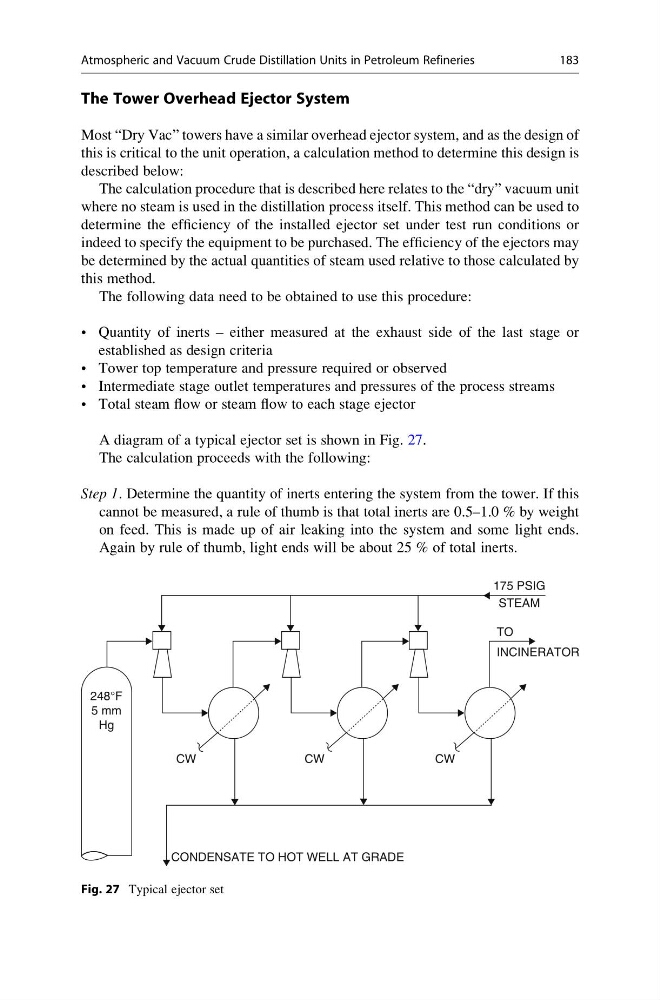
A diagram of a typical ejector set is shown in Fig. 27.
The calculation proceeds with the following:
Step 1. Determine the quantity of inerts entering the system from the tower. If this
cannot be measured, a rule of thumb is that total inerts are 0.5–1.0 % by weight
on feed. This is made up of air leaking into the system and some light ends.
Again by rule of thumb, light ends will be about 25 % of total inerts.
248°F
5 mm
Hg
CW
CONDENSATE TO HOT WELL AT GRADE
CW
CW
175 PSIG
STEAM
TO
INCINERATOR
Fig. 27 Typical ejector set
Atmospheric and Vacuum Crude Distillation Units in Petroleum Refineries
183
Most “Dry Vac” towers have a similar overhead ejector system, and as the design of
this is critical to the unit operation, a calculation method to determine this design is
described below:
The calculation procedure that is described here relates to the “dry” vacuum unit
where no steam is used in the distillation process itself. This method can be used to
determine the efficiency of the installed ejector set under test run conditions or
indeed to specify the equipment to be purchased. The efficiency of the ejectors may
be determined by the actual quantities of steam used relative to those calculated by
this method.
The following data need to be obtained to use this procedure:
• Quantity of inerts – either measured at the exhaust side of the last stage or
established as design criteria
• Tower top temperature and pressure required or observed
• Intermediate stage outlet temperatures and pressures of the process streams
• Total steam flow or steam flow to each stage ejector
A diagram of a typical ejector set is shown in Fig. 27.
The calculation proceeds with the following:
Step 1. Determine the quantity of inerts entering the system from the tower. If this
cannot be measured, a rule of thumb is that total inerts are 0.5–1.0 % by weight
on feed. This is made up of air leaking into the system and some light ends.
Again by rule of thumb, light ends will be about 25 % of total inerts.
248°F
5 mm
Hg
CW
CONDENSATE TO HOT WELL AT GRADE
CW
CW
175 PSIG
STEAM
TO
INCINERATOR
Fig. 27 Typical ejector set
Atmospheric and Vacuum Crude Distillation Units in Petroleum Refineries
183