

in the tower by heat and mass transfer with the cold reflux streams moving down the
tower in the same way as the side streams in the atmospheric unit. The products are
taken off at the appropriate sections and are cooled either by heat exchange with
colder streams in the atmospheric unit, by air coolers, or, in some cases, as heating
media for light ends reboilers. They are then pumped to storage.
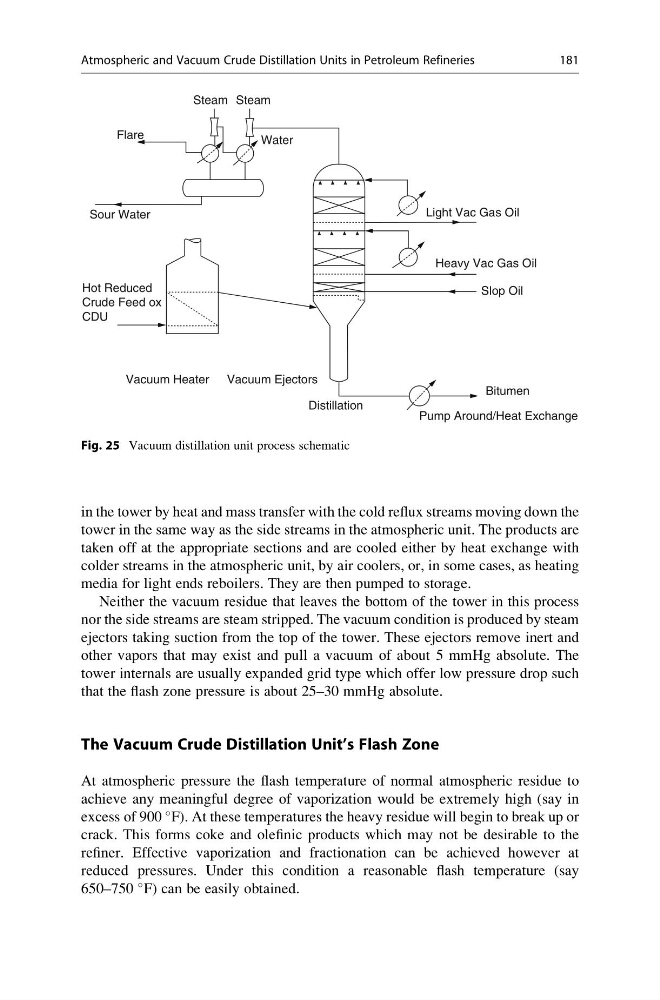
Neither the vacuum residue that leaves the bottom of the tower in this process
nor the side streams are steam stripped. The vacuum condition is produced by steam
ejectors taking suction from the top of the tower. These ejectors remove inert and
other vapors that may exist and pull a vacuum of about 5 mmHg absolute. The
tower internals are usually expanded grid type which offer low pressure drop such
that the flash zone pressure is about 25–30 mmHg absolute.
The Vacuum Crude Distillation Unit’s Flash Zone
At atmospheric pressure the flash temperature of normal atmospheric residue to
achieve any meaningful degree of vaporization would be extremely high (say in
excess of 900
F). At these temperatures the heavy residue will begin to break up or
crack. This forms coke and olefinic products which may not be desirable to the
refiner. Effective vaporization and fractionation can be achieved however at
reduced pressures. Under this condition a reasonable flash temperature (say
650–750
F) can be easily obtained.
Steam Steam
Water
Light Vac Gas Oil
Heavy Vac Gas Oil
Slop Oil
Bitumen
Distillation
Vacuum Ejectors
Vacuum Heater
Hot Reduced
Crude Feed ox
CDU
Sour Water
Flare
Pump Around/Heat Exchange
Fig. 25 Vacuum distillation unit process schematic
Atmospheric and Vacuum Crude Distillation Units in Petroleum Refineries
181
tower in the same way as the side streams in the atmospheric unit. The products are
taken off at the appropriate sections and are cooled either by heat exchange with
colder streams in the atmospheric unit, by air coolers, or, in some cases, as heating
media for light ends reboilers. They are then pumped to storage.
Neither the vacuum residue that leaves the bottom of the tower in this process
nor the side streams are steam stripped. The vacuum condition is produced by steam
ejectors taking suction from the top of the tower. These ejectors remove inert and
other vapors that may exist and pull a vacuum of about 5 mmHg absolute. The
tower internals are usually expanded grid type which offer low pressure drop such
that the flash zone pressure is about 25–30 mmHg absolute.
The Vacuum Crude Distillation Unit’s Flash Zone
At atmospheric pressure the flash temperature of normal atmospheric residue to
achieve any meaningful degree of vaporization would be extremely high (say in
excess of 900
F). At these temperatures the heavy residue will begin to break up or
crack. This forms coke and olefinic products which may not be desirable to the
refiner. Effective vaporization and fractionation can be achieved however at
reduced pressures. Under this condition a reasonable flash temperature (say
650–750
F) can be easily obtained.
Steam Steam
Water
Light Vac Gas Oil
Heavy Vac Gas Oil
Slop Oil
Bitumen
Distillation
Vacuum Ejectors
Vacuum Heater
Hot Reduced
Crude Feed ox
CDU
Sour Water
Flare
Pump Around/Heat Exchange
Fig. 25 Vacuum distillation unit process schematic
Atmospheric and Vacuum Crude Distillation Units in Petroleum Refineries
181