

Distributing the Total Pumparound to Meet the Required
Internal Reflux
The degree of separation of one product from an adjacent one is determined by
the number of fractionating trays used for the separation and the liquid
overflow (reflux) entering the section used for the separation. As has been said
previously, the degree of separation of products in the atmospheric crude distillation tower is measured by the difference between the 95 %vol point of the
lighter fraction and the 5 %vol point of the heavier fraction as measured by their
ASTM distillation curve. Packie developed a relationship between the ASTM
distillation difference, the number of trays, and the amount of overflow in terms of
internal reflux ratio. This relationship is given by a series of curves in the
appendices to this chapter (Appendix 2). The use of these curves is illustrated
by the following stepwise calculation procedure to arrive at the amount of
overflow liquid.
Step 1. Establish the ASTM gap (or overlap) that is required. This is usually given
in the design specification of the unit or by some constraint on one or other of the
products. It is well to note here that ASTM gaps can usually be achieved between
products lighter than light gas oil. Gaps can rarely be achieved within the tower
for products heavier than the light gas oil cut. To trim the front or back ends of
heavy products may require additional equipment such as vacuum flash
equipment.
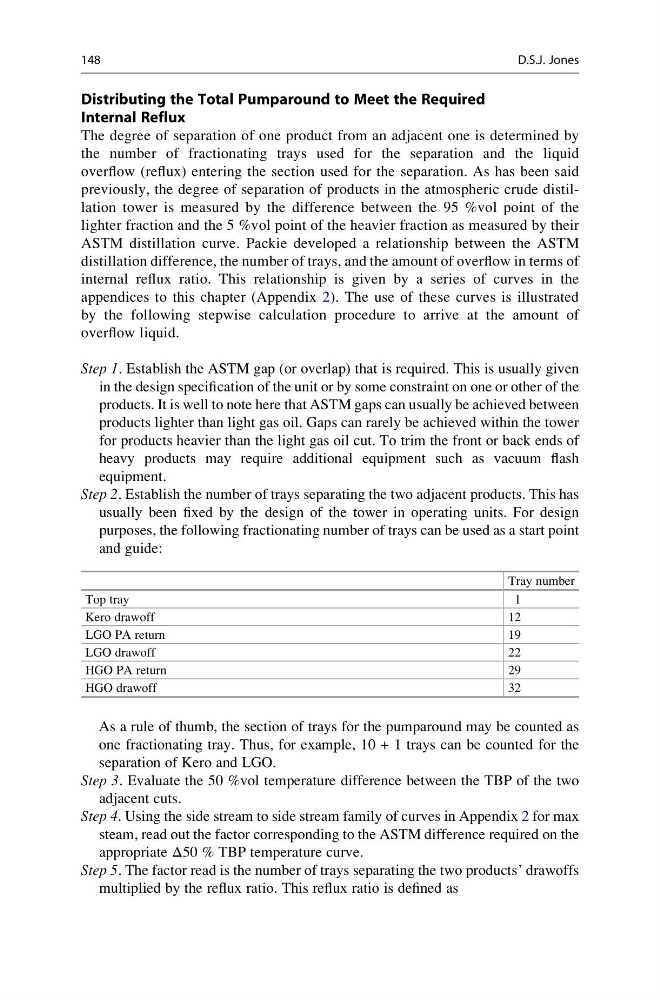
Step 2. Establish the number of trays separating the two adjacent products. This has
usually been fixed by the design of the tower in operating units. For design
purposes, the following fractionating number of trays can be used as a start point
and guide:
Tray number
Top tray
1
Kero drawoff
12
LGO PA return
19
LGO drawoff
22
HGO PA return
29
HGO drawoff
32
As a rule of thumb, the section of trays for the pumparound may be counted as
one fractionating tray. Thus, for example, 10 + 1 trays can be counted for the
separation of Kero and LGO.
Step 3. Evaluate the 50 %vol temperature difference between the TBP of the two
adjacent cuts.
Step 4. Using the side stream to side stream family of curves in Appendix 2 for max
steam, read out the factor corresponding to the ASTM difference required on the
appropriate Δ50 % TBP temperature curve.
Step 5. The factor read is the number of trays separating the two products’ drawoffs
multiplied by the reflux ratio. This reflux ratio is defined as
148
D.S.J. Jones
Internal Reflux
The degree of separation of one product from an adjacent one is determined by
the number of fractionating trays used for the separation and the liquid
overflow (reflux) entering the section used for the separation. As has been said
previously, the degree of separation of products in the atmospheric crude distillation tower is measured by the difference between the 95 %vol point of the
lighter fraction and the 5 %vol point of the heavier fraction as measured by their
ASTM distillation curve. Packie developed a relationship between the ASTM
distillation difference, the number of trays, and the amount of overflow in terms of
internal reflux ratio. This relationship is given by a series of curves in the
appendices to this chapter (Appendix 2). The use of these curves is illustrated
by the following stepwise calculation procedure to arrive at the amount of
overflow liquid.
Step 1. Establish the ASTM gap (or overlap) that is required. This is usually given
in the design specification of the unit or by some constraint on one or other of the
products. It is well to note here that ASTM gaps can usually be achieved between
products lighter than light gas oil. Gaps can rarely be achieved within the tower
for products heavier than the light gas oil cut. To trim the front or back ends of
heavy products may require additional equipment such as vacuum flash
equipment.
Step 2. Establish the number of trays separating the two adjacent products. This has
usually been fixed by the design of the tower in operating units. For design
purposes, the following fractionating number of trays can be used as a start point
and guide:
Tray number
Top tray
1
Kero drawoff
12
LGO PA return
19
LGO drawoff
22
HGO PA return
29
HGO drawoff
32
As a rule of thumb, the section of trays for the pumparound may be counted as
one fractionating tray. Thus, for example, 10 + 1 trays can be counted for the
separation of Kero and LGO.
Step 3. Evaluate the 50 %vol temperature difference between the TBP of the two
adjacent cuts.
Step 4. Using the side stream to side stream family of curves in Appendix 2 for max
steam, read out the factor corresponding to the ASTM difference required on the
appropriate Δ50 % TBP temperature curve.
Step 5. The factor read is the number of trays separating the two products’ drawoffs
multiplied by the reflux ratio. This reflux ratio is defined as
148
D.S.J. Jones