

at 5
F below the flash zone temperature and the steam will be at the flash zone
partial pressure for the steam.
Step 4. From the equation
Heat in ¼ Heat out;
calculate the enthalpy (in Btu/lb) and thus the temperature of the residue or bottom
product leaving the tower.
Note: While the author uses enthalpy data from his own files, it is recommended
that engineers use their own proven data from their own files, or data contained
in Maxwell’s Hydrocarbon Data, or those given in the GPSA Engineering Data
Book.
With all the temperature and enthalpy criteria established, an overall heat
balance over the tower can proceed. In this balance the heat in with the crude will
be that for the overflashed crude at the flash zone temperature. The other heat inputs
are the steam streams to the various strippers. The heat out will consist of the
overhead distillate product at the distillate drum temperature, the overhead condenser(s) duty, the condensed steam, all the side streams and residue as liquid and at
their respective stripper bottom temperature, and finally the total of the
pumparound duty.
As all the enthalpy duties are known except that for the pumparound, this can
now be calculated from the expression
Heat in ¼ Heat out:
Crude Feed
Vapor
Liquid
Top Stripping
Tray.
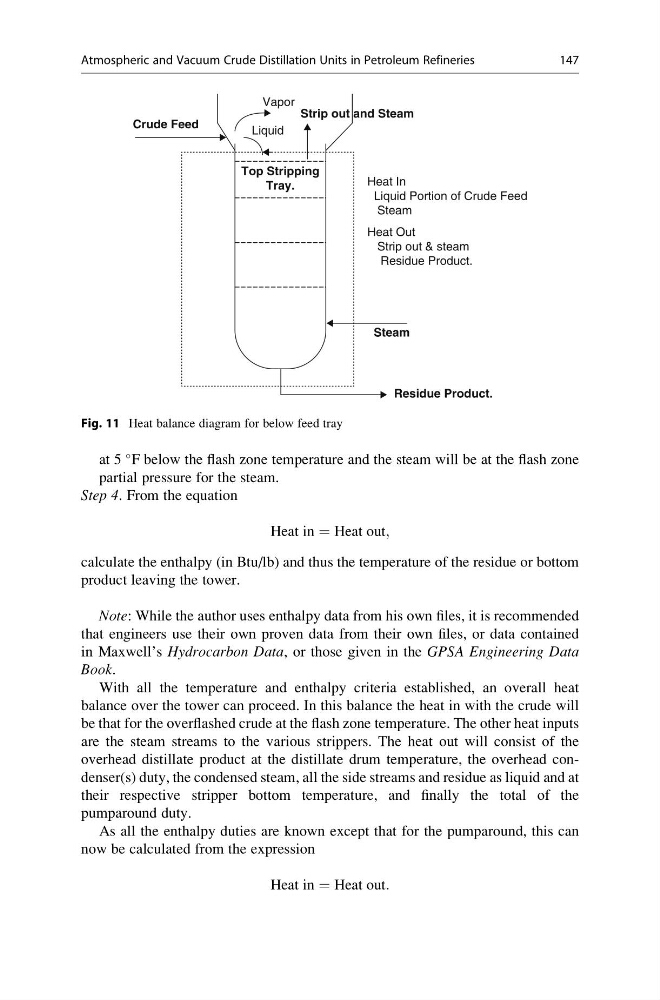
Heat In
Liquid Portion of Crude Feed
Steam
Heat Out
Strip out & steam
Residue Product.
Steam
Residue Product.
Strip out and Steam
Fig. 11 Heat balance diagram for below feed tray
Atmospheric and Vacuum Crude Distillation Units in Petroleum Refineries
147
F below the flash zone temperature and the steam will be at the flash zone
partial pressure for the steam.
Step 4. From the equation
Heat in ¼ Heat out;
calculate the enthalpy (in Btu/lb) and thus the temperature of the residue or bottom
product leaving the tower.
Note: While the author uses enthalpy data from his own files, it is recommended
that engineers use their own proven data from their own files, or data contained
in Maxwell’s Hydrocarbon Data, or those given in the GPSA Engineering Data
Book.
With all the temperature and enthalpy criteria established, an overall heat
balance over the tower can proceed. In this balance the heat in with the crude will
be that for the overflashed crude at the flash zone temperature. The other heat inputs
are the steam streams to the various strippers. The heat out will consist of the
overhead distillate product at the distillate drum temperature, the overhead condenser(s) duty, the condensed steam, all the side streams and residue as liquid and at
their respective stripper bottom temperature, and finally the total of the
pumparound duty.
As all the enthalpy duties are known except that for the pumparound, this can
now be calculated from the expression
Heat in ¼ Heat out:
Crude Feed
Vapor
Liquid
Top Stripping
Tray.
Heat In
Liquid Portion of Crude Feed
Steam
Heat Out
Strip out & steam
Residue Product.
Steam
Residue Product.
Strip out and Steam
Fig. 11 Heat balance diagram for below feed tray
Atmospheric and Vacuum Crude Distillation Units in Petroleum Refineries
147