

exchanger activated by a temperature/flow control is installed. Such an arrangement can also be used on an air condenser.
The tower overhead temperature. The tower overhead temperature in this configuration is the dew point of the overhead product vapor at the partial pressure of
the hydrocarbon.
Note: The partial pressure for this case is the total moles of hydrocarbons (includes
the reflux moles) divided by the total moles of vapor (includes the steam present)
times the total overhead absolute pressure.
The tower overhead pressure. The overhead tower pressure in this case is the
pressure of the overhead condensate drum plus the pressure drops of the heat
exchangers and the associated overhead condensate piping. This pressure drop
may be taken as 7–9 psi.
Configuration 2
This second configuration is usually installed on units of high capacity at throughputs above 70,000 BPSD. Its purpose is to maintain the size of the overhead
equipment to manageable dimensions. This includes drums and the heat exchangers
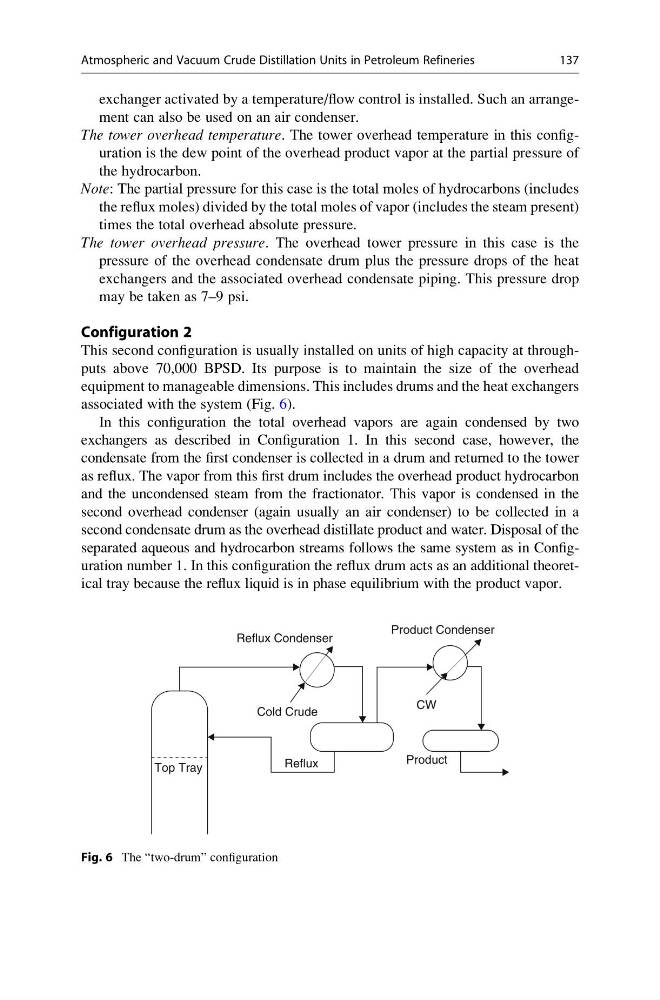
associated with the system (Fig. 6).
In this configuration the total overhead vapors are again condensed by two
exchangers as described in Configuration 1. In this second case, however, the
condensate from the first condenser is collected in a drum and returned to the tower
as reflux. The vapor from this first drum includes the overhead product hydrocarbon
and the uncondensed steam from the fractionator. This vapor is condensed in the
second overhead condenser (again usually an air condenser) to be collected in a
second condensate drum as the overhead distillate product and water. Disposal of the
separated aqueous and hydrocarbon streams follows the same system as in Configuration number 1. In this configuration the reflux drum acts as an additional theoretical tray because the reflux liquid is in phase equilibrium with the product vapor.
Reflux Condenser
Product Condenser
CW
Product
Reflux
Cold Crude
Top Tray
Fig. 6 The “two-drum” configuration
Atmospheric and Vacuum Crude Distillation Units in Petroleum Refineries
137
The tower overhead temperature. The tower overhead temperature in this configuration is the dew point of the overhead product vapor at the partial pressure of
the hydrocarbon.
Note: The partial pressure for this case is the total moles of hydrocarbons (includes
the reflux moles) divided by the total moles of vapor (includes the steam present)
times the total overhead absolute pressure.
The tower overhead pressure. The overhead tower pressure in this case is the
pressure of the overhead condensate drum plus the pressure drops of the heat
exchangers and the associated overhead condensate piping. This pressure drop
may be taken as 7–9 psi.
Configuration 2
This second configuration is usually installed on units of high capacity at throughputs above 70,000 BPSD. Its purpose is to maintain the size of the overhead
equipment to manageable dimensions. This includes drums and the heat exchangers
associated with the system (Fig. 6).
In this configuration the total overhead vapors are again condensed by two
exchangers as described in Configuration 1. In this second case, however, the
condensate from the first condenser is collected in a drum and returned to the tower
as reflux. The vapor from this first drum includes the overhead product hydrocarbon
and the uncondensed steam from the fractionator. This vapor is condensed in the
second overhead condenser (again usually an air condenser) to be collected in a
second condensate drum as the overhead distillate product and water. Disposal of the
separated aqueous and hydrocarbon streams follows the same system as in Configuration number 1. In this configuration the reflux drum acts as an additional theoretical tray because the reflux liquid is in phase equilibrium with the product vapor.
Reflux Condenser
Product Condenser
CW
Product
Reflux
Cold Crude
Top Tray
Fig. 6 The “two-drum” configuration
Atmospheric and Vacuum Crude Distillation Units in Petroleum Refineries
137