

The product drum pressure and temperature. This again is the controlling
pressure for the fractionator as a whole. It is set at the pressure which allows the
vapors to be condensed at a reasonable temperature at or below its bubble point.
In moderate climates with average air temperatures of 60
F, this temperature will
be around 90–100
F with a pressure of 5 psig. Control of the drum pressure and
temperature remains the same as that for Configuration 1.
The reflux drum temperature. The conditions in this drum may be considered
as those for the top tray of the tower in Configuration 1. The temperature
therefore is the dew point of the product distillate at the partial pressure of the
hydrocarbon vapors leaving the drum. This temperature is usually controlled by a
vapor bypass over the exchanger on a flow reset by temperature control valve.
Alternatively, it may be controlled by the crude oil being bypassed on a similar
flow/temperature reset basis. The partial pressure in this case is the moles of
product vapor only divided by the total moles (including the steam) times the
total absolute pressure. This total pressure is the pressure in the distillate product
drum (say 5 psig) plus the pressure drop of the air condenser and piping (say
about 3 psi).
The tower overhead temperature and pressure. The tower top condition in the
case of this second configuration is calculated as the dew point of the reflux stream
entering the tower from the reflux drum. This temperature will be at the partial
pressure of the total hydrocarbons leaving the tower.
Configuration 3
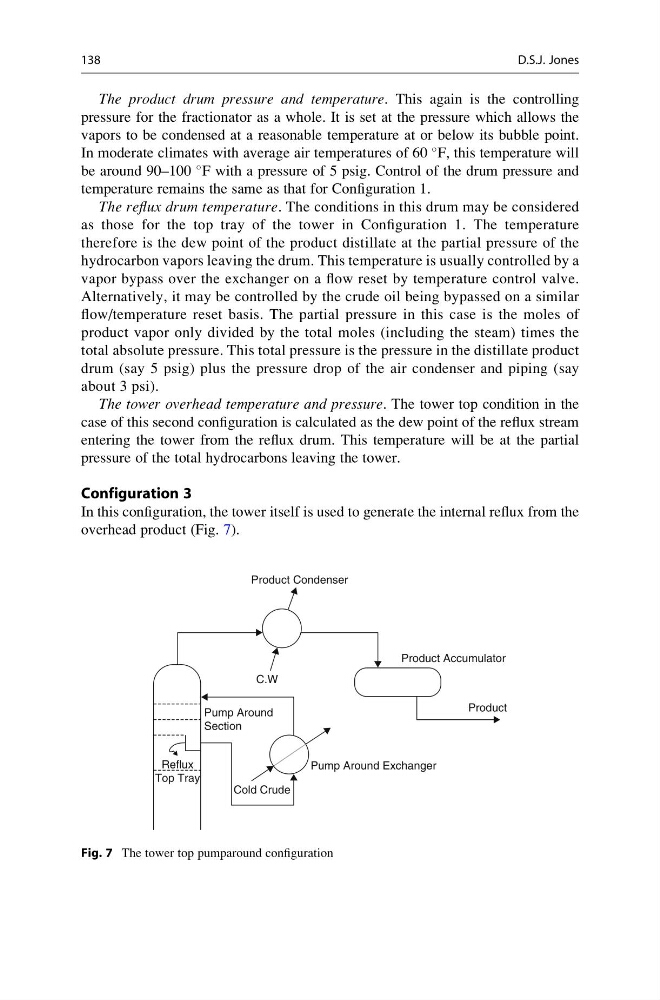
In this configuration, the tower itself is used to generate the internal reflux from the
overhead product (Fig. 7).
Reflux
Top Tray
Pump Around
Section
Pump Around Exchanger
Cold Crude
C.W
Product Condenser
Product Accumulator
Product
Fig. 7 The tower top pumparound configuration
138
D.S.J. Jones
pressure for the fractionator as a whole. It is set at the pressure which allows the
vapors to be condensed at a reasonable temperature at or below its bubble point.
In moderate climates with average air temperatures of 60
F, this temperature will
be around 90–100
F with a pressure of 5 psig. Control of the drum pressure and
temperature remains the same as that for Configuration 1.
The reflux drum temperature. The conditions in this drum may be considered
as those for the top tray of the tower in Configuration 1. The temperature
therefore is the dew point of the product distillate at the partial pressure of the
hydrocarbon vapors leaving the drum. This temperature is usually controlled by a
vapor bypass over the exchanger on a flow reset by temperature control valve.
Alternatively, it may be controlled by the crude oil being bypassed on a similar
flow/temperature reset basis. The partial pressure in this case is the moles of
product vapor only divided by the total moles (including the steam) times the
total absolute pressure. This total pressure is the pressure in the distillate product
drum (say 5 psig) plus the pressure drop of the air condenser and piping (say
about 3 psi).
The tower overhead temperature and pressure. The tower top condition in the
case of this second configuration is calculated as the dew point of the reflux stream
entering the tower from the reflux drum. This temperature will be at the partial
pressure of the total hydrocarbons leaving the tower.
Configuration 3
In this configuration, the tower itself is used to generate the internal reflux from the
overhead product (Fig. 7).
Reflux
Top Tray
Pump Around
Section
Pump Around Exchanger
Cold Crude
C.W
Product Condenser
Product Accumulator
Product
Fig. 7 The tower top pumparound configuration
138
D.S.J. Jones