

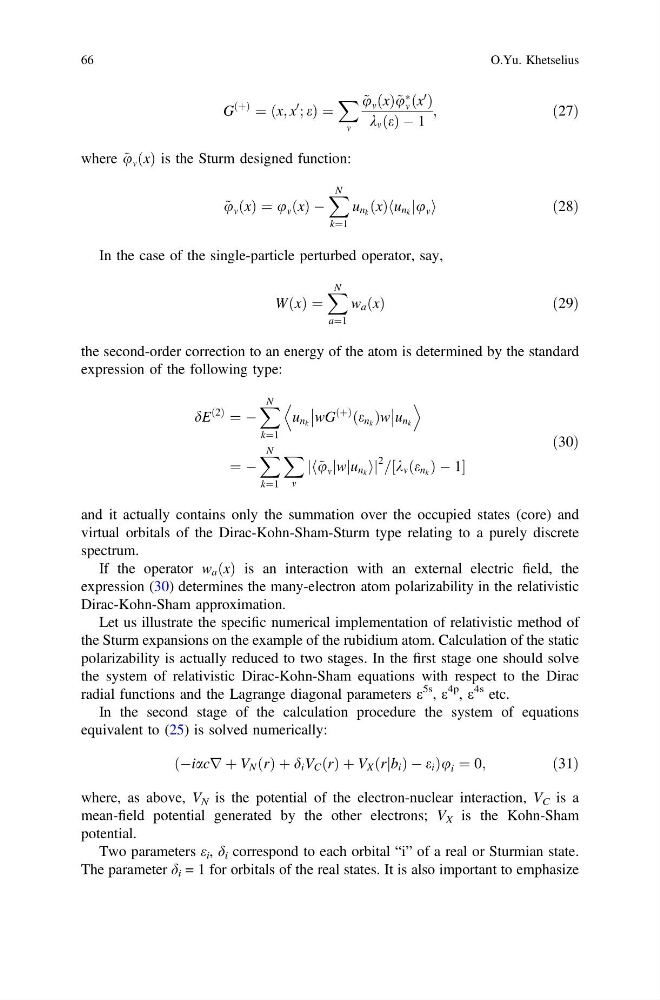
G
ðþÞ
¼ ðx; x
0
; eÞ ¼
X
m
~
u m ðxÞ~ u
Ã
m ðx
0
Þ
k m ðeÞ À 1
;
ð27Þ
where ~
u m ðxÞ is the Sturm designed function:
~
u m ðxÞ ¼ u m ðxÞ À
X N
k¼1
u n k ðxÞ u n k ju m
h
i
ð28Þ
In the case of the single-particle perturbed operator, say,
W x
ð Þ ¼
X N
a¼1
w a ðxÞ
ð 29Þ
the second-order correction to an energy of the atom is determined by the standard
expression of the following type:
dE
ð2Þ
¼ À
X N
k¼1
u n k wG
ðþÞ
ðe n k Þw
u n k
D
E
¼ À
X N
k¼1
X
m
~
u m w
j ju n k
h
i
j
j
2 =½k m ðe n k Þ À 1
ð30Þ
and it actually contains only the summation over the occupied states (core) and
virtual orbitals of the Dirac-Kohn-Sham-Sturm type relating to a purely discrete
spectrum.
If the operator w a ðxÞ is an interaction with an external electric field, the
expression (30) determines the many-electron atom polarizability in the relativistic
Dirac-Kohn-Sham approximation.
Let us illustrate the specific numerical implementation of relativistic method of
the Sturm expansions on the example of the rubidium atom. Calculation of the static
polarizability is actually reduced to two stages. In the first stage one should solve
the system of relativistic Dirac-Kohn-Sham equations with respect to the Dirac
radial functions and the Lagrange diagonal parameters ε
5s , ε
4p , ε
4s etc.
In the second stage of the calculation procedure the system of equations
equivalent to (25) is solved numerically:
ðÀiacr þ V N ðrÞ þ d i V C ðrÞ þ V X ðrjb i Þ À e i Þu i ¼ 0;
ð31Þ
where, as above, V N is the potential of the electron-nuclear interaction, V C is a
mean-field potential generated by the other electrons; V X is the Kohn-Sham
potential.
Two parameters ε i , δ i correspond to each orbital “i” of a real or Sturmian state.
The parameter δ i = 1 for orbitals of the real states. It is also important to emphasize
66
O.Yu. Khetselius
ðþÞ
¼ ðx; x
0
; eÞ ¼
X
m
~
u m ðxÞ~ u
Ã
m ðx
0
Þ
k m ðeÞ À 1
;
ð27Þ
where ~
u m ðxÞ is the Sturm designed function:
~
u m ðxÞ ¼ u m ðxÞ À
X N
k¼1
u n k ðxÞ u n k ju m
h
i
ð28Þ
In the case of the single-particle perturbed operator, say,
W x
ð Þ ¼
X N
a¼1
w a ðxÞ
ð 29Þ
the second-order correction to an energy of the atom is determined by the standard
expression of the following type:
dE
ð2Þ
¼ À
X N
k¼1
u n k wG
ðþÞ
ðe n k Þw
u n k
D
E
¼ À
X N
k¼1
X
m
~
u m w
j ju n k
h
i
j
j
2 =½k m ðe n k Þ À 1
ð30Þ
and it actually contains only the summation over the occupied states (core) and
virtual orbitals of the Dirac-Kohn-Sham-Sturm type relating to a purely discrete
spectrum.
If the operator w a ðxÞ is an interaction with an external electric field, the
expression (30) determines the many-electron atom polarizability in the relativistic
Dirac-Kohn-Sham approximation.
Let us illustrate the specific numerical implementation of relativistic method of
the Sturm expansions on the example of the rubidium atom. Calculation of the static
polarizability is actually reduced to two stages. In the first stage one should solve
the system of relativistic Dirac-Kohn-Sham equations with respect to the Dirac
radial functions and the Lagrange diagonal parameters ε
5s , ε
4p , ε
4s etc.
In the second stage of the calculation procedure the system of equations
equivalent to (25) is solved numerically:
ðÀiacr þ V N ðrÞ þ d i V C ðrÞ þ V X ðrjb i Þ À e i Þu i ¼ 0;
ð31Þ
where, as above, V N is the potential of the electron-nuclear interaction, V C is a
mean-field potential generated by the other electrons; V X is the Kohn-Sham
potential.
Two parameters ε i , δ i correspond to each orbital “i” of a real or Sturmian state.
The parameter δ i = 1 for orbitals of the real states. It is also important to emphasize
66
O.Yu. Khetselius