

that all orbitals of the Sturmian supplement of the Eq. (27) have an exponential
asymptotic behavior as r → ∞, which coincides with the asymptotic behavior of
the last real state orbitals in the corresponding basis of the real state orbitals. In each
case, the functions of the accounted real states represent a reduced spectral
expansion of the Green’s function G.
The residual part decreases as exp[−r(−2ε)
1/2 ] for r → ∞ (here ε is the eigen
energy of the explicitly accounted last real state). All orbitals of the Sturm supplement have absolutely the same asymptotic in the corresponding basis. This fact
is very significant in terms of convergence of the method. As usually, the number of
explicitly accounted real state functions is determined by the concrete numerical
application of the method to computing the studied atomic characteristics. Other
details can be found in Refs. [13, 14, 20, 21, 67–70].
4 Shift and Broadening of Hyperfine Spectral Lines
for Multielectron Atoms in an Atmosphere
of a Buffer Gas
4.1 Shift and Broadening of the Thallium and Ytterbium
Hyperfine Lines in an Atmosphere of the Inert Gas
At first, let us consider the thallium atom in atmosphere of the inert gas. Its studying
is of a great interest as this atom a sufficiently heavy. In contrast to more simple
alkali atoms (look below) the thallium atom contains p-electrons outside closed
shells and has a nuclear charge Z = 81. Obviously, a correct treating relativistic and
exchange-correlation effects is critically important for accurate describing its energy
and spectral characteristics.
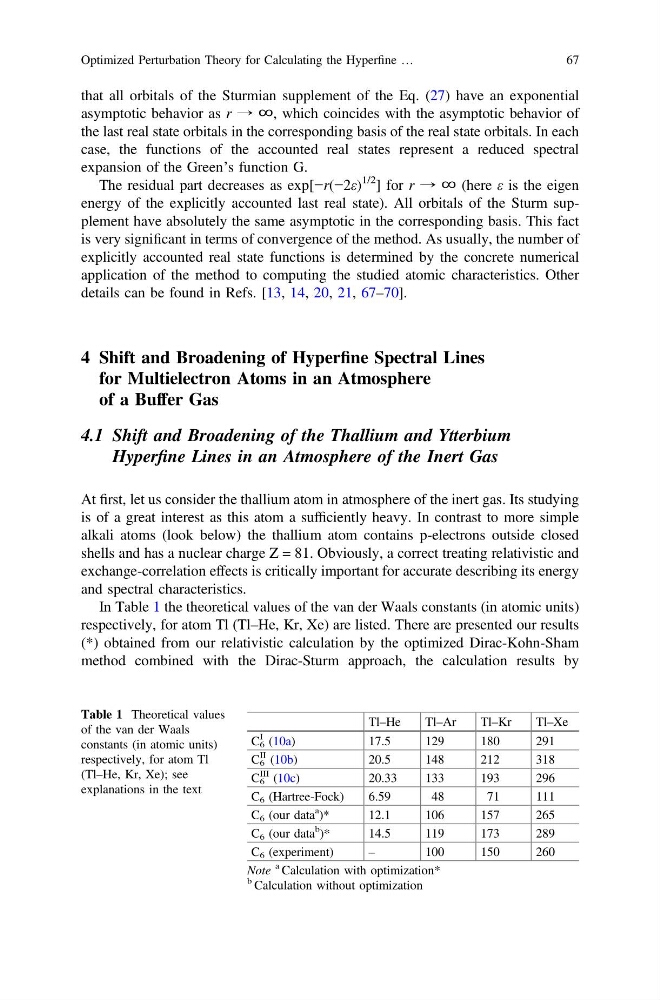
In Table 1 the theoretical values of the van der Waals constants (in atomic units)
respectively, for atom Tl (Tl–He, Kr, Xe) are listed. There are presented our results
(*) obtained from our relativistic calculation by the optimized Dirac-Kohn-Sham
method combined with the Dirac-Sturm approach, the calculation results by
Table 1 Theoretical values
of the van der Waals
constants (in atomic units)
respectively, for atom Tl
(Tl–He, Kr, Xe); see
explanations in the text
Tl–He
Tl–Ar
Tl–Kr
Tl–Xe
C 6
I (10a)
17.5
129
180
291
C 6
II (10b)
20.5
148
212
318
C 6
III (10c)
20.33
133
193
296
C 6 (Hartree-Fock)
6.59
48
71
111
C 6 (our data
a )*
12.1
106
157
265
C 6 (our data
b
)*
14.5
119
173
289
C 6 (experiment)
–
100
150
260
Note
a Calculation with optimization*
b Calculation without optimization
Optimized Perturbation Theory for Calculating the Hyperfine …
67
asymptotic behavior as r → ∞, which coincides with the asymptotic behavior of
the last real state orbitals in the corresponding basis of the real state orbitals. In each
case, the functions of the accounted real states represent a reduced spectral
expansion of the Green’s function G.
The residual part decreases as exp[−r(−2ε)
1/2 ] for r → ∞ (here ε is the eigen
energy of the explicitly accounted last real state). All orbitals of the Sturm supplement have absolutely the same asymptotic in the corresponding basis. This fact
is very significant in terms of convergence of the method. As usually, the number of
explicitly accounted real state functions is determined by the concrete numerical
application of the method to computing the studied atomic characteristics. Other
details can be found in Refs. [13, 14, 20, 21, 67–70].
4 Shift and Broadening of Hyperfine Spectral Lines
for Multielectron Atoms in an Atmosphere
of a Buffer Gas
4.1 Shift and Broadening of the Thallium and Ytterbium
Hyperfine Lines in an Atmosphere of the Inert Gas
At first, let us consider the thallium atom in atmosphere of the inert gas. Its studying
is of a great interest as this atom a sufficiently heavy. In contrast to more simple
alkali atoms (look below) the thallium atom contains p-electrons outside closed
shells and has a nuclear charge Z = 81. Obviously, a correct treating relativistic and
exchange-correlation effects is critically important for accurate describing its energy
and spectral characteristics.
In Table 1 the theoretical values of the van der Waals constants (in atomic units)
respectively, for atom Tl (Tl–He, Kr, Xe) are listed. There are presented our results
(*) obtained from our relativistic calculation by the optimized Dirac-Kohn-Sham
method combined with the Dirac-Sturm approach, the calculation results by
Table 1 Theoretical values
of the van der Waals
constants (in atomic units)
respectively, for atom Tl
(Tl–He, Kr, Xe); see
explanations in the text
Tl–He
Tl–Ar
Tl–Kr
Tl–Xe
C 6
I (10a)
17.5
129
180
291
C 6
II (10b)
20.5
148
212
318
C 6
III (10c)
20.33
133
193
296
C 6 (Hartree-Fock)
6.59
48
71
111
C 6 (our data
a )*
12.1
106
157
265
C 6 (our data
b
)*
14.5
119
173
289
C 6 (experiment)
–
100
150
260
Note
a Calculation with optimization*
b Calculation without optimization
Optimized Perturbation Theory for Calculating the Hyperfine …
67