

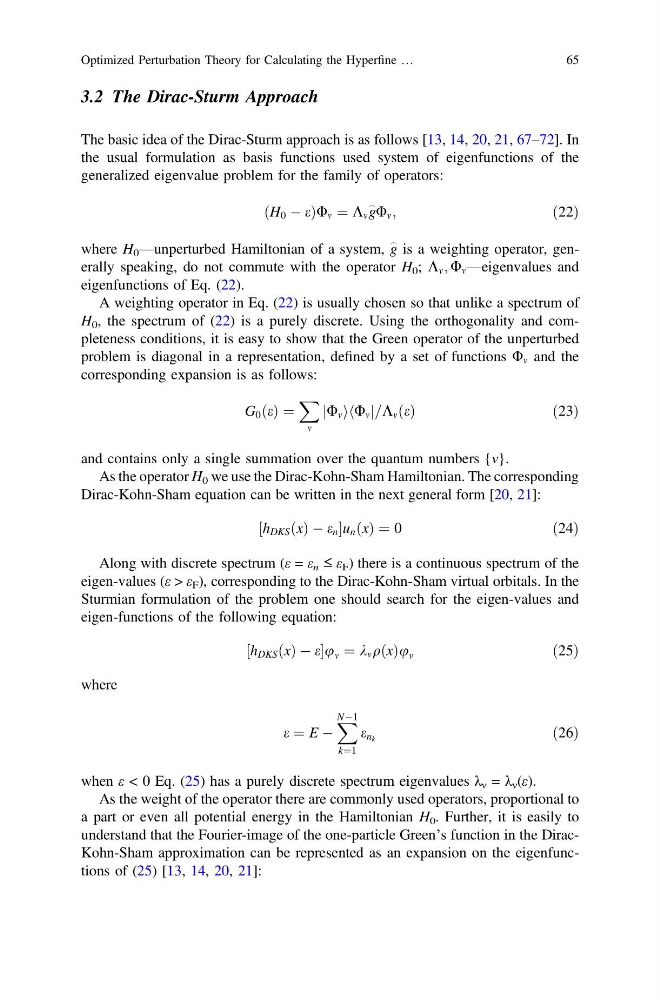
3.2 The Dirac-Sturm Approach
The basic idea of the Dirac-Sturm approach is as follows [13, 14, 20, 21, 67–72]. In
the usual formulation as basis functions used system of eigenfunctions of the
generalized eigenvalue problem for the family of operators:
ðH 0 À eÞU m ¼ K m g
_ U m ;
ð22Þ
where H 0 —unperturbed Hamiltonian of a system, g
_ is a weighting operator, generally speaking, do not commute with the operator H 0 ; K m ; U m —eigenvalues and
eigenfunctions of Eq. (22).
A weighting operator in Eq. (22) is usually chosen so that unlike a spectrum of
H 0 , the spectrum of (22) is a purely discrete. Using the orthogonality and completeness conditions, it is easy to show that the Green operator of the unperturbed
problem is diagonal in a representation, defined by a set of functions U m and the
corresponding expansion is as follows:
G 0 e
ð Þ ¼
X
m
U m i
j
U m j
h =K m e
ð Þ
ð23Þ
and contains only a single summation over the quantum numbers {ν}.
As the operator H 0 we use the Dirac-Kohn-Sham Hamiltonian. The corresponding
Dirac-Kohn-Sham equation can be written in the next general form [20, 21]:
½h DKS ðxÞ À e n u n ðxÞ ¼ 0
ð24Þ
Along with discrete spectrum (ε = ε n ≤ ε F ) there is a continuous spectrum of the
eigen-values (ε > ε F ), corresponding to the Dirac-Kohn-Sham virtual orbitals. In the
Sturmian formulation of the problem one should search for the eigen-values and
eigen-functions of the following equation:
½h DKS ðxÞ À eu m ¼ k m qðxÞu m
ð25Þ
where
e ¼ E À
X NÀ1
k¼1
e n k
ð26Þ
when ε < 0 Eq. (25) has a purely discrete spectrum eigenvalues λ ν = λ ν (ε).
As the weight of the operator there are commonly used operators, proportional to
a part or even all potential energy in the Hamiltonian H 0 . Further, it is easily to
understand that the Fourier-image of the one-particle Green’s function in the DiracKohn-Sham approximation can be represented as an expansion on the eigenfunctions of (25) [13, 14, 20, 21]:
Optimized Perturbation Theory for Calculating the Hyperfine …
65
The basic idea of the Dirac-Sturm approach is as follows [13, 14, 20, 21, 67–72]. In
the usual formulation as basis functions used system of eigenfunctions of the
generalized eigenvalue problem for the family of operators:
ðH 0 À eÞU m ¼ K m g
_ U m ;
ð22Þ
where H 0 —unperturbed Hamiltonian of a system, g
_ is a weighting operator, generally speaking, do not commute with the operator H 0 ; K m ; U m —eigenvalues and
eigenfunctions of Eq. (22).
A weighting operator in Eq. (22) is usually chosen so that unlike a spectrum of
H 0 , the spectrum of (22) is a purely discrete. Using the orthogonality and completeness conditions, it is easy to show that the Green operator of the unperturbed
problem is diagonal in a representation, defined by a set of functions U m and the
corresponding expansion is as follows:
G 0 e
ð Þ ¼
X
m
U m i
j
U m j
h =K m e
ð Þ
ð23Þ
and contains only a single summation over the quantum numbers {ν}.
As the operator H 0 we use the Dirac-Kohn-Sham Hamiltonian. The corresponding
Dirac-Kohn-Sham equation can be written in the next general form [20, 21]:
½h DKS ðxÞ À e n u n ðxÞ ¼ 0
ð24Þ
Along with discrete spectrum (ε = ε n ≤ ε F ) there is a continuous spectrum of the
eigen-values (ε > ε F ), corresponding to the Dirac-Kohn-Sham virtual orbitals. In the
Sturmian formulation of the problem one should search for the eigen-values and
eigen-functions of the following equation:
½h DKS ðxÞ À eu m ¼ k m qðxÞu m
ð25Þ
where
e ¼ E À
X NÀ1
k¼1
e n k
ð26Þ
when ε < 0 Eq. (25) has a purely discrete spectrum eigenvalues λ ν = λ ν (ε).
As the weight of the operator there are commonly used operators, proportional to
a part or even all potential energy in the Hamiltonian H 0 . Further, it is easily to
understand that the Fourier-image of the one-particle Green’s function in the DiracKohn-Sham approximation can be represented as an expansion on the eigenfunctions of (25) [13, 14, 20, 21]:
Optimized Perturbation Theory for Calculating the Hyperfine …
65