

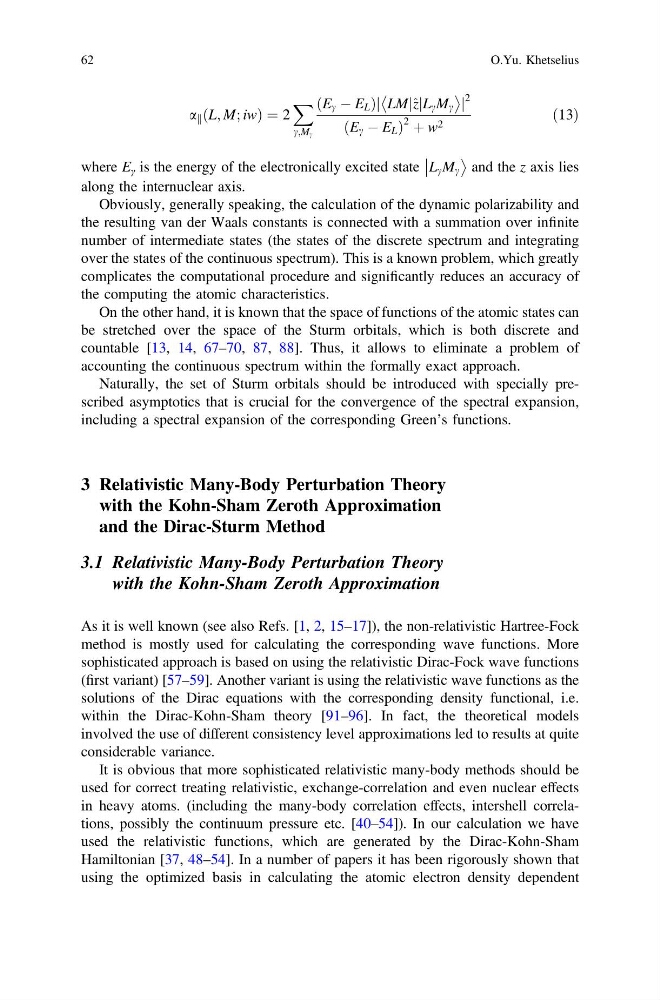
a k ðL; M; iwÞ ¼ 2
X
c;M c
ðE c À E L Þj LMj^ zjL c M c
j
2
ðE c À E L Þ
2 þ w 2
ð13Þ
where E γ is the energy of the electronically excited state L c M c
and the z axis lies
along the internuclear axis.
Obviously, generally speaking, the calculation of the dynamic polarizability and
the resulting van der Waals constants is connected with a summation over infinite
number of intermediate states (the states of the discrete spectrum and integrating
over the states of the continuous spectrum). This is a known problem, which greatly
complicates the computational procedure and significantly reduces an accuracy of
the computing the atomic characteristics.
On the other hand, it is known that the space of functions of the atomic states can
be stretched over the space of the Sturm orbitals, which is both discrete and
countable [13, 14, 67–70, 87, 88]. Thus, it allows to eliminate a problem of
accounting the continuous spectrum within the formally exact approach.
Naturally, the set of Sturm orbitals should be introduced with specially prescribed asymptotics that is crucial for the convergence of the spectral expansion,
including a spectral expansion of the corresponding Green’s functions.
3 Relativistic Many-Body Perturbation Theory
with the Kohn-Sham Zeroth Approximation
and the Dirac-Sturm Method
3.1 Relativistic Many-Body Perturbation Theory
with the Kohn-Sham Zeroth Approximation
As it is well known (see also Refs. [1, 2, 15–17]), the non-relativistic Hartree-Fock
method is mostly used for calculating the corresponding wave functions. More
sophisticated approach is based on using the relativistic Dirac-Fock wave functions
(first variant) [57–59]. Another variant is using the relativistic wave functions as the
solutions of the Dirac equations with the corresponding density functional, i.e.
within the Dirac-Kohn-Sham theory [91–96]. In fact, the theoretical models
involved the use of different consistency level approximations led to results at quite
considerable variance.
It is obvious that more sophisticated relativistic many-body methods should be
used for correct treating relativistic, exchange-correlation and even nuclear effects
in heavy atoms. (including the many-body correlation effects, intershell correlations, possibly the continuum pressure etc. [40–54]). In our calculation we have
used the relativistic functions, which are generated by the Dirac-Kohn-Sham
Hamiltonian [37, 48–54]. In a number of papers it has been rigorously shown that
using the optimized basis in calculating the atomic electron density dependent
62
O.Yu. Khetselius
X
c;M c
ðE c À E L Þj LMj^ zjL c M c
j
2
ðE c À E L Þ
2 þ w 2
ð13Þ
where E γ is the energy of the electronically excited state L c M c
and the z axis lies
along the internuclear axis.
Obviously, generally speaking, the calculation of the dynamic polarizability and
the resulting van der Waals constants is connected with a summation over infinite
number of intermediate states (the states of the discrete spectrum and integrating
over the states of the continuous spectrum). This is a known problem, which greatly
complicates the computational procedure and significantly reduces an accuracy of
the computing the atomic characteristics.
On the other hand, it is known that the space of functions of the atomic states can
be stretched over the space of the Sturm orbitals, which is both discrete and
countable [13, 14, 67–70, 87, 88]. Thus, it allows to eliminate a problem of
accounting the continuous spectrum within the formally exact approach.
Naturally, the set of Sturm orbitals should be introduced with specially prescribed asymptotics that is crucial for the convergence of the spectral expansion,
including a spectral expansion of the corresponding Green’s functions.
3 Relativistic Many-Body Perturbation Theory
with the Kohn-Sham Zeroth Approximation
and the Dirac-Sturm Method
3.1 Relativistic Many-Body Perturbation Theory
with the Kohn-Sham Zeroth Approximation
As it is well known (see also Refs. [1, 2, 15–17]), the non-relativistic Hartree-Fock
method is mostly used for calculating the corresponding wave functions. More
sophisticated approach is based on using the relativistic Dirac-Fock wave functions
(first variant) [57–59]. Another variant is using the relativistic wave functions as the
solutions of the Dirac equations with the corresponding density functional, i.e.
within the Dirac-Kohn-Sham theory [91–96]. In fact, the theoretical models
involved the use of different consistency level approximations led to results at quite
considerable variance.
It is obvious that more sophisticated relativistic many-body methods should be
used for correct treating relativistic, exchange-correlation and even nuclear effects
in heavy atoms. (including the many-body correlation effects, intershell correlations, possibly the continuum pressure etc. [40–54]). In our calculation we have
used the relativistic functions, which are generated by the Dirac-Kohn-Sham
Hamiltonian [37, 48–54]. In a number of papers it has been rigorously shown that
using the optimized basis in calculating the atomic electron density dependent
62
O.Yu. Khetselius