

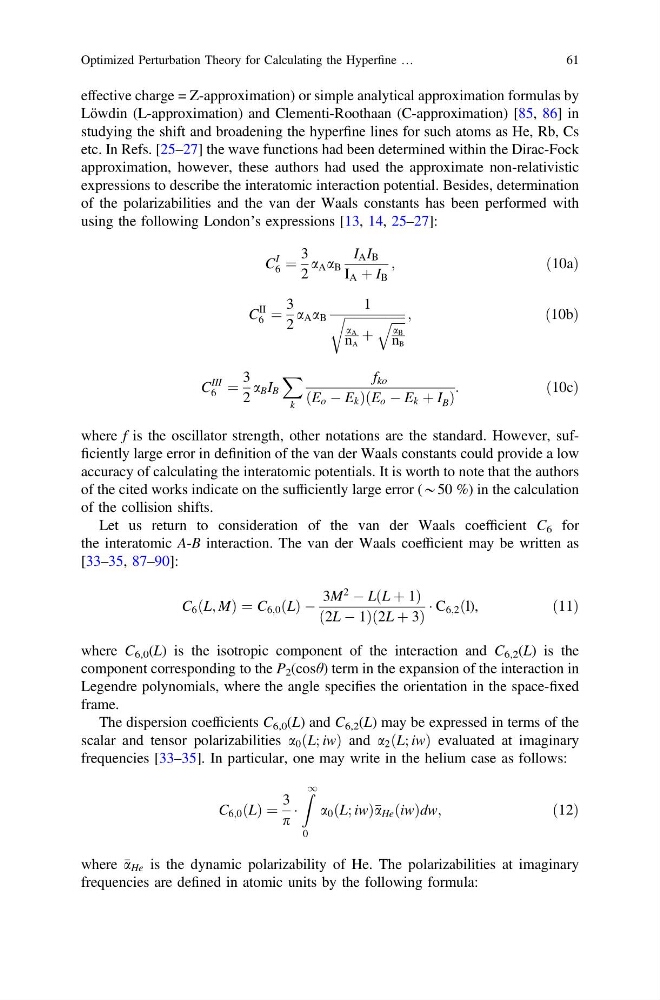
effective charge = Z-approximation) or simple analytical approximation formulas by
Löwdin (L-approximation) and Clementi-Roothaan (C-approximation) [85, 86] in
studying the shift and broadening the hyperfine lines for such atoms as He, Rb, Cs
etc. In Refs. [25–27] the wave functions had been determined within the Dirac-Fock
approximation, however, these authors had used the approximate non-relativistic
expressions to describe the interatomic interaction potential. Besides, determination
of the polarizabilities and the van der Waals constants has been performed with
using the following London’s expressions [13, 14, 25–27]:
C
I
6 ¼
3
2
a A a B
I A I B
I A þ I B
;
ð10aÞ
C
II
6 ¼
3
2
a A a B
1
ffiffiffiffiffiffiffiffiffiffiffiffiffiffiffiffiffiffiffi ffi
a A
n A þ
ffiffiffiffi ffi
a B
n B
q
r
;
ð10bÞ
C
III
6 ¼
3
2
a B I B
X
k
f ko
ðE o À E k ÞðE o À E k þ I B Þ
:
ð10cÞ
where f is the oscillator strength, other notations are the standard. However, sufficiently large error in definition of the van der Waals constants could provide a low
accuracy of calculating the interatomic potentials. It is worth to note that the authors
of the cited works indicate on the sufficiently large error (*50 %) in the calculation
of the collision shifts.
Let us return to consideration of the van der Waals coefficient C 6 for
the interatomic A-B interaction. The van der Waals coefficient may be written as
[33–35, 87–90]:
C 6 ðL; MÞ ¼ C 6;0 ðLÞ À
3M
2
À LðL þ 1Þ
ð2L À 1Þð2L þ 3Þ
Á C 6;2 ðl),
ð11Þ
where C 6,0 (L) is the isotropic component of the interaction and C 6,2 (L) is the
component corresponding to the P 2 (cosθ) term in the expansion of the interaction in
Legendre polynomials, where the angle specifies the orientation in the space-fixed
frame.
The dispersion coefficients C 6,0 (L) and C 6,2 (L) may be expressed in terms of the
scalar and tensor polarizabilities a 0 ðL; iwÞ and a 2 ðL; iwÞ evaluated at imaginary
frequencies [33–35]. In particular, one may write in the helium case as follows:
C 6;0 ðLÞ ¼
3
p
Á
Z 1
0
a 0 ðL; iwÞ a He ðiwÞdw;
ð12Þ
where a He is the dynamic polarizability of He. The polarizabilities at imaginary
frequencies are defined in atomic units by the following formula:
Optimized Perturbation Theory for Calculating the Hyperfine …
61
Löwdin (L-approximation) and Clementi-Roothaan (C-approximation) [85, 86] in
studying the shift and broadening the hyperfine lines for such atoms as He, Rb, Cs
etc. In Refs. [25–27] the wave functions had been determined within the Dirac-Fock
approximation, however, these authors had used the approximate non-relativistic
expressions to describe the interatomic interaction potential. Besides, determination
of the polarizabilities and the van der Waals constants has been performed with
using the following London’s expressions [13, 14, 25–27]:
C
I
6 ¼
3
2
a A a B
I A I B
I A þ I B
;
ð10aÞ
C
II
6 ¼
3
2
a A a B
1
ffiffiffiffiffiffiffiffiffiffiffiffiffiffiffiffiffiffiffi ffi
a A
n A þ
ffiffiffiffi ffi
a B
n B
q
r
;
ð10bÞ
C
III
6 ¼
3
2
a B I B
X
k
f ko
ðE o À E k ÞðE o À E k þ I B Þ
:
ð10cÞ
where f is the oscillator strength, other notations are the standard. However, sufficiently large error in definition of the van der Waals constants could provide a low
accuracy of calculating the interatomic potentials. It is worth to note that the authors
of the cited works indicate on the sufficiently large error (*50 %) in the calculation
of the collision shifts.
Let us return to consideration of the van der Waals coefficient C 6 for
the interatomic A-B interaction. The van der Waals coefficient may be written as
[33–35, 87–90]:
C 6 ðL; MÞ ¼ C 6;0 ðLÞ À
3M
2
À LðL þ 1Þ
ð2L À 1Þð2L þ 3Þ
Á C 6;2 ðl),
ð11Þ
where C 6,0 (L) is the isotropic component of the interaction and C 6,2 (L) is the
component corresponding to the P 2 (cosθ) term in the expansion of the interaction in
Legendre polynomials, where the angle specifies the orientation in the space-fixed
frame.
The dispersion coefficients C 6,0 (L) and C 6,2 (L) may be expressed in terms of the
scalar and tensor polarizabilities a 0 ðL; iwÞ and a 2 ðL; iwÞ evaluated at imaginary
frequencies [33–35]. In particular, one may write in the helium case as follows:
C 6;0 ðLÞ ¼
3
p
Á
Z 1
0
a 0 ðL; iwÞ a He ðiwÞdw;
ð12Þ
where a He is the dynamic polarizability of He. The polarizabilities at imaginary
frequencies are defined in atomic units by the following formula:
Optimized Perturbation Theory for Calculating the Hyperfine …
61