

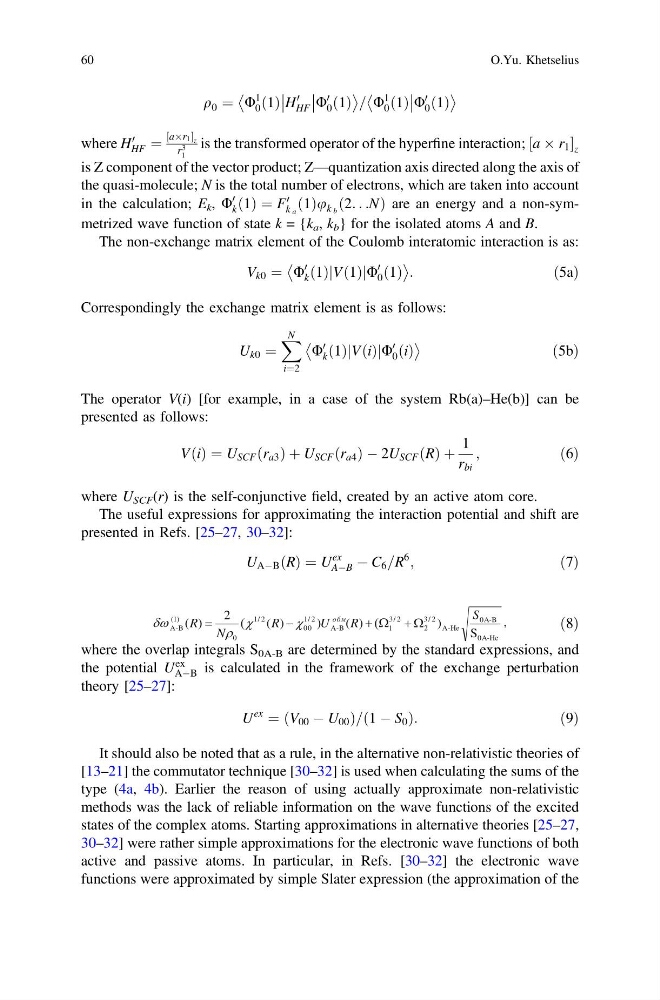
q 0 ¼ U
1
0 1
ð Þ H
0
HF
U
0
0 1
ð Þ
= U
1
0 1
ð Þ U
0
0 1
ð Þ
where H
0
HF ¼
½aÂr 1 z
r 3
1
is the transformed operator of the hyperfine interaction; ½a  r 1 z
is Z component of the vector product; Z—quantization axis directed along the axis of
the quasi-molecule; N is the total number of electrons, which are taken into account
in the calculation; E k , U
0
k ð1Þ ¼ F
0
k a
ð1Þu k b ð2. . .NÞ are an energy and a non-symmetrized wave function of state k = {k a , k b } for the isolated atoms A and B.
The non-exchange matrix element of the Coulomb interatomic interaction is as:
V k0 ¼ U
0
k ð1Þ Vð1Þ
j
jU
0
0 ð1Þ
:
ð5aÞ
Correspondingly the exchange matrix element is as follows:
U k0 ¼
X N
i¼2
U
0
k ð1Þ V i
ð Þ
j
jU
0
0 ðiÞ
ð5bÞ
The operator V(i) [for example, in a case of the system Rb(a)–He(b)] can be
presented as follows:
VðiÞ ¼ U SCF r a3
ð Þ þ U SCF r a4
ð Þ À 2U SCF R
ð Þ þ
1
r bi
;
ð6Þ
where U SCF (r) is the self-conjunctive field, created by an active atom core.
The useful expressions for approximating the interaction potential and shift are
presented in Refs. [25–27, 30–32]:
U AÀB ðRÞ ¼ U
ex
AÀB À C 6 =R
6
;
ð7Þ
He
-
0A
B
-
0A
He
-
A
2
/
3
2
2
/
3
1
B
-
A
2
/
1
00
2
/
1
0
)
1
(
B
-
A
S
)
)
(
)
)
(
2
)
(
S
R
U
R
N
R
,
ð8Þ
where the overlap integrals S 0A-B are determined by the standard expressions, and
the potential U
ex
AÀB is calculated in the framework of the exchange perturbation
theory [25–27]:
U
ex
¼ V 00 À U 00
ð
Þ = 1 À S 0
ð
Þ:
ð9Þ
It should also be noted that as a rule, in the alternative non-relativistic theories of
[13–21] the commutator technique [30–32] is used when calculating the sums of the
type (4a, 4b). Earlier the reason of using actually approximate non-relativistic
methods was the lack of reliable information on the wave functions of the excited
states of the complex atoms. Starting approximations in alternative theories [25–27,
30–32] were rather simple approximations for the electronic wave functions of both
active and passive atoms. In particular, in Refs. [30–32] the electronic wave
functions were approximated by simple Slater expression (the approximation of the
60
O.Yu. Khetselius
1
0 1
ð Þ H
0
HF
U
0
0 1
ð Þ
= U
1
0 1
ð Þ U
0
0 1
ð Þ
where H
0
HF ¼
½aÂr 1 z
r 3
1
is the transformed operator of the hyperfine interaction; ½a  r 1 z
is Z component of the vector product; Z—quantization axis directed along the axis of
the quasi-molecule; N is the total number of electrons, which are taken into account
in the calculation; E k , U
0
k ð1Þ ¼ F
0
k a
ð1Þu k b ð2. . .NÞ are an energy and a non-symmetrized wave function of state k = {k a , k b } for the isolated atoms A and B.
The non-exchange matrix element of the Coulomb interatomic interaction is as:
V k0 ¼ U
0
k ð1Þ Vð1Þ
j
jU
0
0 ð1Þ
:
ð5aÞ
Correspondingly the exchange matrix element is as follows:
U k0 ¼
X N
i¼2
U
0
k ð1Þ V i
ð Þ
j
jU
0
0 ðiÞ
ð5bÞ
The operator V(i) [for example, in a case of the system Rb(a)–He(b)] can be
presented as follows:
VðiÞ ¼ U SCF r a3
ð Þ þ U SCF r a4
ð Þ À 2U SCF R
ð Þ þ
1
r bi
;
ð6Þ
where U SCF (r) is the self-conjunctive field, created by an active atom core.
The useful expressions for approximating the interaction potential and shift are
presented in Refs. [25–27, 30–32]:
U AÀB ðRÞ ¼ U
ex
AÀB À C 6 =R
6
;
ð7Þ
He
-
0A
B
-
0A
He
-
A
2
/
3
2
2
/
3
1
B
-
A
2
/
1
00
2
/
1
0
)
1
(
B
-
A
S
)
)
(
)
)
(
2
)
(
S
R
U
R
N
R
,
ð8Þ
where the overlap integrals S 0A-B are determined by the standard expressions, and
the potential U
ex
AÀB is calculated in the framework of the exchange perturbation
theory [25–27]:
U
ex
¼ V 00 À U 00
ð
Þ = 1 À S 0
ð
Þ:
ð9Þ
It should also be noted that as a rule, in the alternative non-relativistic theories of
[13–21] the commutator technique [30–32] is used when calculating the sums of the
type (4a, 4b). Earlier the reason of using actually approximate non-relativistic
methods was the lack of reliable information on the wave functions of the excited
states of the complex atoms. Starting approximations in alternative theories [25–27,
30–32] were rather simple approximations for the electronic wave functions of both
active and passive atoms. In particular, in Refs. [30–32] the electronic wave
functions were approximated by simple Slater expression (the approximation of the
60
O.Yu. Khetselius