

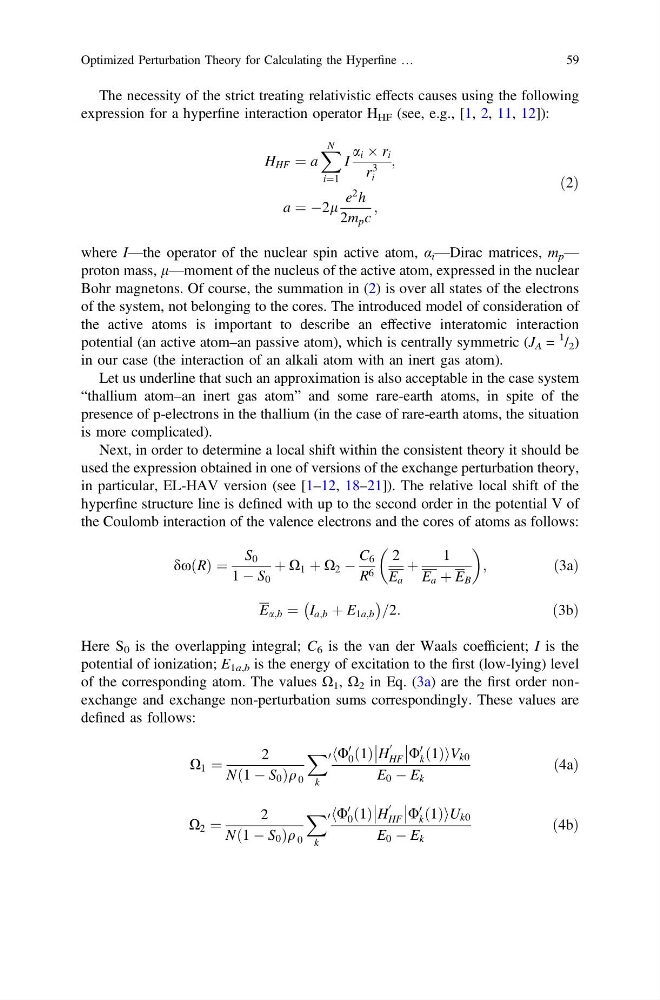
The necessity of the strict treating relativistic effects causes using the following
expression for a hyperfine interaction operator H HF (see, e.g., [1, 2, 11, 12]):
H HF ¼ a
X N
i¼1
I
a i  r i
r
3
i
;
a ¼ À2l
e
2 h
2m p c
;
ð2Þ
where I—the operator of the nuclear spin active atom, α i —Dirac matrices, m p —
proton mass, l—moment of the nucleus of the active atom, expressed in the nuclear
Bohr magnetons. Of course, the summation in (2) is over all states of the electrons
of the system, not belonging to the cores. The introduced model of consideration of
the active atoms is important to describe an effective interatomic interaction
potential (an active atom–an passive atom), which is centrally symmetric (J A =
1 / 2 )
in our case (the interaction of an alkali atom with an inert gas atom).
Let us underline that such an approximation is also acceptable in the case system
“thallium atom–an inert gas atom” and some rare-earth atoms, in spite of the
presence of p-electrons in the thallium (in the case of rare-earth atoms, the situation
is more complicated).
Next, in order to determine a local shift within the consistent theory it should be
used the expression obtained in one of versions of the exchange perturbation theory,
in particular, EL-HAV version (see [1–12, 18–21]). The relative local shift of the
hyperfine structure line is defined with up to the second order in the potential V of
the Coulomb interaction of the valence electrons and the cores of atoms as follows:
dx R
ð Þ ¼
S 0
1 À S 0
þ X 1 þ X 2 À
C 6
R 6
2
E a
þ
1
E a þ E B
;
ð3aÞ
E a;b ¼ I a;b þ E 1a;b
À
Á =2:
ð3bÞ
Here S 0 is the overlapping integral; C 6 is the van der Waals coefficient; I is the
potential of ionization; E 1a,b is the energy of excitation to the first (low-lying) level
of the corresponding atom. The values Ω 1 , Ω 2 in Eq. (3a) are the first order nonexchange and exchange non-perturbation sums correspondingly. These values are
defined as follows:
X 1 ¼
2
N 1 À S 0
ð
Þq 0
X
k
0hU
0
0 ð1Þ H
0
HF
U
0
k ð1ÞiV k0
E 0 À E k
ð4aÞ
X 2 ¼
2
N 1 À S 0
ð
Þq 0
X
k
0hU
0
0 1
ð Þ H
0
HF
U
0
k 1
ð ÞiU k0
E 0 À E k
ð4bÞ
Optimized Perturbation Theory for Calculating the Hyperfine …
59
expression for a hyperfine interaction operator H HF (see, e.g., [1, 2, 11, 12]):
H HF ¼ a
X N
i¼1
I
a i  r i
r
3
i
;
a ¼ À2l
e
2 h
2m p c
;
ð2Þ
where I—the operator of the nuclear spin active atom, α i —Dirac matrices, m p —
proton mass, l—moment of the nucleus of the active atom, expressed in the nuclear
Bohr magnetons. Of course, the summation in (2) is over all states of the electrons
of the system, not belonging to the cores. The introduced model of consideration of
the active atoms is important to describe an effective interatomic interaction
potential (an active atom–an passive atom), which is centrally symmetric (J A =
1 / 2 )
in our case (the interaction of an alkali atom with an inert gas atom).
Let us underline that such an approximation is also acceptable in the case system
“thallium atom–an inert gas atom” and some rare-earth atoms, in spite of the
presence of p-electrons in the thallium (in the case of rare-earth atoms, the situation
is more complicated).
Next, in order to determine a local shift within the consistent theory it should be
used the expression obtained in one of versions of the exchange perturbation theory,
in particular, EL-HAV version (see [1–12, 18–21]). The relative local shift of the
hyperfine structure line is defined with up to the second order in the potential V of
the Coulomb interaction of the valence electrons and the cores of atoms as follows:
dx R
ð Þ ¼
S 0
1 À S 0
þ X 1 þ X 2 À
C 6
R 6
2
E a
þ
1
E a þ E B
;
ð3aÞ
E a;b ¼ I a;b þ E 1a;b
À
Á =2:
ð3bÞ
Here S 0 is the overlapping integral; C 6 is the van der Waals coefficient; I is the
potential of ionization; E 1a,b is the energy of excitation to the first (low-lying) level
of the corresponding atom. The values Ω 1 , Ω 2 in Eq. (3a) are the first order nonexchange and exchange non-perturbation sums correspondingly. These values are
defined as follows:
X 1 ¼
2
N 1 À S 0
ð
Þq 0
X
k
0hU
0
0 ð1Þ H
0
HF
U
0
k ð1ÞiV k0
E 0 À E k
ð4aÞ
X 2 ¼
2
N 1 À S 0
ð
Þq 0
X
k
0hU
0
0 1
ð Þ H
0
HF
U
0
k 1
ð ÞiU k0
E 0 À E k
ð4bÞ
Optimized Perturbation Theory for Calculating the Hyperfine …
59