

procedure has been implemented into our approach. In result, the numerical data on
the hyperfine line collision shifts and broadening for some alkali (Rb, Cs), thallium
and ytterbium atoms in atmosphere of the inert gas (such as He, Ke, Xe) are
presented and compared with available theoretical and experimental data (see, for
example, [1–27, 30–32]). Besides, new data on the van der Waals constants and
other parameters for the studied two-atomic systems are presented too.
2 Optimized Atomic Perturbation Theory and Advanced
Kinetic Theory of Spectral Lines
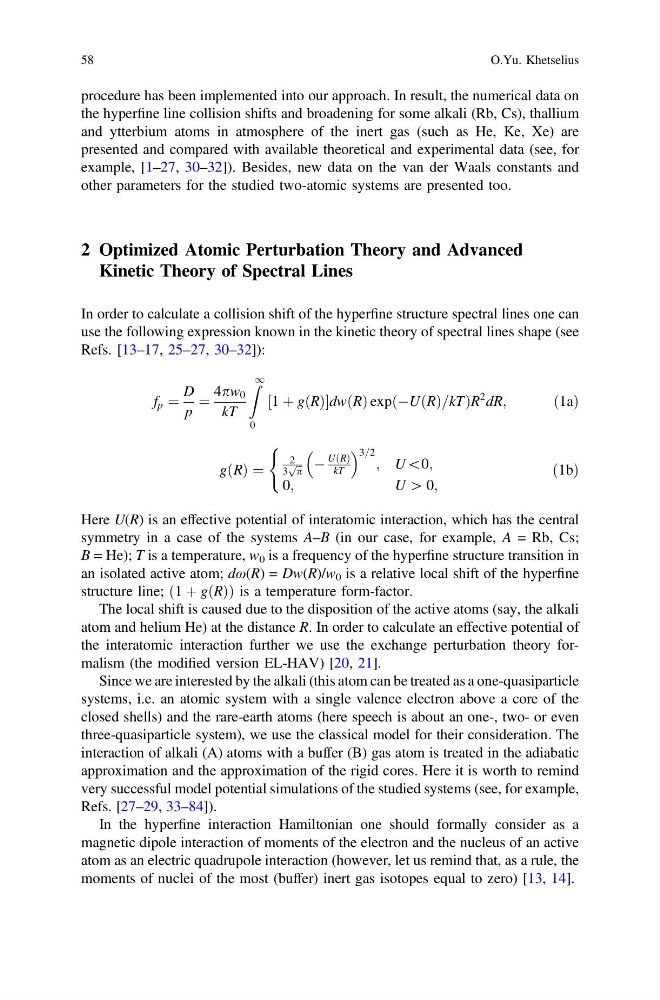
In order to calculate a collision shift of the hyperfine structure spectral lines one can
use the following expression known in the kinetic theory of spectral lines shape (see
Refs. [13–17, 25–27, 30–32]):
f p ¼
D
p
¼
4pw 0
kT
Z 1
0
½1 þ gðRÞdw R
ð Þ exp ÀU R
ð Þ=kT
ð
Þ R
2 dR;
ð1aÞ
g R
ð Þ ¼
2
3
ffiffi
p
p
À
U R
ð Þ
kT
3=2 ; U\0;
0;
U [ 0;
(
ð1bÞ
Here U(R) is an effective potential of interatomic interaction, which has the central
symmetry in a case of the systems A–B (in our case, for example, A = Rb, Cs;
B = He); T is a temperature, w 0 is a frequency of the hyperfine structure transition in
an isolated active atom; dω(R) = Dw(R)/w 0 is a relative local shift of the hyperfine
structure line; ð1 þ gðRÞÞ is a temperature form-factor.
The local shift is caused due to the disposition of the active atoms (say, the alkali
atom and helium He) at the distance R. In order to calculate an effective potential of
the interatomic interaction further we use the exchange perturbation theory formalism (the modified version EL-HAV) [20, 21].
Since we are interested by the alkali (this atom can be treated as a one-quasiparticle
systems, i.e. an atomic system with a single valence electron above a core of the
closed shells) and the rare-earth atoms (here speech is about an one-, two- or even
three-quasiparticle system), we use the classical model for their consideration. The
interaction of alkali (A) atoms with a buffer (B) gas atom is treated in the adiabatic
approximation and the approximation of the rigid cores. Here it is worth to remind
very successful model potential simulations of the studied systems (see, for example,
Refs. [27–29, 33–84]).
In the hyperfine interaction Hamiltonian one should formally consider as a
magnetic dipole interaction of moments of the electron and the nucleus of an active
atom as an electric quadrupole interaction (however, let us remind that, as a rule, the
moments of nuclei of the most (buffer) inert gas isotopes equal to zero) [13, 14].
58
O.Yu. Khetselius
the hyperfine line collision shifts and broadening for some alkali (Rb, Cs), thallium
and ytterbium atoms in atmosphere of the inert gas (such as He, Ke, Xe) are
presented and compared with available theoretical and experimental data (see, for
example, [1–27, 30–32]). Besides, new data on the van der Waals constants and
other parameters for the studied two-atomic systems are presented too.
2 Optimized Atomic Perturbation Theory and Advanced
Kinetic Theory of Spectral Lines
In order to calculate a collision shift of the hyperfine structure spectral lines one can
use the following expression known in the kinetic theory of spectral lines shape (see
Refs. [13–17, 25–27, 30–32]):
f p ¼
D
p
¼
4pw 0
kT
Z 1
0
½1 þ gðRÞdw R
ð Þ exp ÀU R
ð Þ=kT
ð
Þ R
2 dR;
ð1aÞ
g R
ð Þ ¼
2
3
ffiffi
p
p
À
U R
ð Þ
kT
3=2 ; U\0;
0;
U [ 0;
(
ð1bÞ
Here U(R) is an effective potential of interatomic interaction, which has the central
symmetry in a case of the systems A–B (in our case, for example, A = Rb, Cs;
B = He); T is a temperature, w 0 is a frequency of the hyperfine structure transition in
an isolated active atom; dω(R) = Dw(R)/w 0 is a relative local shift of the hyperfine
structure line; ð1 þ gðRÞÞ is a temperature form-factor.
The local shift is caused due to the disposition of the active atoms (say, the alkali
atom and helium He) at the distance R. In order to calculate an effective potential of
the interatomic interaction further we use the exchange perturbation theory formalism (the modified version EL-HAV) [20, 21].
Since we are interested by the alkali (this atom can be treated as a one-quasiparticle
systems, i.e. an atomic system with a single valence electron above a core of the
closed shells) and the rare-earth atoms (here speech is about an one-, two- or even
three-quasiparticle system), we use the classical model for their consideration. The
interaction of alkali (A) atoms with a buffer (B) gas atom is treated in the adiabatic
approximation and the approximation of the rigid cores. Here it is worth to remind
very successful model potential simulations of the studied systems (see, for example,
Refs. [27–29, 33–84]).
In the hyperfine interaction Hamiltonian one should formally consider as a
magnetic dipole interaction of moments of the electron and the nucleus of an active
atom as an electric quadrupole interaction (however, let us remind that, as a rule, the
moments of nuclei of the most (buffer) inert gas isotopes equal to zero) [13, 14].
58
O.Yu. Khetselius