

with only one valence electron is used, the electronic absorption spectrum shows no
transitions in the energy range considered (Fig. 4d).
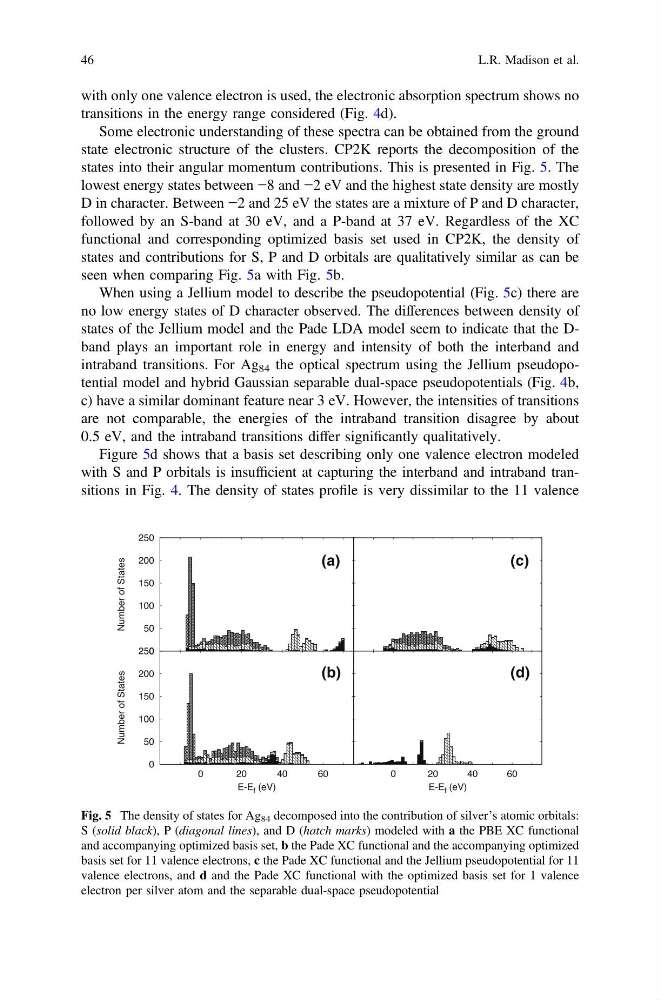
Some electronic understanding of these spectra can be obtained from the ground
state electronic structure of the clusters. CP2K reports the decomposition of the
states into their angular momentum contributions. This is presented in Fig. 5. The
lowest energy states between −8 and −2 eV and the highest state density are mostly
D in character. Between −2 and 25 eV the states are a mixture of P and D character,
followed by an S-band at 30 eV, and a P-band at 37 eV. Regardless of the XC
functional and corresponding optimized basis set used in CP2K, the density of
states and contributions for S, P and D orbitals are qualitatively similar as can be
seen when comparing Fig. 5a with Fig. 5b.
When using a Jellium model to describe the pseudopotential (Fig. 5c) there are
no low energy states of D character observed. The differences between density of
states of the Jellium model and the Pade LDA model seem to indicate that the Dband plays an important role in energy and intensity of both the interband and
intraband transitions. For Ag 84 the optical spectrum using the Jellium pseudopotential model and hybrid Gaussian separable dual-space pseudopotentials (Fig. 4b,
c) have a similar dominant feature near 3 eV. However, the intensities of transitions
are not comparable, the energies of the intraband transition disagree by about
0.5 eV, and the intraband transitions differ significantly qualitatively.
Figure 5d shows that a basis set describing only one valence electron modeled
with S and P orbitals is insufficient at capturing the interband and intraband transitions in Fig. 4. The density of states profile is very dissimilar to the 11 valence
(a)
(c)
(b)
(d)
Fig. 5 The density of states for Ag 84 decomposed into the contribution of silver’s atomic orbitals:
S (solid black), P (diagonal lines), and D (hatch marks) modeled with a the PBE XC functional
and accompanying optimized basis set, b the Pade XC functional and the accompanying optimized
basis set for 11 valence electrons, c the Pade XC functional and the Jellium pseudopotential for 11
valence electrons, and d and the Pade XC functional with the optimized basis set for 1 valence
electron per silver atom and the separable dual-space pseudopotential
46
L.R. Madison et al.
transitions in the energy range considered (Fig. 4d).
Some electronic understanding of these spectra can be obtained from the ground
state electronic structure of the clusters. CP2K reports the decomposition of the
states into their angular momentum contributions. This is presented in Fig. 5. The
lowest energy states between −8 and −2 eV and the highest state density are mostly
D in character. Between −2 and 25 eV the states are a mixture of P and D character,
followed by an S-band at 30 eV, and a P-band at 37 eV. Regardless of the XC
functional and corresponding optimized basis set used in CP2K, the density of
states and contributions for S, P and D orbitals are qualitatively similar as can be
seen when comparing Fig. 5a with Fig. 5b.
When using a Jellium model to describe the pseudopotential (Fig. 5c) there are
no low energy states of D character observed. The differences between density of
states of the Jellium model and the Pade LDA model seem to indicate that the Dband plays an important role in energy and intensity of both the interband and
intraband transitions. For Ag 84 the optical spectrum using the Jellium pseudopotential model and hybrid Gaussian separable dual-space pseudopotentials (Fig. 4b,
c) have a similar dominant feature near 3 eV. However, the intensities of transitions
are not comparable, the energies of the intraband transition disagree by about
0.5 eV, and the intraband transitions differ significantly qualitatively.
Figure 5d shows that a basis set describing only one valence electron modeled
with S and P orbitals is insufficient at capturing the interband and intraband transitions in Fig. 4. The density of states profile is very dissimilar to the 11 valence
(a)
(c)
(b)
(d)
Fig. 5 The density of states for Ag 84 decomposed into the contribution of silver’s atomic orbitals:
S (solid black), P (diagonal lines), and D (hatch marks) modeled with a the PBE XC functional
and accompanying optimized basis set, b the Pade XC functional and the accompanying optimized
basis set for 11 valence electrons, c the Pade XC functional and the Jellium pseudopotential for 11
valence electrons, and d and the Pade XC functional with the optimized basis set for 1 valence
electron per silver atom and the separable dual-space pseudopotential
46
L.R. Madison et al.