

electron models (Fig. 5a–c). The lack electronic transitions in Fig. 4 may be
ascribed to the minimal number of electrons in this model and the complete lack of
D orbitals in the basis set.
3.1.4 Size and Geometry of Clusters
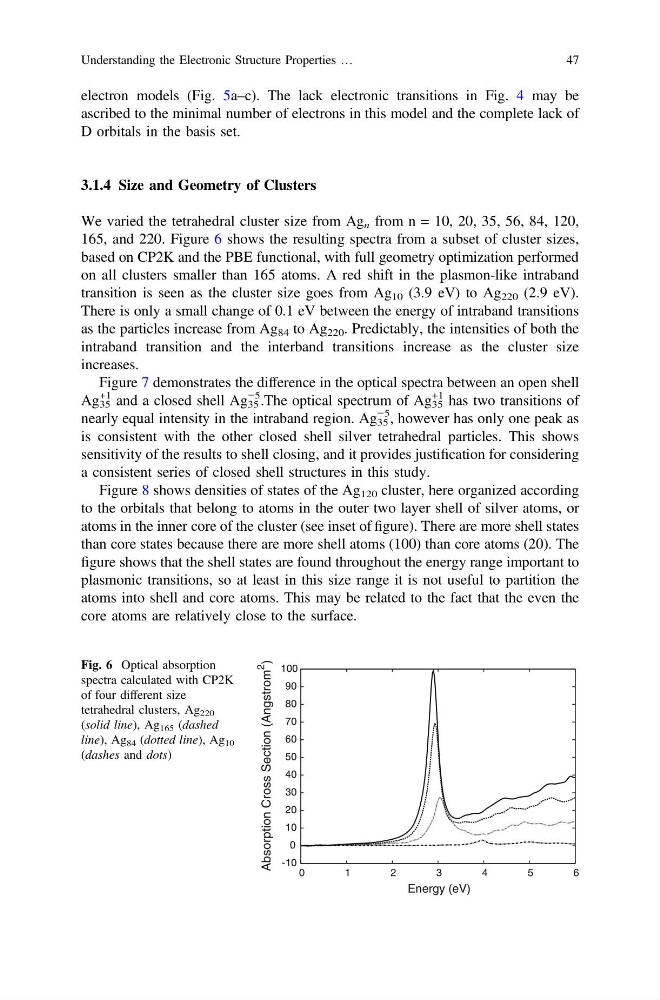
We varied the tetrahedral cluster size from Ag n from n = 10, 20, 35, 56, 84, 120,
165, and 220. Figure 6 shows the resulting spectra from a subset of cluster sizes,
based on CP2K and the PBE functional, with full geometry optimization performed
on all clusters smaller than 165 atoms. A red shift in the plasmon-like intraband
transition is seen as the cluster size goes from Ag 10 (3.9 eV) to Ag 220 (2.9 eV).
There is only a small change of 0.1 eV between the energy of intraband transitions
as the particles increase from Ag 84 to Ag 220 . Predictably, the intensities of both the
intraband transition and the interband transitions increase as the cluster size
increases.
Figure 7 demonstrates the difference in the optical spectra between an open shell
Ag 35
+1 and a closed shell Ag 35
−5 .The optical spectrum of Ag 35
+1 has two transitions of
nearly equal intensity in the intraband region. Ag 35
−5 , however has only one peak as
is consistent with the other closed shell silver tetrahedral particles. This shows
sensitivity of the results to shell closing, and it provides justification for considering
a consistent series of closed shell structures in this study.
Figure 8 shows densities of states of the Ag 120 cluster, here organized according
to the orbitals that belong to atoms in the outer two layer shell of silver atoms, or
atoms in the inner core of the cluster (see inset of figure). There are more shell states
than core states because there are more shell atoms (100) than core atoms (20). The
figure shows that the shell states are found throughout the energy range important to
plasmonic transitions, so at least in this size range it is not useful to partition the
atoms into shell and core atoms. This may be related to the fact that the even the
core atoms are relatively close to the surface.
-10
0
10
20
30
40
50
60
70
80
90
100
0
1
2
3
4
5
6
Absorption Cross Section (Angstrom
2
)
Energy (eV)
Fig. 6 Optical absorption
spectra calculated with CP2K
of four different size
tetrahedral clusters, Ag 220
(solid line), Ag 165 (dashed
line), Ag 84 (dotted line), Ag 10
(dashes and dots)
Understanding the Electronic Structure Properties …
47
ascribed to the minimal number of electrons in this model and the complete lack of
D orbitals in the basis set.
3.1.4 Size and Geometry of Clusters
We varied the tetrahedral cluster size from Ag n from n = 10, 20, 35, 56, 84, 120,
165, and 220. Figure 6 shows the resulting spectra from a subset of cluster sizes,
based on CP2K and the PBE functional, with full geometry optimization performed
on all clusters smaller than 165 atoms. A red shift in the plasmon-like intraband
transition is seen as the cluster size goes from Ag 10 (3.9 eV) to Ag 220 (2.9 eV).
There is only a small change of 0.1 eV between the energy of intraband transitions
as the particles increase from Ag 84 to Ag 220 . Predictably, the intensities of both the
intraband transition and the interband transitions increase as the cluster size
increases.
Figure 7 demonstrates the difference in the optical spectra between an open shell
Ag 35
+1 and a closed shell Ag 35
−5 .The optical spectrum of Ag 35
+1 has two transitions of
nearly equal intensity in the intraband region. Ag 35
−5 , however has only one peak as
is consistent with the other closed shell silver tetrahedral particles. This shows
sensitivity of the results to shell closing, and it provides justification for considering
a consistent series of closed shell structures in this study.
Figure 8 shows densities of states of the Ag 120 cluster, here organized according
to the orbitals that belong to atoms in the outer two layer shell of silver atoms, or
atoms in the inner core of the cluster (see inset of figure). There are more shell states
than core states because there are more shell atoms (100) than core atoms (20). The
figure shows that the shell states are found throughout the energy range important to
plasmonic transitions, so at least in this size range it is not useful to partition the
atoms into shell and core atoms. This may be related to the fact that the even the
core atoms are relatively close to the surface.
-10
0
10
20
30
40
50
60
70
80
90
100
0
1
2
3
4
5
6
Absorption Cross Section (Angstrom
2
)
Energy (eV)
Fig. 6 Optical absorption
spectra calculated with CP2K
of four different size
tetrahedral clusters, Ag 220
(solid line), Ag 165 (dashed
line), Ag 84 (dotted line), Ag 10
(dashes and dots)
Understanding the Electronic Structure Properties …
47