

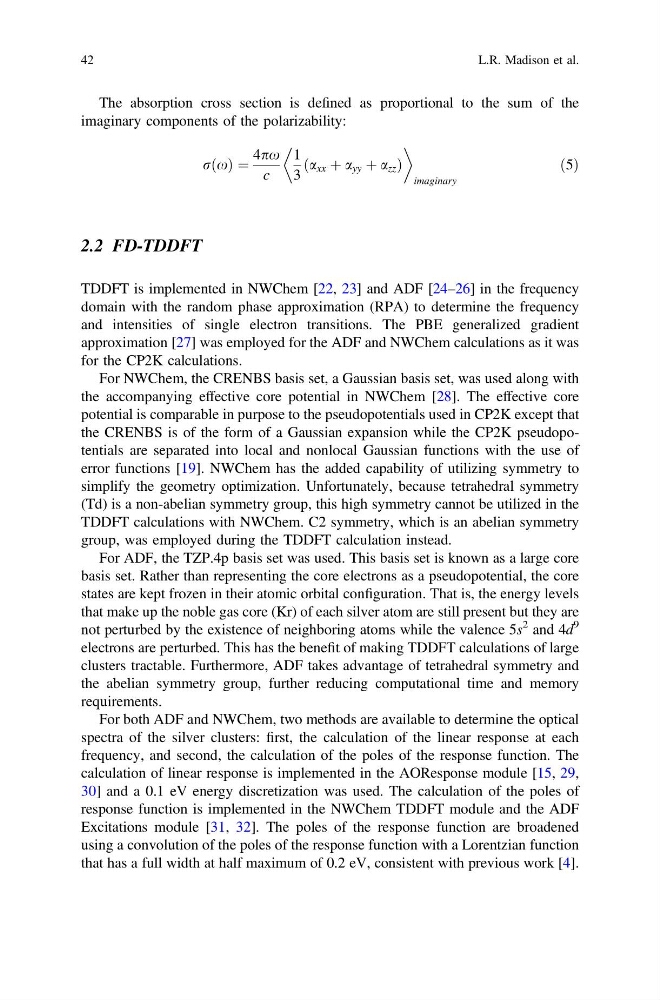
The absorption cross section is defined as proportional to the sum of the
imaginary components of the polarizability:
rðxÞ ¼
4px
c
1
3
ða xx þ a yy þ a zz Þ
imaginary
ð5Þ
2.2 FD-TDDFT
TDDFT is implemented in NWChem [22, 23] and ADF [24–26] in the frequency
domain with the random phase approximation (RPA) to determine the frequency
and intensities of single electron transitions. The PBE generalized gradient
approximation [27] was employed for the ADF and NWChem calculations as it was
for the CP2K calculations.
For NWChem, the CRENBS basis set, a Gaussian basis set, was used along with
the accompanying effective core potential in NWChem [28]. The effective core
potential is comparable in purpose to the pseudopotentials used in CP2K except that
the CRENBS is of the form of a Gaussian expansion while the CP2K pseudopotentials are separated into local and nonlocal Gaussian functions with the use of
error functions [19]. NWChem has the added capability of utilizing symmetry to
simplify the geometry optimization. Unfortunately, because tetrahedral symmetry
(Td) is a non-abelian symmetry group, this high symmetry cannot be utilized in the
TDDFT calculations with NWChem. C2 symmetry, which is an abelian symmetry
group, was employed during the TDDFT calculation instead.
For ADF, the TZP.4p basis set was used. This basis set is known as a large core
basis set. Rather than representing the core electrons as a pseudopotential, the core
states are kept frozen in their atomic orbital configuration. That is, the energy levels
that make up the noble gas core (Kr) of each silver atom are still present but they are
not perturbed by the existence of neighboring atoms while the valence 5s
2 and 4d
9
electrons are perturbed. This has the benefit of making TDDFT calculations of large
clusters tractable. Furthermore, ADF takes advantage of tetrahedral symmetry and
the abelian symmetry group, further reducing computational time and memory
requirements.
For both ADF and NWChem, two methods are available to determine the optical
spectra of the silver clusters: first, the calculation of the linear response at each
frequency, and second, the calculation of the poles of the response function. The
calculation of linear response is implemented in the AOResponse module [15, 29,
30] and a 0.1 eV energy discretization was used. The calculation of the poles of
response function is implemented in the NWChem TDDFT module and the ADF
Excitations module [31, 32]. The poles of the response function are broadened
using a convolution of the poles of the response function with a Lorentzian function
that has a full width at half maximum of 0.2 eV, consistent with previous work [4].
42
L.R. Madison et al.
imaginary components of the polarizability:
rðxÞ ¼
4px
c
1
3
ða xx þ a yy þ a zz Þ
imaginary
ð5Þ
2.2 FD-TDDFT
TDDFT is implemented in NWChem [22, 23] and ADF [24–26] in the frequency
domain with the random phase approximation (RPA) to determine the frequency
and intensities of single electron transitions. The PBE generalized gradient
approximation [27] was employed for the ADF and NWChem calculations as it was
for the CP2K calculations.
For NWChem, the CRENBS basis set, a Gaussian basis set, was used along with
the accompanying effective core potential in NWChem [28]. The effective core
potential is comparable in purpose to the pseudopotentials used in CP2K except that
the CRENBS is of the form of a Gaussian expansion while the CP2K pseudopotentials are separated into local and nonlocal Gaussian functions with the use of
error functions [19]. NWChem has the added capability of utilizing symmetry to
simplify the geometry optimization. Unfortunately, because tetrahedral symmetry
(Td) is a non-abelian symmetry group, this high symmetry cannot be utilized in the
TDDFT calculations with NWChem. C2 symmetry, which is an abelian symmetry
group, was employed during the TDDFT calculation instead.
For ADF, the TZP.4p basis set was used. This basis set is known as a large core
basis set. Rather than representing the core electrons as a pseudopotential, the core
states are kept frozen in their atomic orbital configuration. That is, the energy levels
that make up the noble gas core (Kr) of each silver atom are still present but they are
not perturbed by the existence of neighboring atoms while the valence 5s
2 and 4d
9
electrons are perturbed. This has the benefit of making TDDFT calculations of large
clusters tractable. Furthermore, ADF takes advantage of tetrahedral symmetry and
the abelian symmetry group, further reducing computational time and memory
requirements.
For both ADF and NWChem, two methods are available to determine the optical
spectra of the silver clusters: first, the calculation of the linear response at each
frequency, and second, the calculation of the poles of the response function. The
calculation of linear response is implemented in the AOResponse module [15, 29,
30] and a 0.1 eV energy discretization was used. The calculation of the poles of
response function is implemented in the NWChem TDDFT module and the ADF
Excitations module [31, 32]. The poles of the response function are broadened
using a convolution of the poles of the response function with a Lorentzian function
that has a full width at half maximum of 0.2 eV, consistent with previous work [4].
42
L.R. Madison et al.