

Pseudopotential and a Jellium model. Hybrid Gaussian and plane wave basis sets
are used in these calculations [21]. These basis sets have been optimized for
selected exchange-correlation (XC) functionals, namely the PBE and Pade XC
functional, and as a result the PBE calculation based on CP2K is not rigorously the
same as the PBE calculation with NWChem or ADF.
Geometry optimizations were performed on each initial silver cluster we considered and with each choice of functional and pseudopotential, using the conjugate
gradient method. Following geometry optimization, RT-TDDFT was performed
with CP2K, using a timestep of 1 atomic unit, 2.42 × 10
−17 s, and each calculation
has a total of 2,000 steps, or 48.4 fs duration. The RT-TDDFT calculations
determine the time-dependent dipole moment of the molecule, which can be used to
determine the optical spectra. This approach has been described by Chen [12] and
will be briefly reviewed here.
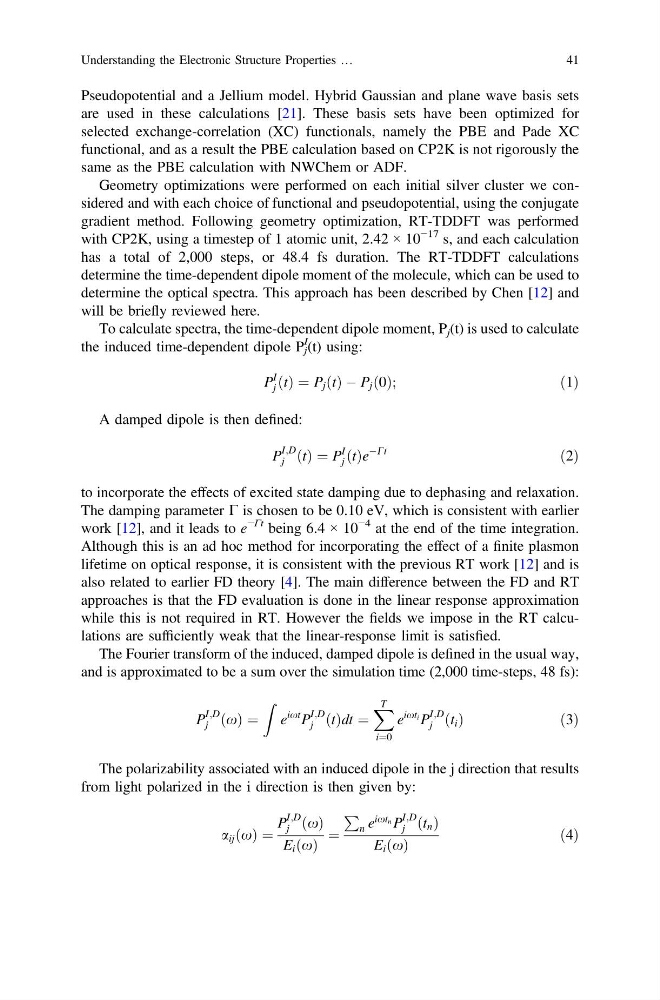
To calculate spectra, the time-dependent dipole moment, P j (t) is used to calculate
the induced time-dependent dipole P j
I
(t) using:
P
I
j ðtÞ ¼ P j ðtÞ À P j ð0Þ;
ð1Þ
A damped dipole is then defined:
P
I;D
j ðtÞ ¼ P
I
j ðtÞe
ÀCt
ð2Þ
to incorporate the effects of excited state damping due to dephasing and relaxation.
The damping parameter C is chosen to be 0.10 eV, which is consistent with earlier
work [12], and it leads to e
−Γt being 6.4 × 10
−4 at the end of the time integration.
Although this is an ad hoc method for incorporating the effect of a finite plasmon
lifetime on optical response, it is consistent with the previous RT work [12] and is
also related to earlier FD theory [4]. The main difference between the FD and RT
approaches is that the FD evaluation is done in the linear response approximation
while this is not required in RT. However the fields we impose in the RT calculations are sufficiently weak that the linear-response limit is satisfied.
The Fourier transform of the induced, damped dipole is defined in the usual way,
and is approximated to be a sum over the simulation time (2,000 time-steps, 48 fs):
P
I;D
j ðxÞ ¼
Z
e
ixt P
I;D
j ðtÞdt ¼
X T
i¼0
e
ixt i P
I;D
j ðt i Þ
ð 3Þ
The polarizability associated with an induced dipole in the j direction that results
from light polarized in the i direction is then given by:
a ij ðxÞ ¼
P
I;D
j ðxÞ
E i ðxÞ
¼
P
n e
ixt n P
I;D
j ðt n Þ
E i ðxÞ
ð4Þ
Understanding the Electronic Structure Properties …
41
are used in these calculations [21]. These basis sets have been optimized for
selected exchange-correlation (XC) functionals, namely the PBE and Pade XC
functional, and as a result the PBE calculation based on CP2K is not rigorously the
same as the PBE calculation with NWChem or ADF.
Geometry optimizations were performed on each initial silver cluster we considered and with each choice of functional and pseudopotential, using the conjugate
gradient method. Following geometry optimization, RT-TDDFT was performed
with CP2K, using a timestep of 1 atomic unit, 2.42 × 10
−17 s, and each calculation
has a total of 2,000 steps, or 48.4 fs duration. The RT-TDDFT calculations
determine the time-dependent dipole moment of the molecule, which can be used to
determine the optical spectra. This approach has been described by Chen [12] and
will be briefly reviewed here.
To calculate spectra, the time-dependent dipole moment, P j (t) is used to calculate
the induced time-dependent dipole P j
I
(t) using:
P
I
j ðtÞ ¼ P j ðtÞ À P j ð0Þ;
ð1Þ
A damped dipole is then defined:
P
I;D
j ðtÞ ¼ P
I
j ðtÞe
ÀCt
ð2Þ
to incorporate the effects of excited state damping due to dephasing and relaxation.
The damping parameter C is chosen to be 0.10 eV, which is consistent with earlier
work [12], and it leads to e
−Γt being 6.4 × 10
−4 at the end of the time integration.
Although this is an ad hoc method for incorporating the effect of a finite plasmon
lifetime on optical response, it is consistent with the previous RT work [12] and is
also related to earlier FD theory [4]. The main difference between the FD and RT
approaches is that the FD evaluation is done in the linear response approximation
while this is not required in RT. However the fields we impose in the RT calculations are sufficiently weak that the linear-response limit is satisfied.
The Fourier transform of the induced, damped dipole is defined in the usual way,
and is approximated to be a sum over the simulation time (2,000 time-steps, 48 fs):
P
I;D
j ðxÞ ¼
Z
e
ixt P
I;D
j ðtÞdt ¼
X T
i¼0
e
ixt i P
I;D
j ðt i Þ
ð 3Þ
The polarizability associated with an induced dipole in the j direction that results
from light polarized in the i direction is then given by:
a ij ðxÞ ¼
P
I;D
j ðxÞ
E i ðxÞ
¼
P
n e
ixt n P
I;D
j ðt n Þ
E i ðxÞ
ð4Þ
Understanding the Electronic Structure Properties …
41