

close to the equilibrium bond length, HF could still optimize to an excited state
resulting in an incorrect geometry, especially if the ground and excited PECs are not
parallel. Non-parallel PECs can be problematic as a bad initial guess can result in an
incorrect optimized geometry, especially when a gradient-driven optimization
algorithm is used. In this case the two different initial guesses produce PECs with
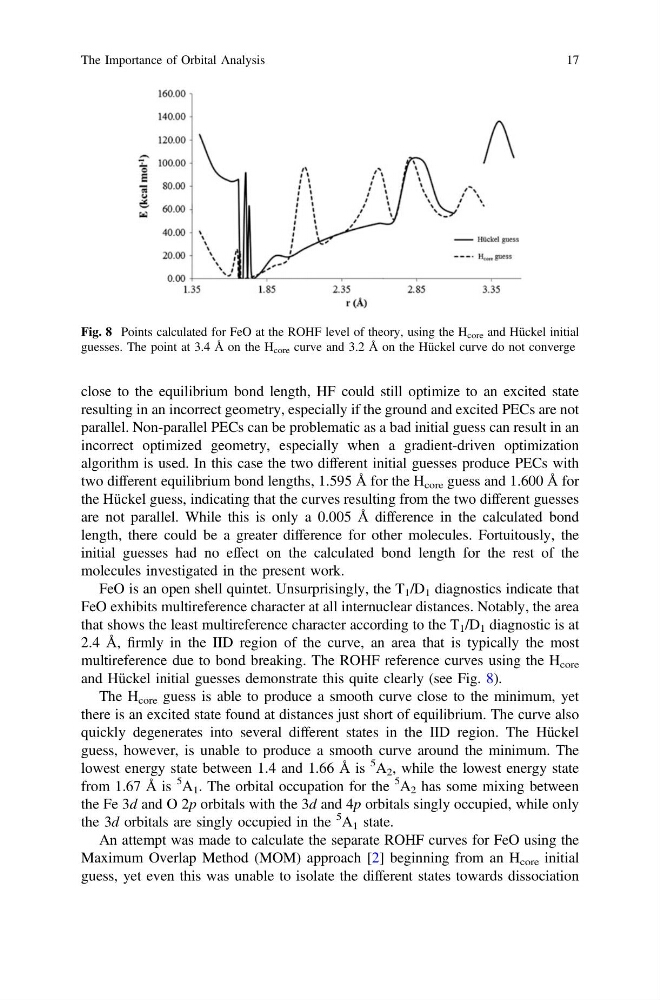
two different equilibrium bond lengths, 1.595 Å for the H core guess and 1.600 Å for
the Hückel guess, indicating that the curves resulting from the two different guesses
are not parallel. While this is only a 0.005 Å difference in the calculated bond
length, there could be a greater difference for other molecules. Fortuitously, the
initial guesses had no effect on the calculated bond length for the rest of the
molecules investigated in the present work.
FeO is an open shell quintet. Unsurprisingly, the T 1 /D 1 diagnostics indicate that
FeO exhibits multireference character at all internuclear distances. Notably, the area
that shows the least multireference character according to the T 1 /D 1 diagnostic is at
2.4 Å, firmly in the IID region of the curve, an area that is typically the most
multireference due to bond breaking. The ROHF reference curves using the H core
and Hückel initial guesses demonstrate this quite clearly (see Fig. 8).
The H core guess is able to produce a smooth curve close to the minimum, yet
there is an excited state found at distances just short of equilibrium. The curve also
quickly degenerates into several different states in the IID region. The Hückel
guess, however, is unable to produce a smooth curve around the minimum. The
lowest energy state between 1.4 and 1.66 Å is
5 A 2 , while the lowest energy state
from 1.67 Å is
5 A 1 . The orbital occupation for the
5 A 2 has some mixing between
the Fe 3d and O 2p orbitals with the 3d and 4p orbitals singly occupied, while only
the 3d orbitals are singly occupied in the
5 A 1 state.
An attempt was made to calculate the separate ROHF curves for FeO using the
Maximum Overlap Method (MOM) approach [2] beginning from an H core initial
guess, yet even this was unable to isolate the different states towards dissociation
Fig. 8 Points calculated for FeO at the ROHF level of theory, using the H core and Hückel initial
guesses. The point at 3.4 Å on the H core curve and 3.2 Å on the Hückel curve do not converge
The Importance of Orbital Analysis
17
resulting in an incorrect geometry, especially if the ground and excited PECs are not
parallel. Non-parallel PECs can be problematic as a bad initial guess can result in an
incorrect optimized geometry, especially when a gradient-driven optimization
algorithm is used. In this case the two different initial guesses produce PECs with
two different equilibrium bond lengths, 1.595 Å for the H core guess and 1.600 Å for
the Hückel guess, indicating that the curves resulting from the two different guesses
are not parallel. While this is only a 0.005 Å difference in the calculated bond
length, there could be a greater difference for other molecules. Fortuitously, the
initial guesses had no effect on the calculated bond length for the rest of the
molecules investigated in the present work.
FeO is an open shell quintet. Unsurprisingly, the T 1 /D 1 diagnostics indicate that
FeO exhibits multireference character at all internuclear distances. Notably, the area
that shows the least multireference character according to the T 1 /D 1 diagnostic is at
2.4 Å, firmly in the IID region of the curve, an area that is typically the most
multireference due to bond breaking. The ROHF reference curves using the H core
and Hückel initial guesses demonstrate this quite clearly (see Fig. 8).
The H core guess is able to produce a smooth curve close to the minimum, yet
there is an excited state found at distances just short of equilibrium. The curve also
quickly degenerates into several different states in the IID region. The Hückel
guess, however, is unable to produce a smooth curve around the minimum. The
lowest energy state between 1.4 and 1.66 Å is
5 A 2 , while the lowest energy state
from 1.67 Å is
5 A 1 . The orbital occupation for the
5 A 2 has some mixing between
the Fe 3d and O 2p orbitals with the 3d and 4p orbitals singly occupied, while only
the 3d orbitals are singly occupied in the
5 A 1 state.
An attempt was made to calculate the separate ROHF curves for FeO using the
Maximum Overlap Method (MOM) approach [2] beginning from an H core initial
guess, yet even this was unable to isolate the different states towards dissociation
Fig. 8 Points calculated for FeO at the ROHF level of theory, using the H core and Hückel initial
guesses. The point at 3.4 Å on the H core curve and 3.2 Å on the Hückel curve do not converge
The Importance of Orbital Analysis
17