

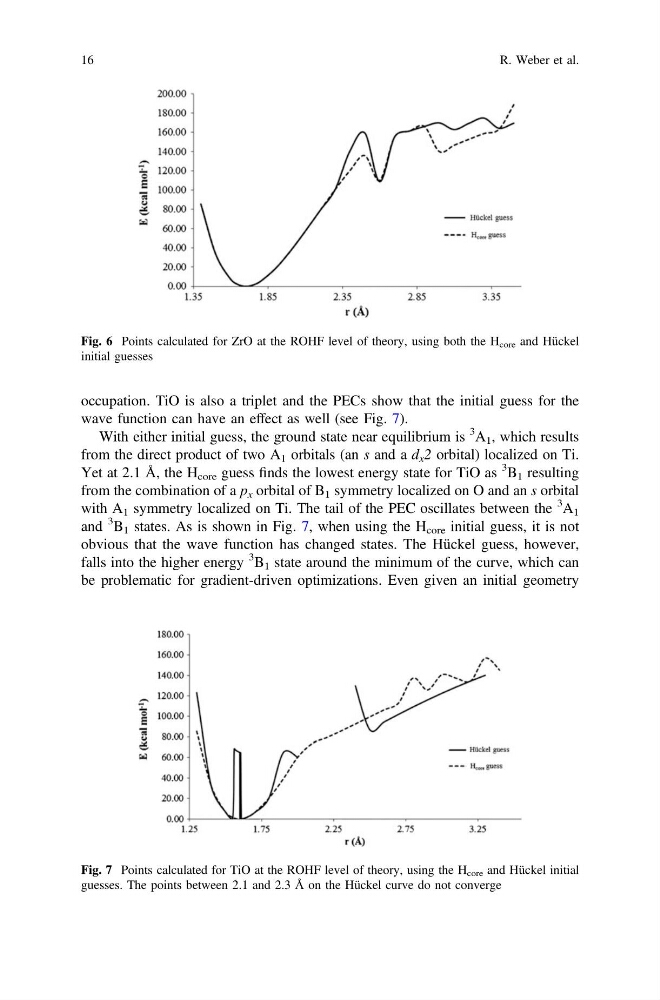
occupation. TiO is also a triplet and the PECs show that the initial guess for the
wave function can have an effect as well (see Fig. 7).
With either initial guess, the ground state near equilibrium is
3 A 1 , which results
from the direct product of two A 1 orbitals (an s and a d x 2 orbital) localized on Ti.
Yet at 2.1 Å, the H core guess finds the lowest energy state for TiO as
3 B 1 resulting
from the combination of a p x orbital of B 1 symmetry localized on O and an s orbital
with A 1 symmetry localized on Ti. The tail of the PEC oscillates between the
3 A 1
and
3 B 1 states. As is shown in Fig. 7, when using the H core initial guess, it is not
obvious that the wave function has changed states. The Hückel guess, however,
falls into the higher energy
3 B 1 state around the minimum of the curve, which can
be problematic for gradient-driven optimizations. Even given an initial geometry
Fig. 6 Points calculated for ZrO at the ROHF level of theory, using both the H core and Hückel
initial guesses
Fig. 7 Points calculated for TiO at the ROHF level of theory, using the H core and Hückel initial
guesses. The points between 2.1 and 2.3 Å on the Hückel curve do not converge
16
R. Weber et al.
wave function can have an effect as well (see Fig. 7).
With either initial guess, the ground state near equilibrium is
3 A 1 , which results
from the direct product of two A 1 orbitals (an s and a d x 2 orbital) localized on Ti.
Yet at 2.1 Å, the H core guess finds the lowest energy state for TiO as
3 B 1 resulting
from the combination of a p x orbital of B 1 symmetry localized on O and an s orbital
with A 1 symmetry localized on Ti. The tail of the PEC oscillates between the
3 A 1
and
3 B 1 states. As is shown in Fig. 7, when using the H core initial guess, it is not
obvious that the wave function has changed states. The Hückel guess, however,
falls into the higher energy
3 B 1 state around the minimum of the curve, which can
be problematic for gradient-driven optimizations. Even given an initial geometry
Fig. 6 Points calculated for ZrO at the ROHF level of theory, using both the H core and Hückel
initial guesses
Fig. 7 Points calculated for TiO at the ROHF level of theory, using the H core and Hückel initial
guesses. The points between 2.1 and 2.3 Å on the Hückel curve do not converge
16
R. Weber et al.