

the partitioning of the exact dynamics [12]. Using the model of nuclei as vibrating
oscillators, we can use the partitioning technique to estimate the complex energy of
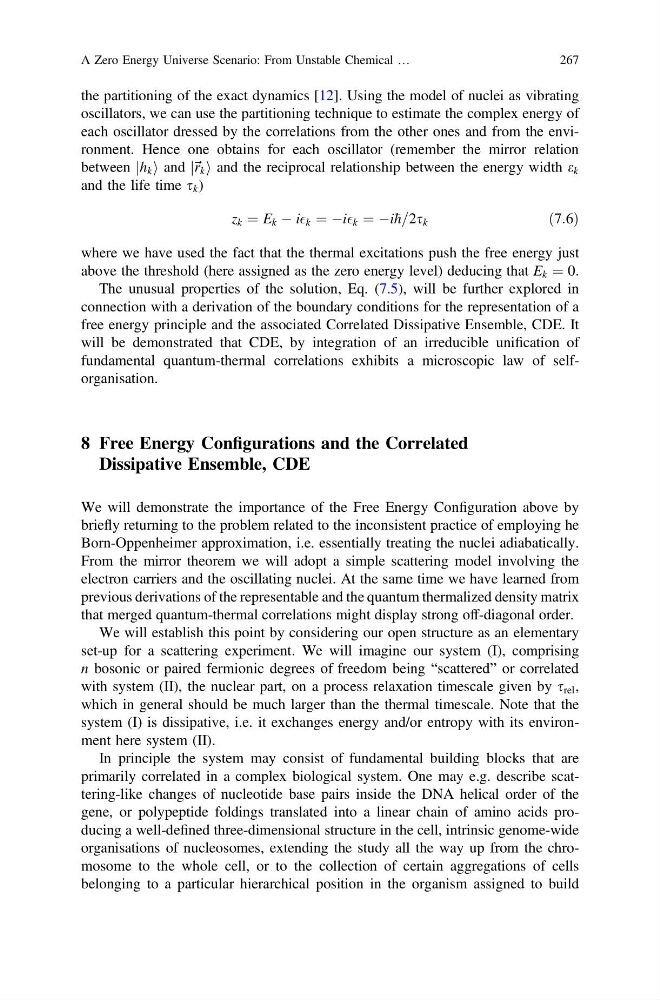
each oscillator dressed by the correlations from the other ones and from the environment. Hence one obtains for each oscillator (remember the mirror relation
between h k
j i and ~ r k
j i and the reciprocal relationship between the energy width e k
and the life time s k )
z k ¼ E k À i k ¼ Ài k ¼ Ài h=2s k
ð7:6Þ
where we have used the fact that the thermal excitations push the free energy just
above the threshold (here assigned as the zero energy level) deducing that E k ¼ 0.
The unusual properties of the solution, Eq. (7.5), will be further explored in
connection with a derivation of the boundary conditions for the representation of a
free energy principle and the associated Correlated Dissipative Ensemble, CDE. It
will be demonstrated that CDE, by integration of an irreducible unification of
fundamental quantum-thermal correlations exhibits a microscopic law of selforganisation.
8 Free Energy Configurations and the Correlated
Dissipative Ensemble, CDE
We will demonstrate the importance of the Free Energy Configuration above by
briefly returning to the problem related to the inconsistent practice of employing he
Born-Oppenheimer approximation, i.e. essentially treating the nuclei adiabatically.
From the mirror theorem we will adopt a simple scattering model involving the
electron carriers and the oscillating nuclei. At the same time we have learned from
previous derivations of the representable and the quantum thermalized density matrix
that merged quantum-thermal correlations might display strong off-diagonal order.
We will establish this point by considering our open structure as an elementary
set-up for a scattering experiment. We will imagine our system (I), comprising
n bosonic or paired fermionic degrees of freedom being “scattered” or correlated
with system (II), the nuclear part, on a process relaxation timescale given by s rel ,
which in general should be much larger than the thermal timescale. Note that the
system (I) is dissipative, i.e. it exchanges energy and/or entropy with its environment here system (II).
In principle the system may consist of fundamental building blocks that are
primarily correlated in a complex biological system. One may e.g. describe scattering-like changes of nucleotide base pairs inside the DNA helical order of the
gene, or polypeptide foldings translated into a linear chain of amino acids producing a well-defined three-dimensional structure in the cell, intrinsic genome-wide
organisations of nucleosomes, extending the study all the way up from the chromosome to the whole cell, or to the collection of certain aggregations of cells
belonging to a particular hierarchical position in the organism assigned to build
A Zero Energy Universe Scenario: From Unstable Chemical …
267
oscillators, we can use the partitioning technique to estimate the complex energy of
each oscillator dressed by the correlations from the other ones and from the environment. Hence one obtains for each oscillator (remember the mirror relation
between h k
j i and ~ r k
j i and the reciprocal relationship between the energy width e k
and the life time s k )
z k ¼ E k À i k ¼ Ài k ¼ Ài h=2s k
ð7:6Þ
where we have used the fact that the thermal excitations push the free energy just
above the threshold (here assigned as the zero energy level) deducing that E k ¼ 0.
The unusual properties of the solution, Eq. (7.5), will be further explored in
connection with a derivation of the boundary conditions for the representation of a
free energy principle and the associated Correlated Dissipative Ensemble, CDE. It
will be demonstrated that CDE, by integration of an irreducible unification of
fundamental quantum-thermal correlations exhibits a microscopic law of selforganisation.
8 Free Energy Configurations and the Correlated
Dissipative Ensemble, CDE
We will demonstrate the importance of the Free Energy Configuration above by
briefly returning to the problem related to the inconsistent practice of employing he
Born-Oppenheimer approximation, i.e. essentially treating the nuclei adiabatically.
From the mirror theorem we will adopt a simple scattering model involving the
electron carriers and the oscillating nuclei. At the same time we have learned from
previous derivations of the representable and the quantum thermalized density matrix
that merged quantum-thermal correlations might display strong off-diagonal order.
We will establish this point by considering our open structure as an elementary
set-up for a scattering experiment. We will imagine our system (I), comprising
n bosonic or paired fermionic degrees of freedom being “scattered” or correlated
with system (II), the nuclear part, on a process relaxation timescale given by s rel ,
which in general should be much larger than the thermal timescale. Note that the
system (I) is dissipative, i.e. it exchanges energy and/or entropy with its environment here system (II).
In principle the system may consist of fundamental building blocks that are
primarily correlated in a complex biological system. One may e.g. describe scattering-like changes of nucleotide base pairs inside the DNA helical order of the
gene, or polypeptide foldings translated into a linear chain of amino acids producing a well-defined three-dimensional structure in the cell, intrinsic genome-wide
organisations of nucleosomes, extending the study all the way up from the chromosome to the whole cell, or to the collection of certain aggregations of cells
belonging to a particular hierarchical position in the organism assigned to build
A Zero Energy Universe Scenario: From Unstable Chemical …
267