

specific material structures and to foster communication channels for the spinal
cord, the central nervous system.
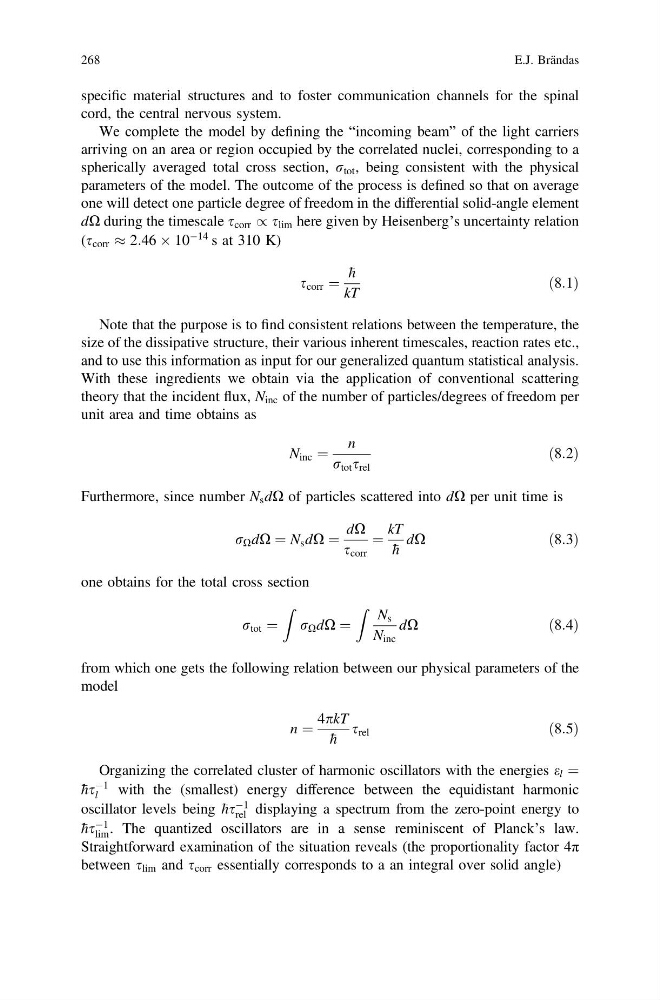
We complete the model by defining the “incoming beam” of the light carriers
arriving on an area or region occupied by the correlated nuclei, corresponding to a
spherically averaged total cross section, r tot , being consistent with the physical
parameters of the model. The outcome of the process is defined so that on average
one will detect one particle degree of freedom in the differential solid-angle element
dX during the timescale s corr / s lim here given by Heisenberg’s uncertainty relation
(s corr % 2:46 Â 10
À14 s at 310 K)
s corr ¼
h
kT
ð8:1Þ
Note that the purpose is to find consistent relations between the temperature, the
size of the dissipative structure, their various inherent timescales, reaction rates etc.,
and to use this information as input for our generalized quantum statistical analysis.
With these ingredients we obtain via the application of conventional scattering
theory that the incident flux, N inc of the number of particles/degrees of freedom per
unit area and time obtains as
N inc ¼
n
r tot s rel
ð8:2Þ
Furthermore, since number N s dX of particles scattered into dX per unit time is
r X dX ¼ N s dX ¼
dX
s corr
¼
kT
h
dX
ð8:3Þ
one obtains for the total cross section
r tot ¼
Z
r X dX ¼
Z N s
N inc
dX
ð8:4Þ
from which one gets the following relation between our physical parameters of the
model
n ¼
4pkT
h
s rel
ð8:5Þ
Organizing the correlated cluster of harmonic oscillators with the energies e l ¼
hs
À1
l
with the (smallest) energy difference between the equidistant harmonic
oscillator levels being hs
À1
rel displaying a spectrum from the zero-point energy to
hs
À1
lim . The quantized oscillators are in a sense reminiscent of Planck’s law.
Straightforward examination of the situation reveals (the proportionality factor 4π
between s lim and s corr essentially corresponds to a an integral over solid angle)
268
E.J. Brändas
cord, the central nervous system.
We complete the model by defining the “incoming beam” of the light carriers
arriving on an area or region occupied by the correlated nuclei, corresponding to a
spherically averaged total cross section, r tot , being consistent with the physical
parameters of the model. The outcome of the process is defined so that on average
one will detect one particle degree of freedom in the differential solid-angle element
dX during the timescale s corr / s lim here given by Heisenberg’s uncertainty relation
(s corr % 2:46 Â 10
À14 s at 310 K)
s corr ¼
h
kT
ð8:1Þ
Note that the purpose is to find consistent relations between the temperature, the
size of the dissipative structure, their various inherent timescales, reaction rates etc.,
and to use this information as input for our generalized quantum statistical analysis.
With these ingredients we obtain via the application of conventional scattering
theory that the incident flux, N inc of the number of particles/degrees of freedom per
unit area and time obtains as
N inc ¼
n
r tot s rel
ð8:2Þ
Furthermore, since number N s dX of particles scattered into dX per unit time is
r X dX ¼ N s dX ¼
dX
s corr
¼
kT
h
dX
ð8:3Þ
one obtains for the total cross section
r tot ¼
Z
r X dX ¼
Z N s
N inc
dX
ð8:4Þ
from which one gets the following relation between our physical parameters of the
model
n ¼
4pkT
h
s rel
ð8:5Þ
Organizing the correlated cluster of harmonic oscillators with the energies e l ¼
hs
À1
l
with the (smallest) energy difference between the equidistant harmonic
oscillator levels being hs
À1
rel displaying a spectrum from the zero-point energy to
hs
À1
lim . The quantized oscillators are in a sense reminiscent of Planck’s law.
Straightforward examination of the situation reveals (the proportionality factor 4π
between s lim and s corr essentially corresponds to a an integral over solid angle)
268
E.J. Brändas