

frame and imparts mirroring relations
7 as the total system (I + II) is subject to
endogenous perturbations. Thus we can use our preferred basis jhi in two ways:
first identifying h~ rjh k i ¼ h k ~ r
ð Þ ¼ f ð~ r À~ r k Þ, with ~ r essentially being the coordinate
for the center of mass of the fermionic pair and ~ r k the coordinate for the nucleus k,
with f being a function localized at the origin. One can hence, mutatis mutandis use
the Dirac ket j~ r k i to denote the nuclear degree of freedom at site k. As a metaphor
one might denote system (II) as a device or target for measurements on the
structure, organization, assembly or arrangement, i.e. the system (I). The obvious
objection that the two mappings may have different dimensions is naturally
resolved by the realization the difference corresponds to the appropriate number of
zero eigenvalues of the larger dimensional mapping.
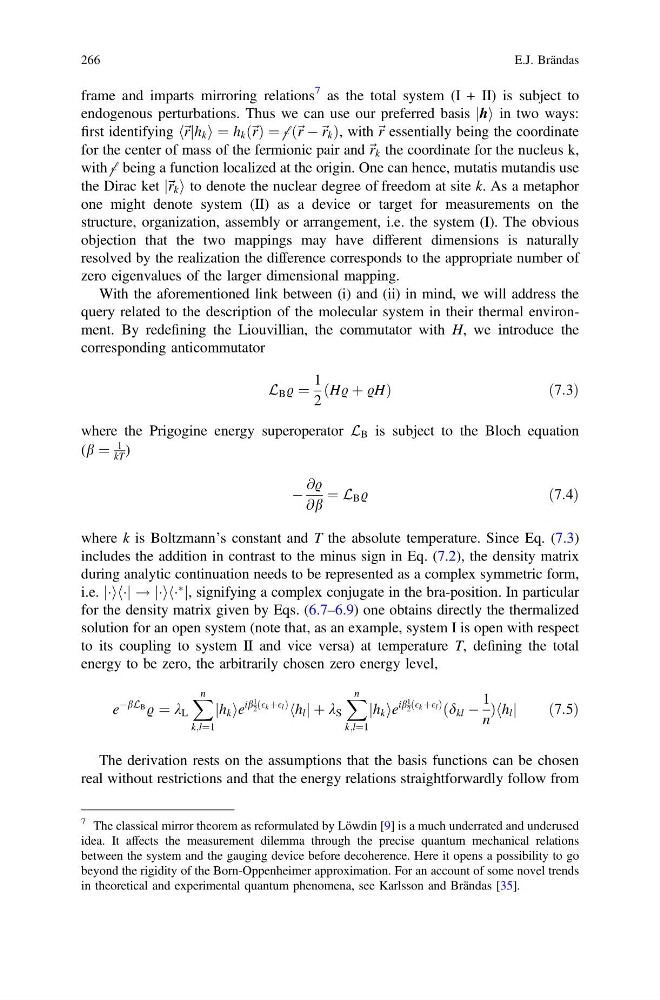
With the aforementioned link between (i) and (ii) in mind, we will address the
query related to the description of the molecular system in their thermal environment. By redefining the Liouvillian, the commutator with H, we introduce the
corresponding anticommutator
L B . ¼
1
2
H. þ .H
ð
Þ
ð 7:3Þ
where the Prigogine energy superoperator L B is subject to the Bloch equation
(b ¼
1
kT )
À
@.
@b
¼ L B .
ð7:4Þ
where k is Boltzmann’s constant and T the absolute temperature. Since Eq. (7.3)
includes the addition in contrast to the minus sign in Eq. (7.2), the density matrix
during analytic continuation needs to be represented as a complex symmetric form,
i.e. Á
j i Á
h j ! Á
j i Á
Ã
h j, signifying a complex conjugate in the bra-position. In particular
for the density matrix given by Eqs. (6.7–6.9) one obtains directly the thermalized
solution for an open system (note that, as an example, system I is open with respect
to its coupling to system II and vice versa) at temperature T, defining the total
energy to be zero, the arbitrarily chosen zero energy level,
e
ÀbL B . ¼ k L
X n
k;l¼1
h k
j ie
ib
1
2 ð k þ l Þ h l
h j þ k S
X n
k;l¼1
h k
j ie
ib
1
2 k þ l
ð
Þ
ðd kl À
1
n
Þ h l
h j
ð7:5Þ
The derivation rests on the assumptions that the basis functions can be chosen
real without restrictions and that the energy relations straightforwardly follow from
7 The classical mirror theorem as reformulated by Löwdin [9] is a much underrated and underused
idea. It affects the measurement dilemma through the precise quantum mechanical relations
between the system and the gauging device before decoherence. Here it opens a possibility to go
beyond the rigidity of the Born-Oppenheimer approximation. For an account of some novel trends
in theoretical and experimental quantum phenomena, see Karlsson and Brändas [35].
266
E.J. Brändas
7 as the total system (I + II) is subject to
endogenous perturbations. Thus we can use our preferred basis jhi in two ways:
first identifying h~ rjh k i ¼ h k ~ r
ð Þ ¼ f ð~ r À~ r k Þ, with ~ r essentially being the coordinate
for the center of mass of the fermionic pair and ~ r k the coordinate for the nucleus k,
with f being a function localized at the origin. One can hence, mutatis mutandis use
the Dirac ket j~ r k i to denote the nuclear degree of freedom at site k. As a metaphor
one might denote system (II) as a device or target for measurements on the
structure, organization, assembly or arrangement, i.e. the system (I). The obvious
objection that the two mappings may have different dimensions is naturally
resolved by the realization the difference corresponds to the appropriate number of
zero eigenvalues of the larger dimensional mapping.
With the aforementioned link between (i) and (ii) in mind, we will address the
query related to the description of the molecular system in their thermal environment. By redefining the Liouvillian, the commutator with H, we introduce the
corresponding anticommutator
L B . ¼
1
2
H. þ .H
ð
Þ
ð 7:3Þ
where the Prigogine energy superoperator L B is subject to the Bloch equation
(b ¼
1
kT )
À
@.
@b
¼ L B .
ð7:4Þ
where k is Boltzmann’s constant and T the absolute temperature. Since Eq. (7.3)
includes the addition in contrast to the minus sign in Eq. (7.2), the density matrix
during analytic continuation needs to be represented as a complex symmetric form,
i.e. Á
j i Á
h j ! Á
j i Á
Ã
h j, signifying a complex conjugate in the bra-position. In particular
for the density matrix given by Eqs. (6.7–6.9) one obtains directly the thermalized
solution for an open system (note that, as an example, system I is open with respect
to its coupling to system II and vice versa) at temperature T, defining the total
energy to be zero, the arbitrarily chosen zero energy level,
e
ÀbL B . ¼ k L
X n
k;l¼1
h k
j ie
ib
1
2 ð k þ l Þ h l
h j þ k S
X n
k;l¼1
h k
j ie
ib
1
2 k þ l
ð
Þ
ðd kl À
1
n
Þ h l
h j
ð7:5Þ
The derivation rests on the assumptions that the basis functions can be chosen
real without restrictions and that the energy relations straightforwardly follow from
7 The classical mirror theorem as reformulated by Löwdin [9] is a much underrated and underused
idea. It affects the measurement dilemma through the precise quantum mechanical relations
between the system and the gauging device before decoherence. Here it opens a possibility to go
beyond the rigidity of the Born-Oppenheimer approximation. For an account of some novel trends
in theoretical and experimental quantum phenomena, see Karlsson and Brändas [35].
266
E.J. Brändas