

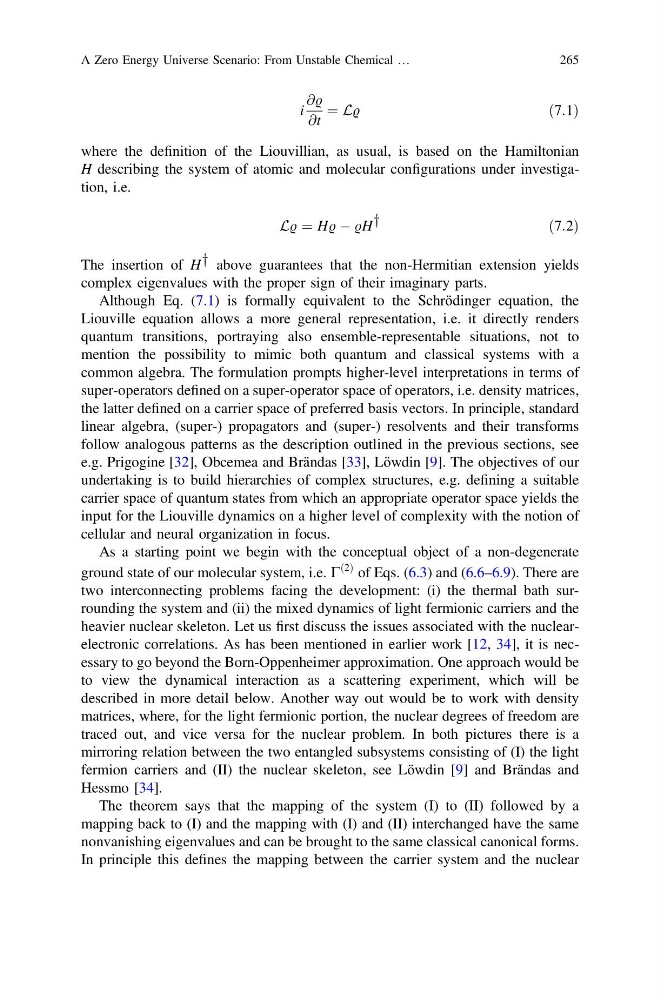
i
@.
@t
¼ L.
ð7:1Þ
where the definition of the Liouvillian, as usual, is based on the Hamiltonian
H describing the system of atomic and molecular configurations under investigation, i.e.
L. ¼ H. À .H y
ð7:2Þ
The insertion of H y above guarantees that the non-Hermitian extension yields
complex eigenvalues with the proper sign of their imaginary parts.
Although Eq. (7.1) is formally equivalent to the Schrödinger equation, the
Liouville equation allows a more general representation, i.e. it directly renders
quantum transitions, portraying also ensemble-representable situations, not to
mention the possibility to mimic both quantum and classical systems with a
common algebra. The formulation prompts higher-level interpretations in terms of
super-operators defined on a super-operator space of operators, i.e. density matrices,
the latter defined on a carrier space of preferred basis vectors. In principle, standard
linear algebra, (super-) propagators and (super-) resolvents and their transforms
follow analogous patterns as the description outlined in the previous sections, see
e.g. Prigogine [32], Obcemea and Brändas [33], Löwdin [9]. The objectives of our
undertaking is to build hierarchies of complex structures, e.g. defining a suitable
carrier space of quantum states from which an appropriate operator space yields the
input for the Liouville dynamics on a higher level of complexity with the notion of
cellular and neural organization in focus.
As a starting point we begin with the conceptual object of a non-degenerate
ground state of our molecular system, i.e. C
ð2Þ of Eqs. (6.3) and (6.6–6.9). There are
two interconnecting problems facing the development: (i) the thermal bath surrounding the system and (ii) the mixed dynamics of light fermionic carriers and the
heavier nuclear skeleton. Let us first discuss the issues associated with the nuclearelectronic correlations. As has been mentioned in earlier work [12, 34], it is necessary to go beyond the Born-Oppenheimer approximation. One approach would be
to view the dynamical interaction as a scattering experiment, which will be
described in more detail below. Another way out would be to work with density
matrices, where, for the light fermionic portion, the nuclear degrees of freedom are
traced out, and vice versa for the nuclear problem. In both pictures there is a
mirroring relation between the two entangled subsystems consisting of (I) the light
fermion carriers and (II) the nuclear skeleton, see Löwdin [9] and Brändas and
Hessmo [34].
The theorem says that the mapping of the system (I) to (II) followed by a
mapping back to (I) and the mapping with (I) and (II) interchanged have the same
nonvanishing eigenvalues and can be brought to the same classical canonical forms.
In principle this defines the mapping between the carrier system and the nuclear
A Zero Energy Universe Scenario: From Unstable Chemical …
265
@.
@t
¼ L.
ð7:1Þ
where the definition of the Liouvillian, as usual, is based on the Hamiltonian
H describing the system of atomic and molecular configurations under investigation, i.e.
L. ¼ H. À .H y
ð7:2Þ
The insertion of H y above guarantees that the non-Hermitian extension yields
complex eigenvalues with the proper sign of their imaginary parts.
Although Eq. (7.1) is formally equivalent to the Schrödinger equation, the
Liouville equation allows a more general representation, i.e. it directly renders
quantum transitions, portraying also ensemble-representable situations, not to
mention the possibility to mimic both quantum and classical systems with a
common algebra. The formulation prompts higher-level interpretations in terms of
super-operators defined on a super-operator space of operators, i.e. density matrices,
the latter defined on a carrier space of preferred basis vectors. In principle, standard
linear algebra, (super-) propagators and (super-) resolvents and their transforms
follow analogous patterns as the description outlined in the previous sections, see
e.g. Prigogine [32], Obcemea and Brändas [33], Löwdin [9]. The objectives of our
undertaking is to build hierarchies of complex structures, e.g. defining a suitable
carrier space of quantum states from which an appropriate operator space yields the
input for the Liouville dynamics on a higher level of complexity with the notion of
cellular and neural organization in focus.
As a starting point we begin with the conceptual object of a non-degenerate
ground state of our molecular system, i.e. C
ð2Þ of Eqs. (6.3) and (6.6–6.9). There are
two interconnecting problems facing the development: (i) the thermal bath surrounding the system and (ii) the mixed dynamics of light fermionic carriers and the
heavier nuclear skeleton. Let us first discuss the issues associated with the nuclearelectronic correlations. As has been mentioned in earlier work [12, 34], it is necessary to go beyond the Born-Oppenheimer approximation. One approach would be
to view the dynamical interaction as a scattering experiment, which will be
described in more detail below. Another way out would be to work with density
matrices, where, for the light fermionic portion, the nuclear degrees of freedom are
traced out, and vice versa for the nuclear problem. In both pictures there is a
mirroring relation between the two entangled subsystems consisting of (I) the light
fermion carriers and (II) the nuclear skeleton, see Löwdin [9] and Brändas and
Hessmo [34].
The theorem says that the mapping of the system (I) to (II) followed by a
mapping back to (I) and the mapping with (I) and (II) interchanged have the same
nonvanishing eigenvalues and can be brought to the same classical canonical forms.
In principle this defines the mapping between the carrier system and the nuclear
A Zero Energy Universe Scenario: From Unstable Chemical …
265