

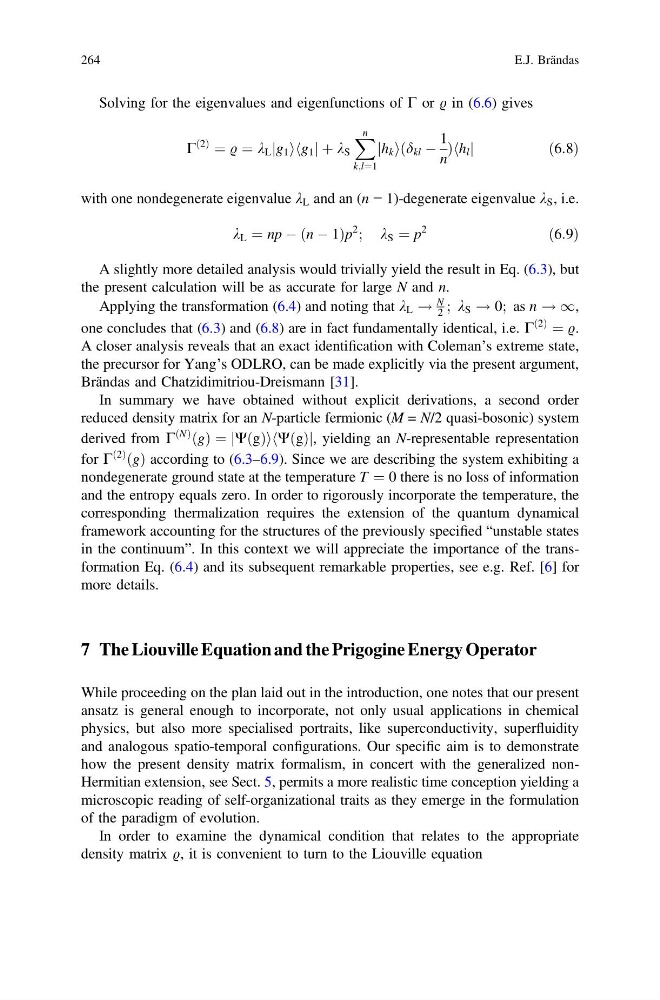
Solving for the eigenvalues and eigenfunctions of C or . in (6.6) gives
C
ð2Þ
¼ . ¼ k L g 1
j i g 1
h j þ k S
X n
k;l¼1
h k
j iðd kl À
1
n
Þ h l
h j
ð6:8Þ
with one nondegenerate eigenvalue k L and an (n − 1)-degenerate eigenvalue k S , i.e.
k L ¼ np À n À 1
ð
Þp
2
; k S ¼ p
2
ð6:9Þ
A slightly more detailed analysis would trivially yield the result in Eq. (6.3), but
the present calculation will be as accurate for large N and n.
Applying the transformation (6.4) and noting that k L !
N
2 ; k S ! 0; as n ! 1,
one concludes that (6.3) and (6.8) are in fact fundamentally identical, i.e. C
ð2Þ
¼ ..
A closer analysis reveals that an exact identification with Coleman’s extreme state,
the precursor for Yang’s ODLRO, can be made explicitly via the present argument,
Brändas and Chatzidimitriou-Dreismann [31].
In summary we have obtained without explicit derivations, a second order
reduced density matrix for an N-particle fermionic (M = N/2 quasi-bosonic) system
derived from C
ðNÞ
ðgÞ ¼ jWðgÞihWðgÞj, yielding an N-representable representation
for C
ð2Þ
ðgÞ according to (6.3–6.9). Since we are describing the system exhibiting a
nondegenerate ground state at the temperature T ¼ 0 there is no loss of information
and the entropy equals zero. In order to rigorously incorporate the temperature, the
corresponding thermalization requires the extension of the quantum dynamical
framework accounting for the structures of the previously specified “unstable states
in the continuum”. In this context we will appreciate the importance of the transformation Eq. (6.4) and its subsequent remarkable properties, see e.g. Ref. [6] for
more details.
7 The Liouville Equation and the Prigogine Energy Operator
While proceeding on the plan laid out in the introduction, one notes that our present
ansatz is general enough to incorporate, not only usual applications in chemical
physics, but also more specialised portraits, like superconductivity, superfluidity
and analogous spatio-temporal configurations. Our specific aim is to demonstrate
how the present density matrix formalism, in concert with the generalized nonHermitian extension, see Sect. 5, permits a more realistic time conception yielding a
microscopic reading of self-organizational traits as they emerge in the formulation
of the paradigm of evolution.
In order to examine the dynamical condition that relates to the appropriate
density matrix ., it is convenient to turn to the Liouville equation
264
E.J. Brändas
C
ð2Þ
¼ . ¼ k L g 1
j i g 1
h j þ k S
X n
k;l¼1
h k
j iðd kl À
1
n
Þ h l
h j
ð6:8Þ
with one nondegenerate eigenvalue k L and an (n − 1)-degenerate eigenvalue k S , i.e.
k L ¼ np À n À 1
ð
Þp
2
; k S ¼ p
2
ð6:9Þ
A slightly more detailed analysis would trivially yield the result in Eq. (6.3), but
the present calculation will be as accurate for large N and n.
Applying the transformation (6.4) and noting that k L !
N
2 ; k S ! 0; as n ! 1,
one concludes that (6.3) and (6.8) are in fact fundamentally identical, i.e. C
ð2Þ
¼ ..
A closer analysis reveals that an exact identification with Coleman’s extreme state,
the precursor for Yang’s ODLRO, can be made explicitly via the present argument,
Brändas and Chatzidimitriou-Dreismann [31].
In summary we have obtained without explicit derivations, a second order
reduced density matrix for an N-particle fermionic (M = N/2 quasi-bosonic) system
derived from C
ðNÞ
ðgÞ ¼ jWðgÞihWðgÞj, yielding an N-representable representation
for C
ð2Þ
ðgÞ according to (6.3–6.9). Since we are describing the system exhibiting a
nondegenerate ground state at the temperature T ¼ 0 there is no loss of information
and the entropy equals zero. In order to rigorously incorporate the temperature, the
corresponding thermalization requires the extension of the quantum dynamical
framework accounting for the structures of the previously specified “unstable states
in the continuum”. In this context we will appreciate the importance of the transformation Eq. (6.4) and its subsequent remarkable properties, see e.g. Ref. [6] for
more details.
7 The Liouville Equation and the Prigogine Energy Operator
While proceeding on the plan laid out in the introduction, one notes that our present
ansatz is general enough to incorporate, not only usual applications in chemical
physics, but also more specialised portraits, like superconductivity, superfluidity
and analogous spatio-temporal configurations. Our specific aim is to demonstrate
how the present density matrix formalism, in concert with the generalized nonHermitian extension, see Sect. 5, permits a more realistic time conception yielding a
microscopic reading of self-organizational traits as they emerge in the formulation
of the paradigm of evolution.
In order to examine the dynamical condition that relates to the appropriate
density matrix ., it is convenient to turn to the Liouville equation
264
E.J. Brändas