

g
j i ¼ B h
j i
B ¼
1
ffiffiffi
n
p
1
x
x
2
Á
x
nÀ1
1
x
3
x
6
Á
x
3ðnÀ1Þ
:
Á
Á
Á
Á
:
Á
Á
Á
Á
1 x
2nÀ1
x
2ð2nÀ1Þ
Á x
ðnÀ1Þð2nÀ1Þ
0
B
B
B
B
B
B
@
1
C
C
C
C
C
C
A
ð6:4Þ
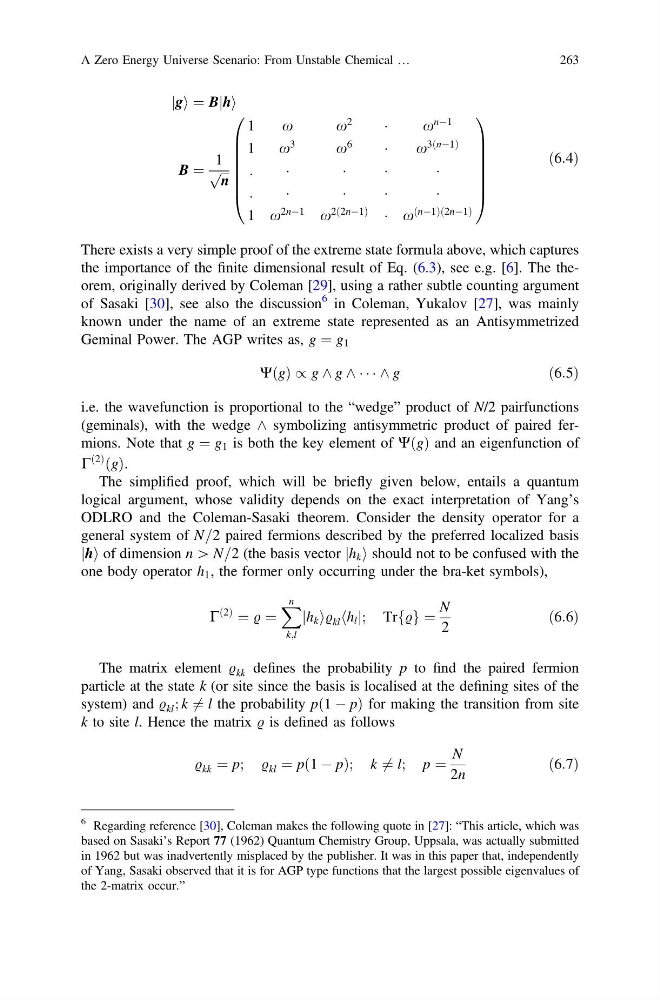
There exists a very simple proof of the extreme state formula above, which captures
the importance of the finite dimensional result of Eq. (6.3), see e.g. [6]. The theorem, originally derived by Coleman [29], using a rather subtle counting argument
of Sasaki [30], see also the discussion
6 in Coleman, Yukalov [27], was mainly
known under the name of an extreme state represented as an Antisymmetrized
Geminal Power. The AGP writes as, g ¼ g 1
WðgÞ / g ^ g ^ Á Á Á ^ g
ð6:5Þ
i.e. the wavefunction is proportional to the “wedge” product of N/2 pairfunctions
(geminals), with the wedge ^ symbolizing antisymmetric product of paired fermions. Note that g ¼ g 1 is both the key element of WðgÞ and an eigenfunction of
C
ð2Þ
ðgÞ.
The simplified proof, which will be briefly given below, entails a quantum
logical argument, whose validity depends on the exact interpretation of Yang’s
ODLRO and the Coleman-Sasaki theorem. Consider the density operator for a
general system of N=2 paired fermions described by the preferred localized basis
h
j i of dimension n [ N=2 (the basis vector h k
j i should not to be confused with the
one body operator h 1 , the former only occurring under the bra-ket symbols),
C
ð2Þ
¼ . ¼
X n
k;l
h k
j i. kl h l
h j; Tr .
f g ¼
N
2
ð6:6Þ
The matrix element . kk defines the probability p to find the paired fermion
particle at the state k (or site since the basis is localised at the defining sites of the
system) and . kl ; k 6 ¼ l the probability pð1 À pÞ for making the transition from site
k to site l. Hence the matrix . is defined as follows
. kk ¼ p; . kl ¼ p 1 À p
ð
Þ; k 6 ¼ l; p ¼
N
2n
ð6:7Þ
6 Regarding reference [30], Coleman makes the following quote in [27]: “This article, which was
based on Sasaki’s Report 77 (1962) Quantum Chemistry Group, Uppsala, was actually submitted
in 1962 but was inadvertently misplaced by the publisher. It was in this paper that, independently
of Yang, Sasaki observed that it is for AGP type functions that the largest possible eigenvalues of
the 2-matrix occur.”
A Zero Energy Universe Scenario: From Unstable Chemical …
263
j i ¼ B h
j i
B ¼
1
ffiffiffi
n
p
1
x
x
2
Á
x
nÀ1
1
x
3
x
6
Á
x
3ðnÀ1Þ
:
Á
Á
Á
Á
:
Á
Á
Á
Á
1 x
2nÀ1
x
2ð2nÀ1Þ
Á x
ðnÀ1Þð2nÀ1Þ
0
B
B
B
B
B
B
@
1
C
C
C
C
C
C
A
ð6:4Þ
There exists a very simple proof of the extreme state formula above, which captures
the importance of the finite dimensional result of Eq. (6.3), see e.g. [6]. The theorem, originally derived by Coleman [29], using a rather subtle counting argument
of Sasaki [30], see also the discussion
6 in Coleman, Yukalov [27], was mainly
known under the name of an extreme state represented as an Antisymmetrized
Geminal Power. The AGP writes as, g ¼ g 1
WðgÞ / g ^ g ^ Á Á Á ^ g
ð6:5Þ
i.e. the wavefunction is proportional to the “wedge” product of N/2 pairfunctions
(geminals), with the wedge ^ symbolizing antisymmetric product of paired fermions. Note that g ¼ g 1 is both the key element of WðgÞ and an eigenfunction of
C
ð2Þ
ðgÞ.
The simplified proof, which will be briefly given below, entails a quantum
logical argument, whose validity depends on the exact interpretation of Yang’s
ODLRO and the Coleman-Sasaki theorem. Consider the density operator for a
general system of N=2 paired fermions described by the preferred localized basis
h
j i of dimension n [ N=2 (the basis vector h k
j i should not to be confused with the
one body operator h 1 , the former only occurring under the bra-ket symbols),
C
ð2Þ
¼ . ¼
X n
k;l
h k
j i. kl h l
h j; Tr .
f g ¼
N
2
ð6:6Þ
The matrix element . kk defines the probability p to find the paired fermion
particle at the state k (or site since the basis is localised at the defining sites of the
system) and . kl ; k 6 ¼ l the probability pð1 À pÞ for making the transition from site
k to site l. Hence the matrix . is defined as follows
. kk ¼ p; . kl ¼ p 1 À p
ð
Þ; k 6 ¼ l; p ¼
N
2n
ð6:7Þ
6 Regarding reference [30], Coleman makes the following quote in [27]: “This article, which was
based on Sasaki’s Report 77 (1962) Quantum Chemistry Group, Uppsala, was actually submitted
in 1962 but was inadvertently misplaced by the publisher. It was in this paper that, independently
of Yang, Sasaki observed that it is for AGP type functions that the largest possible eigenvalues of
the 2-matrix occur.”
A Zero Energy Universe Scenario: From Unstable Chemical …
263