

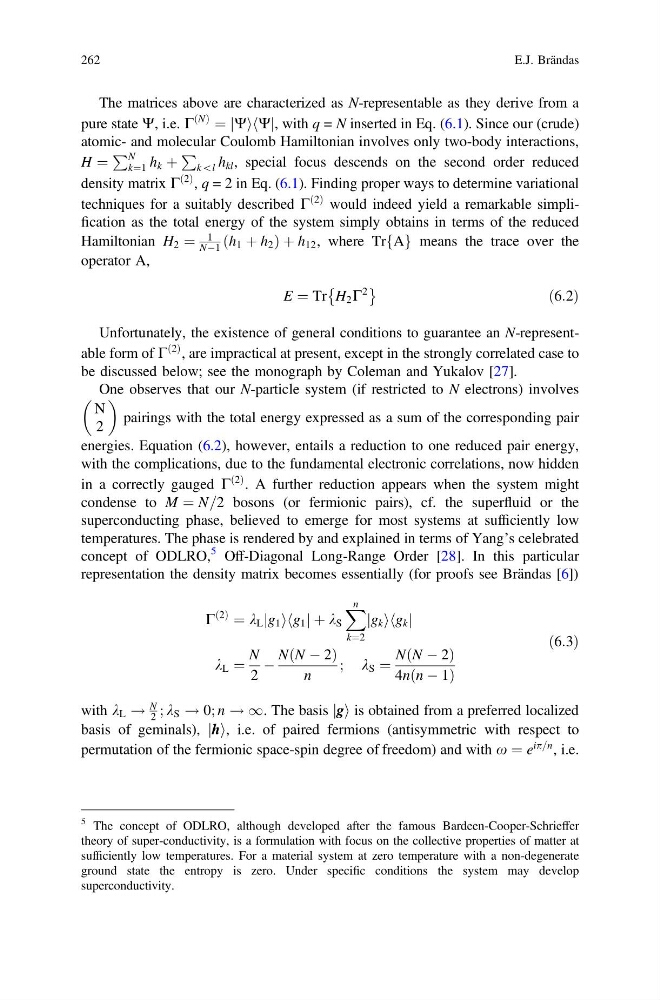
The matrices above are characterized as N-representable as they derive from a
pure state W, i.e. C
ðNÞ
¼ W
j i W
h j, with q = N inserted in Eq. (6.1). Since our (crude)
atomic- and molecular Coulomb Hamiltonian involves only two-body interactions,
H ¼
P N
k¼1 h k þ
P
k\l h kl , special focus descends on the second order reduced
density matrix C
ð2Þ , q = 2 in Eq. (6.1). Finding proper ways to determine variational
techniques for a suitably described C
ð2Þ would indeed yield a remarkable simplification as the total energy of the system simply obtains in terms of the reduced
Hamiltonian H 2 ¼
1
NÀ1 h 1 þ h 2
ð
Þþh 12 , where Tr A
f g means the trace over the
operator A,
E ¼ Tr H 2 C
2
È
É
ð6:2Þ
Unfortunately, the existence of general conditions to guarantee an N-representable form of C
ð2Þ , are impractical at present, except in the strongly correlated case to
be discussed below; see the monograph by Coleman and Yukalov [27].
One observes that our N-particle system (if restricted to N electrons) involves
N
2
pairings with the total energy expressed as a sum of the corresponding pair
energies. Equation (6.2), however, entails a reduction to one reduced pair energy,
with the complications, due to the fundamental electronic correlations, now hidden
in a correctly gauged C
ð2Þ . A further reduction appears when the system might
condense to M ¼ N=2 bosons (or fermionic pairs), cf. the superfluid or the
superconducting phase, believed to emerge for most systems at sufficiently low
temperatures. The phase is rendered by and explained in terms of Yang’s celebrated
concept of ODLRO,
5 Off-Diagonal Long-Range Order [28]. In this particular
representation the density matrix becomes essentially (for proofs see Brändas [6])
C
ð2Þ
¼ k L g 1
j i g 1
h j þ k S
X n
k¼2
g k
j i g k
h j
k L ¼
N
2
À
N N À 2
ð
Þ
n
; k S ¼
N N À 2
ð
Þ
4nðn À 1Þ
ð6:3Þ
with k L !
N
2 ; k S ! 0; n ! 1. The basis jgi is obtained from a preferred localized
basis of geminals), jhi, i.e. of paired fermions (antisymmetric with respect to
permutation of the fermionic space-spin degree of freedom) and with x ¼ e
ip=n , i.e.
5 The concept of ODLRO, although developed after the famous Bardeen-Cooper-Schrieffer
theory of super-conductivity, is a formulation with focus on the collective properties of matter at
sufficiently low temperatures. For a material system at zero temperature with a non-degenerate
ground state the entropy is zero. Under specific conditions the system may develop
superconductivity.
262
E.J. Brändas
pure state W, i.e. C
ðNÞ
¼ W
j i W
h j, with q = N inserted in Eq. (6.1). Since our (crude)
atomic- and molecular Coulomb Hamiltonian involves only two-body interactions,
H ¼
P N
k¼1 h k þ
P
k\l h kl , special focus descends on the second order reduced
density matrix C
ð2Þ , q = 2 in Eq. (6.1). Finding proper ways to determine variational
techniques for a suitably described C
ð2Þ would indeed yield a remarkable simplification as the total energy of the system simply obtains in terms of the reduced
Hamiltonian H 2 ¼
1
NÀ1 h 1 þ h 2
ð
Þþh 12 , where Tr A
f g means the trace over the
operator A,
E ¼ Tr H 2 C
2
È
É
ð6:2Þ
Unfortunately, the existence of general conditions to guarantee an N-representable form of C
ð2Þ , are impractical at present, except in the strongly correlated case to
be discussed below; see the monograph by Coleman and Yukalov [27].
One observes that our N-particle system (if restricted to N electrons) involves
N
2
pairings with the total energy expressed as a sum of the corresponding pair
energies. Equation (6.2), however, entails a reduction to one reduced pair energy,
with the complications, due to the fundamental electronic correlations, now hidden
in a correctly gauged C
ð2Þ . A further reduction appears when the system might
condense to M ¼ N=2 bosons (or fermionic pairs), cf. the superfluid or the
superconducting phase, believed to emerge for most systems at sufficiently low
temperatures. The phase is rendered by and explained in terms of Yang’s celebrated
concept of ODLRO,
5 Off-Diagonal Long-Range Order [28]. In this particular
representation the density matrix becomes essentially (for proofs see Brändas [6])
C
ð2Þ
¼ k L g 1
j i g 1
h j þ k S
X n
k¼2
g k
j i g k
h j
k L ¼
N
2
À
N N À 2
ð
Þ
n
; k S ¼
N N À 2
ð
Þ
4nðn À 1Þ
ð6:3Þ
with k L !
N
2 ; k S ! 0; n ! 1. The basis jgi is obtained from a preferred localized
basis of geminals), jhi, i.e. of paired fermions (antisymmetric with respect to
permutation of the fermionic space-spin degree of freedom) and with x ¼ e
ip=n , i.e.
5 The concept of ODLRO, although developed after the famous Bardeen-Cooper-Schrieffer
theory of super-conductivity, is a formulation with focus on the collective properties of matter at
sufficiently low temperatures. For a material system at zero temperature with a non-degenerate
ground state the entropy is zero. Under specific conditions the system may develop
superconductivity.
262
E.J. Brändas