

B ¼
true
h
j
false
h
j
true
j
i false
j
i
p
ð1 À pÞ
Àð1 À pÞ
Àp
ð4:8Þ
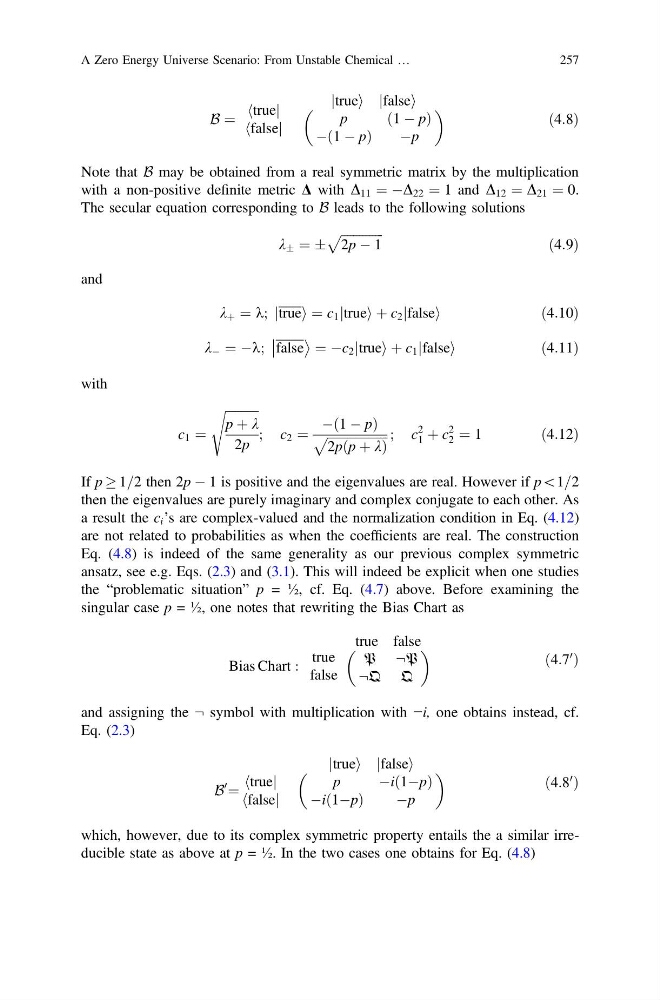
Note that B may be obtained from a real symmetric matrix by the multiplication
with a non-positive definite metric D with D 11 ¼ ÀD 22 ¼ 1 and D 12 ¼ D 21 ¼ 0.
The secular equation corresponding to B leads to the following solutions
k Æ ¼ Æ
ffiffiffiffiffiffiffiffiffiffiffiffiffi ffi
2p À 1
p
ð4:9Þ
and
k þ ¼ k; true
j
i ¼ c 1 true
j
iþ c 2 false
j
i
ð4:10Þ
k À ¼ Àk; false
¼ Àc 2 true
j
iþc 1 false
j
i
ð4:11Þ
with
c 1 ¼
ffiffiffiffiffiffiffiffiffiffiffi
p þ k
2p
s
; c 2 ¼
À 1 À p
ð
Þ
ffiffiffiffiffiffiffiffiffiffiffiffiffiffiffiffiffiffiffi ffi
2p p þ k
ð
Þ
p
; c
2
1 þ c
2
2 ¼ 1
ð4:12Þ
If p ! 1=2 then 2p À 1 is positive and the eigenvalues are real. However if p\1=2
then the eigenvalues are purely imaginary and complex conjugate to each other. As
a result the c i ’s are complex-valued and the normalization condition in Eq. (4.12)
are not related to probabilities as when the coefficients are real. The construction
Eq. (4.8) is indeed of the same generality as our previous complex symmetric
ansatz, see e.g. Eqs. (2.3) and (3.1). This will indeed be explicit when one studies
the “problematic situation” p = ½, cf. Eq. (4.7) above. Before examining the
singular case p = ½, one notes that rewriting the Bias Chart as
Bias Chart :
true
false
true false
P :P
:Q Q
ð4:7
0
Þ
and assigning the : symbol with multiplication with −i, one obtains instead, cf.
Eq. (2.3)
true
j
i false
j
i
B
0
¼
htruej
hfalsej
p
Ài 1Àp
ð
Þ
Ài 1Àp
ð
Þ
Àp
ð4:8
0
Þ
which, however, due to its complex symmetric property entails the a similar irreducible state as above at p = ½. In the two cases one obtains for Eq. (4.8)
A Zero Energy Universe Scenario: From Unstable Chemical …
257
true
h
j
false
h
j
true
j
i false
j
i
p
ð1 À pÞ
Àð1 À pÞ
Àp
ð4:8Þ
Note that B may be obtained from a real symmetric matrix by the multiplication
with a non-positive definite metric D with D 11 ¼ ÀD 22 ¼ 1 and D 12 ¼ D 21 ¼ 0.
The secular equation corresponding to B leads to the following solutions
k Æ ¼ Æ
ffiffiffiffiffiffiffiffiffiffiffiffiffi ffi
2p À 1
p
ð4:9Þ
and
k þ ¼ k; true
j
i ¼ c 1 true
j
iþ c 2 false
j
i
ð4:10Þ
k À ¼ Àk; false
¼ Àc 2 true
j
iþc 1 false
j
i
ð4:11Þ
with
c 1 ¼
ffiffiffiffiffiffiffiffiffiffiffi
p þ k
2p
s
; c 2 ¼
À 1 À p
ð
Þ
ffiffiffiffiffiffiffiffiffiffiffiffiffiffiffiffiffiffiffi ffi
2p p þ k
ð
Þ
p
; c
2
1 þ c
2
2 ¼ 1
ð4:12Þ
If p ! 1=2 then 2p À 1 is positive and the eigenvalues are real. However if p\1=2
then the eigenvalues are purely imaginary and complex conjugate to each other. As
a result the c i ’s are complex-valued and the normalization condition in Eq. (4.12)
are not related to probabilities as when the coefficients are real. The construction
Eq. (4.8) is indeed of the same generality as our previous complex symmetric
ansatz, see e.g. Eqs. (2.3) and (3.1). This will indeed be explicit when one studies
the “problematic situation” p = ½, cf. Eq. (4.7) above. Before examining the
singular case p = ½, one notes that rewriting the Bias Chart as
Bias Chart :
true
false
true false
P :P
:Q Q
ð4:7
0
Þ
and assigning the : symbol with multiplication with −i, one obtains instead, cf.
Eq. (2.3)
true
j
i false
j
i
B
0
¼
htruej
hfalsej
p
Ài 1Àp
ð
Þ
Ài 1Àp
ð
Þ
Àp
ð4:8
0
Þ
which, however, due to its complex symmetric property entails the a similar irreducible state as above at p = ½. In the two cases one obtains for Eq. (4.8)
A Zero Energy Universe Scenario: From Unstable Chemical …
257