

true
j
i false
j
i
L n ¼
htruej
hfalsej
p
ð1 À pÞ
ð1 À pÞ
p
ð4:2Þ
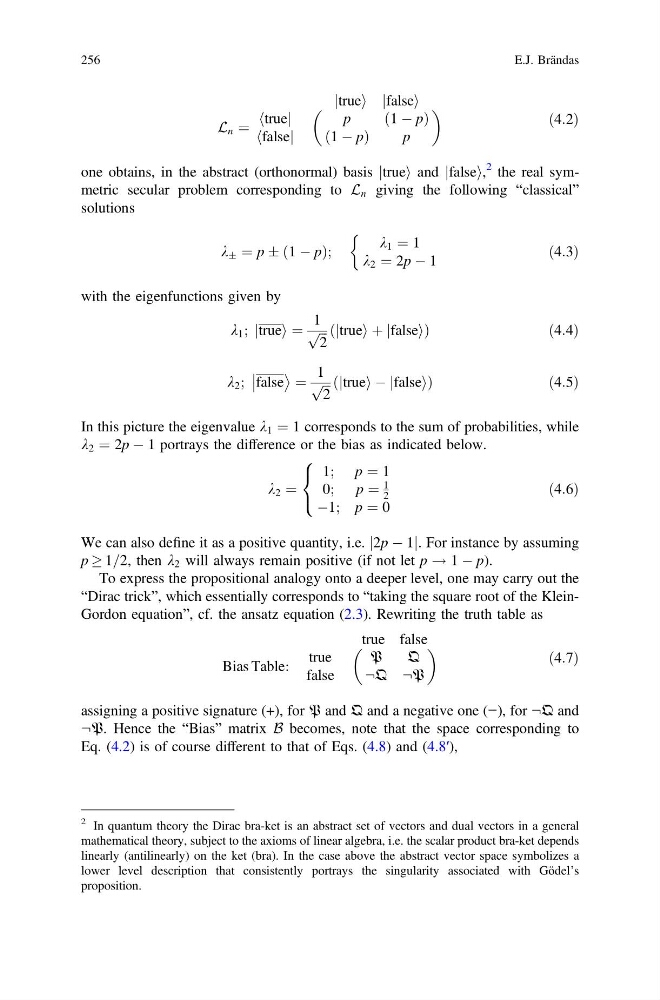
one obtains, in the abstract (orthonormal) basis true
j
i and false
j
i,
2 the real symmetric secular problem corresponding to L n giving the following “classical”
solutions
k Æ ¼ p Æ 1 À p
ð
Þ;
k 1 ¼ 1
k 2 ¼ 2p À 1
&
ð4:3Þ
with the eigenfunctions given by
k 1 ; true
j
i ¼
1
ffiffi ffi
2
p true
j
iþ false
j
i
ð
Þ
ð 4:4Þ
k 2 ; false
¼
1
ffiffi ffi
2
p true
j
iÀ false
j
i
ð
Þ
ð 4:5Þ
In this picture the eigenvalue k 1 ¼ 1 corresponds to the sum of probabilities, while
k 2 ¼ 2p À 1 portrays the difference or the bias as indicated below.
k 2 ¼
1; p ¼ 1
0; p ¼
1
2
À1; p ¼ 0
8
<
:
ð4:6Þ
We can also define it as a positive quantity, i.e. j2p À 1j. For instance by assuming
p ! 1=2, then k 2 will always remain positive (if not let p ! 1 À p).
To express the propositional analogy onto a deeper level, one may carry out the
“Dirac trick”, which essentially corresponds to “taking the square root of the KleinGordon equation”, cf. the ansatz equation (2.3). Rewriting the truth table as
true false
Bias Table:
true
false
P
Q
:Q :P
ð4:7Þ
assigning a positive signature (+), for P and Q and a negative one (−), for :Q and
:P. Hence the “Bias” matrix B becomes, note that the space corresponding to
Eq. (4.2) is of course different to that of Eqs. (4.8) and (4.8′),
2 In quantum theory the Dirac bra-ket is an abstract set of vectors and dual vectors in a general
mathematical theory, subject to the axioms of linear algebra, i.e. the scalar product bra-ket depends
linearly (antilinearly) on the ket (bra). In the case above the abstract vector space symbolizes a
lower level description that consistently portrays the singularity associated with Gödel’s
proposition.
256
E.J. Brändas
j
i false
j
i
L n ¼
htruej
hfalsej
p
ð1 À pÞ
ð1 À pÞ
p
ð4:2Þ
one obtains, in the abstract (orthonormal) basis true
j
i and false
j
i,
2 the real symmetric secular problem corresponding to L n giving the following “classical”
solutions
k Æ ¼ p Æ 1 À p
ð
Þ;
k 1 ¼ 1
k 2 ¼ 2p À 1
&
ð4:3Þ
with the eigenfunctions given by
k 1 ; true
j
i ¼
1
ffiffi ffi
2
p true
j
iþ false
j
i
ð
Þ
ð 4:4Þ
k 2 ; false
¼
1
ffiffi ffi
2
p true
j
iÀ false
j
i
ð
Þ
ð 4:5Þ
In this picture the eigenvalue k 1 ¼ 1 corresponds to the sum of probabilities, while
k 2 ¼ 2p À 1 portrays the difference or the bias as indicated below.
k 2 ¼
1; p ¼ 1
0; p ¼
1
2
À1; p ¼ 0
8
<
:
ð4:6Þ
We can also define it as a positive quantity, i.e. j2p À 1j. For instance by assuming
p ! 1=2, then k 2 will always remain positive (if not let p ! 1 À p).
To express the propositional analogy onto a deeper level, one may carry out the
“Dirac trick”, which essentially corresponds to “taking the square root of the KleinGordon equation”, cf. the ansatz equation (2.3). Rewriting the truth table as
true false
Bias Table:
true
false
P
Q
:Q :P
ð4:7Þ
assigning a positive signature (+), for P and Q and a negative one (−), for :Q and
:P. Hence the “Bias” matrix B becomes, note that the space corresponding to
Eq. (4.2) is of course different to that of Eqs. (4.8) and (4.8′),
2 In quantum theory the Dirac bra-ket is an abstract set of vectors and dual vectors in a general
mathematical theory, subject to the axioms of linear algebra, i.e. the scalar product bra-ket depends
linearly (antilinearly) on the ket (bra). In the case above the abstract vector space symbolizes a
lower level description that consistently portrays the singularity associated with Gödel’s
proposition.
256
E.J. Brändas