

block with a Segrè characteristic equal to two (the dimension of the largest block).
The purpose is (i) the insight that a living system cannot decohere or halt the
computation corresponding to the Gödel sentence and (ii) to utilize this validation
to make conclusions about the physical world we live in, extending the description
to complex enough system of biological relevance.
In the molecular dynamics of many energy surfaces, there is the famous noncrossing rule, when energy curves or surfaces veer very close to each other the
reason being the underlying complex crossings on the second Riemann sheet of the
energy plane. Current interest in these structures as well as the possibility to obtain
crossings on the first sheet, has rapidly developed into a hot topic today, as the
concept of conical intersections has become a major paradigm in non-adiabatic
chemistry, Domcke and Yarkony [14]. The philosophy may physically be a bit
different when imbedding the theory in a non-adiabatic environment, but we are
nevertheless talking about similar mathematical structures.
To belabour the analogy outlined above and setting the stage for a quantum
logical interpretation we will consider a formal system, in which the formulae
represent propositions, studying some simple ideas on propositional logics. We will
not go into technical questions like x-consistency etc., since our purpose is only to
reproduce the formal system satisfying the necessary hypothesis embodying
propositions consisting of so-called well-formed formulas (wffs). We will hence
deliberate on Gödel’s first incompleteness theorem [4], viz. there will always be
statements (wffs) in a consistent system of axioms, listed e.g. as an algorithm,
which are not provable within the system, e.g. truths about natural numbers, or
simply about arithmetic. If the theory, generated by wffs, includes statements of its
own completeness, then it becomes inconsistent; for some recent discussions on the
proof the second theorem, see Feferman [10].
In order to translate the interpretation of a truth-functional propositional calculus, i.e. assigning to each proposition one or the other of the truth values-symbol by
their usual truth-functional meanings truth or falsity (provable or non-provable in
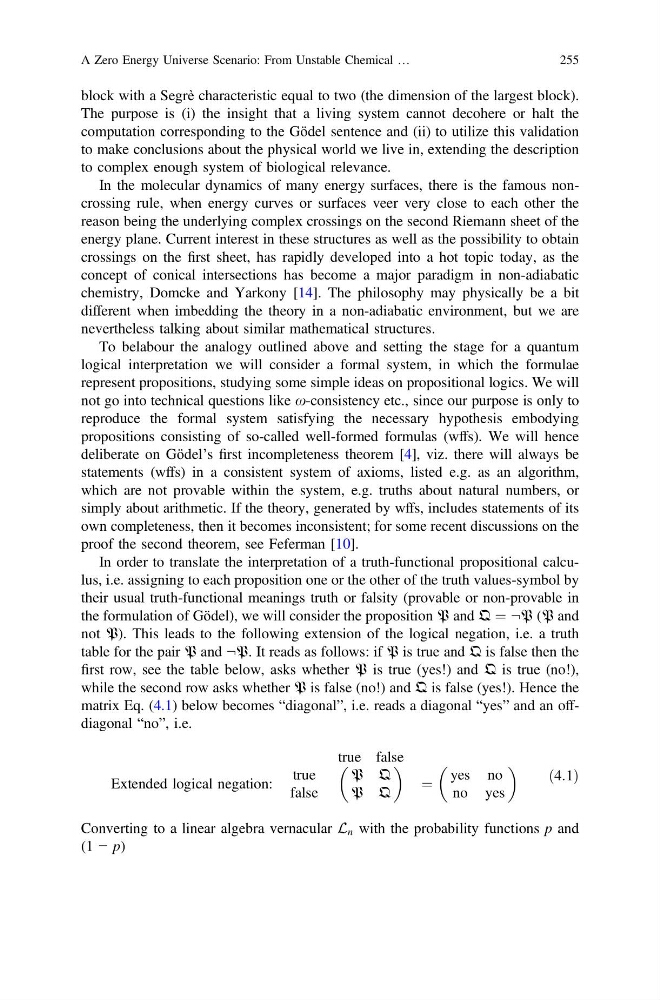
the formulation of Gödel), we will consider the proposition P and Q ¼ :P (P and
not P). This leads to the following extension of the logical negation, i.e. a truth
table for the pair P and :P. It reads as follows: if P is true and Q is false then the
first row, see the table below, asks whether P is true (yes!) and Q is true (no!),
while the second row asks whether P is false (no!) and Q is false (yes!). Hence the
matrix Eq. (4.1) below becomes “diagonal”, i.e. reads a diagonal “yes” and an offdiagonal “no”, i.e.
true false
Extended logical negation:
true
false
P Q
P Q
¼
yes no
no yes
ð4:1Þ
Converting to a linear algebra vernacular L n with the probability functions p and
(1 − p)
A Zero Energy Universe Scenario: From Unstable Chemical …
255
The purpose is (i) the insight that a living system cannot decohere or halt the
computation corresponding to the Gödel sentence and (ii) to utilize this validation
to make conclusions about the physical world we live in, extending the description
to complex enough system of biological relevance.
In the molecular dynamics of many energy surfaces, there is the famous noncrossing rule, when energy curves or surfaces veer very close to each other the
reason being the underlying complex crossings on the second Riemann sheet of the
energy plane. Current interest in these structures as well as the possibility to obtain
crossings on the first sheet, has rapidly developed into a hot topic today, as the
concept of conical intersections has become a major paradigm in non-adiabatic
chemistry, Domcke and Yarkony [14]. The philosophy may physically be a bit
different when imbedding the theory in a non-adiabatic environment, but we are
nevertheless talking about similar mathematical structures.
To belabour the analogy outlined above and setting the stage for a quantum
logical interpretation we will consider a formal system, in which the formulae
represent propositions, studying some simple ideas on propositional logics. We will
not go into technical questions like x-consistency etc., since our purpose is only to
reproduce the formal system satisfying the necessary hypothesis embodying
propositions consisting of so-called well-formed formulas (wffs). We will hence
deliberate on Gödel’s first incompleteness theorem [4], viz. there will always be
statements (wffs) in a consistent system of axioms, listed e.g. as an algorithm,
which are not provable within the system, e.g. truths about natural numbers, or
simply about arithmetic. If the theory, generated by wffs, includes statements of its
own completeness, then it becomes inconsistent; for some recent discussions on the
proof the second theorem, see Feferman [10].
In order to translate the interpretation of a truth-functional propositional calculus, i.e. assigning to each proposition one or the other of the truth values-symbol by
their usual truth-functional meanings truth or falsity (provable or non-provable in
the formulation of Gödel), we will consider the proposition P and Q ¼ :P (P and
not P). This leads to the following extension of the logical negation, i.e. a truth
table for the pair P and :P. It reads as follows: if P is true and Q is false then the
first row, see the table below, asks whether P is true (yes!) and Q is true (no!),
while the second row asks whether P is false (no!) and Q is false (yes!). Hence the
matrix Eq. (4.1) below becomes “diagonal”, i.e. reads a diagonal “yes” and an offdiagonal “no”, i.e.
true false
Extended logical negation:
true
false
P Q
P Q
¼
yes no
no yes
ð4:1Þ
Converting to a linear algebra vernacular L n with the probability functions p and
(1 − p)
A Zero Energy Universe Scenario: From Unstable Chemical …
255