

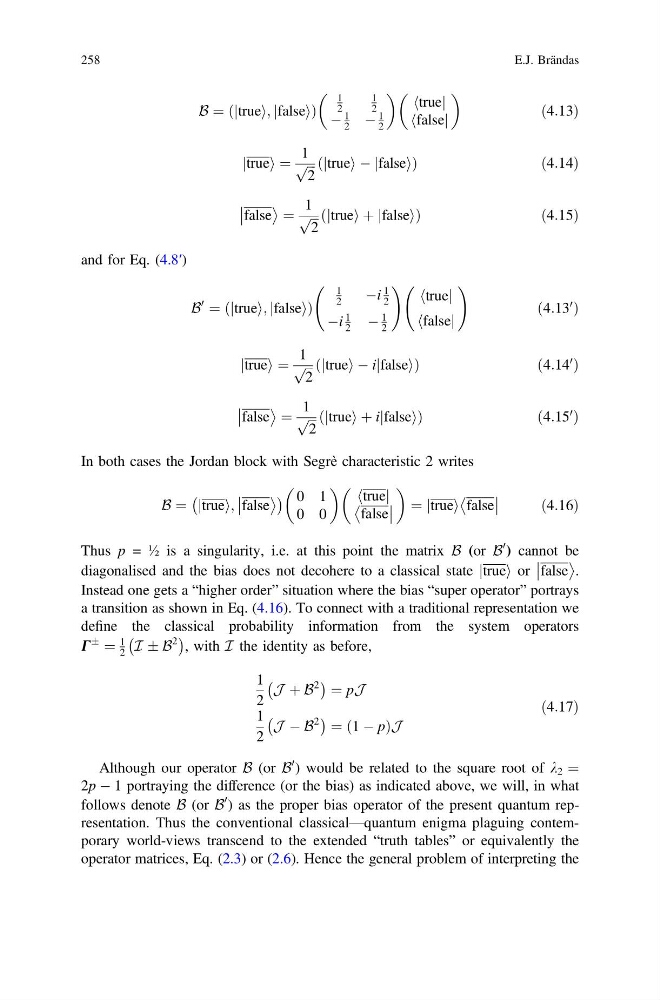
B ¼ true
j
i; false
j
i
ð
Þ
1
2
1
2
À
1
2 À
1
2
true
h
j
false
h
j
ð4:13Þ
true
j
i ¼
1
ffiffi ffi
2
p ð true
j
iÀ false
j
iÞ
ð4:14Þ
false
¼
1
ffiffi ffi
2
p ð true
j
iþ false
j
iÞ
ð4:15Þ
and for Eq. (4.8′)
B
0
¼ true
j
i; false
j
i
ð
Þ
1
2
Ài
1
2
Ài
1
2
À
1
2
! htruej
hfalsej
!
ð4:13
0
Þ
true
j
i ¼
1
ffiffi ffi
2
p ð true
j
iÀ i false
j
iÞ
ð4:14
0
Þ
false
¼
1
ffiffi ffi
2
p ð true
j
iþ i false
j
iÞ
ð4:15
0
Þ
In both cases the Jordan block with Segrè characteristic 2 writes
B ¼ true
j
i; false
À
Á 0 1
0 0
true
h
j
false
¼ true
j
i false
ð4:16Þ
Thus p = ½ is a singularity, i.e. at this point the matrix B (or B
0 ) cannot be
diagonalised and the bias does not decohere to a classical state true
j
i or false
.
Instead one gets a “higher order” situation where the bias “super operator” portrays
a transition as shown in Eq. (4.16). To connect with a traditional representation we
define the classical probability information from the system operators
C
Æ
¼
1
2 I Æ B
2
À
Á
, with I the identity as before,
1
2
J þ B
2
À
Á ¼ pJ
1
2
J À B
2
À
Á ¼ ð1 À pÞJ
ð4:17Þ
Although our operator B (or B
0 ) would be related to the square root of k 2 ¼
2p À 1 portraying the difference (or the bias) as indicated above, we will, in what
follows denote B (or B
0 ) as the proper bias operator of the present quantum representation. Thus the conventional classical—quantum enigma plaguing contemporary world-views transcend to the extended “truth tables” or equivalently the
operator matrices, Eq. (2.3) or (2.6). Hence the general problem of interpreting the
258
E.J. Brändas
j
i; false
j
i
ð
Þ
1
2
1
2
À
1
2 À
1
2
true
h
j
false
h
j
ð4:13Þ
true
j
i ¼
1
ffiffi ffi
2
p ð true
j
iÀ false
j
iÞ
ð4:14Þ
false
¼
1
ffiffi ffi
2
p ð true
j
iþ false
j
iÞ
ð4:15Þ
and for Eq. (4.8′)
B
0
¼ true
j
i; false
j
i
ð
Þ
1
2
Ài
1
2
Ài
1
2
À
1
2
! htruej
hfalsej
!
ð4:13
0
Þ
true
j
i ¼
1
ffiffi ffi
2
p ð true
j
iÀ i false
j
iÞ
ð4:14
0
Þ
false
¼
1
ffiffi ffi
2
p ð true
j
iþ i false
j
iÞ
ð4:15
0
Þ
In both cases the Jordan block with Segrè characteristic 2 writes
B ¼ true
j
i; false
À
Á 0 1
0 0
true
h
j
false
¼ true
j
i false
ð4:16Þ
Thus p = ½ is a singularity, i.e. at this point the matrix B (or B
0 ) cannot be
diagonalised and the bias does not decohere to a classical state true
j
i or false
.
Instead one gets a “higher order” situation where the bias “super operator” portrays
a transition as shown in Eq. (4.16). To connect with a traditional representation we
define the classical probability information from the system operators
C
Æ
¼
1
2 I Æ B
2
À
Á
, with I the identity as before,
1
2
J þ B
2
À
Á ¼ pJ
1
2
J À B
2
À
Á ¼ ð1 À pÞJ
ð4:17Þ
Although our operator B (or B
0 ) would be related to the square root of k 2 ¼
2p À 1 portraying the difference (or the bias) as indicated above, we will, in what
follows denote B (or B
0 ) as the proper bias operator of the present quantum representation. Thus the conventional classical—quantum enigma plaguing contemporary world-views transcend to the extended “truth tables” or equivalently the
operator matrices, Eq. (2.3) or (2.6). Hence the general problem of interpreting the
258
E.J. Brändas