

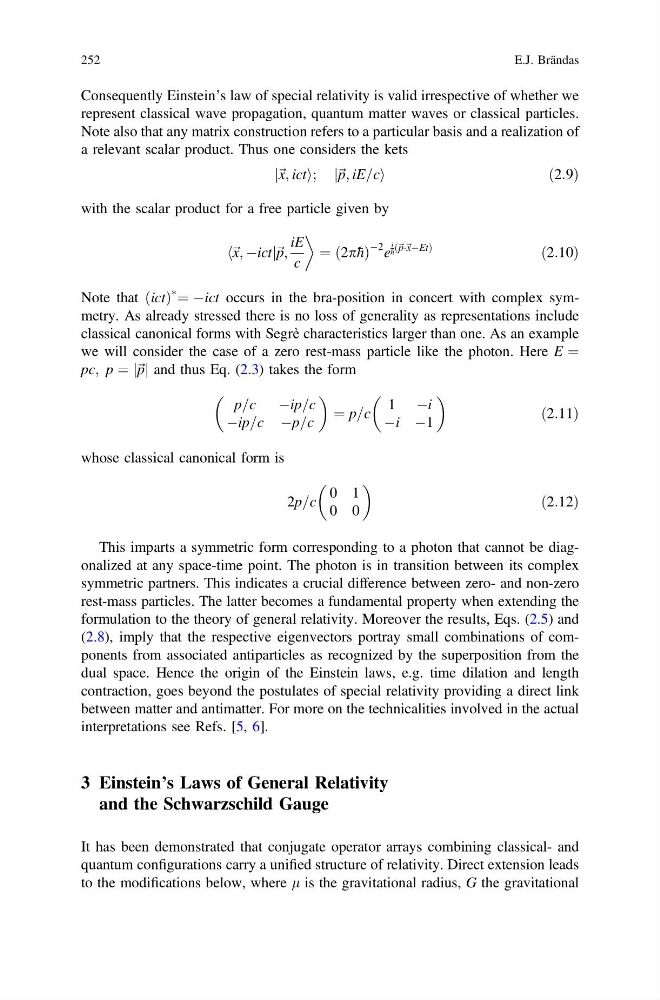
Consequently Einstein’s law of special relativity is valid irrespective of whether we
represent classical wave propagation, quantum matter waves or classical particles.
Note also that any matrix construction refers to a particular basis and a realization of
a relevant scalar product. Thus one considers the kets
~ x; ict
j
i; ~ p; iE=c
j
i
ð2:9Þ
with the scalar product for a free particle given by
h~ x; Àictj~ p;
iE
c
)
¼ 2p h
ð
Þ
À2 e
i
h ~ pÁ~ xÀEt
ð
Þ
ð2:10Þ
Note that ict
ð Þ
à ¼ Àict occurs in the bra-position in concert with complex symmetry. As already stressed there is no loss of generality as representations include
classical canonical forms with Segrè characteristics larger than one. As an example
we will consider the case of a zero rest-mass particle like the photon. Here E ¼
pc; p ¼ j~ pj and thus Eq. (2.3) takes the form
p=c
Àip=c
Àip=c Àp=c
¼ p=c
1 Ài
Ài À1
ð2:11Þ
whose classical canonical form is
2p=c
0 1
0 0
ð2:12Þ
This imparts a symmetric form corresponding to a photon that cannot be diagonalized at any space-time point. The photon is in transition between its complex
symmetric partners. This indicates a crucial difference between zero- and non-zero
rest-mass particles. The latter becomes a fundamental property when extending the
formulation to the theory of general relativity. Moreover the results, Eqs. (2.5) and
(2.8), imply that the respective eigenvectors portray small combinations of components from associated antiparticles as recognized by the superposition from the
dual space. Hence the origin of the Einstein laws, e.g. time dilation and length
contraction, goes beyond the postulates of special relativity providing a direct link
between matter and antimatter. For more on the technicalities involved in the actual
interpretations see Refs. [5, 6].
3 Einstein’s Laws of General Relativity
and the Schwarzschild Gauge
It has been demonstrated that conjugate operator arrays combining classical- and
quantum configurations carry a unified structure of relativity. Direct extension leads
to the modifications below, where l is the gravitational radius, G the gravitational
252
E.J. Brändas
represent classical wave propagation, quantum matter waves or classical particles.
Note also that any matrix construction refers to a particular basis and a realization of
a relevant scalar product. Thus one considers the kets
~ x; ict
j
i; ~ p; iE=c
j
i
ð2:9Þ
with the scalar product for a free particle given by
h~ x; Àictj~ p;
iE
c
)
¼ 2p h
ð
Þ
À2 e
i
h ~ pÁ~ xÀEt
ð
Þ
ð2:10Þ
Note that ict
ð Þ
à ¼ Àict occurs in the bra-position in concert with complex symmetry. As already stressed there is no loss of generality as representations include
classical canonical forms with Segrè characteristics larger than one. As an example
we will consider the case of a zero rest-mass particle like the photon. Here E ¼
pc; p ¼ j~ pj and thus Eq. (2.3) takes the form
p=c
Àip=c
Àip=c Àp=c
¼ p=c
1 Ài
Ài À1
ð2:11Þ
whose classical canonical form is
2p=c
0 1
0 0
ð2:12Þ
This imparts a symmetric form corresponding to a photon that cannot be diagonalized at any space-time point. The photon is in transition between its complex
symmetric partners. This indicates a crucial difference between zero- and non-zero
rest-mass particles. The latter becomes a fundamental property when extending the
formulation to the theory of general relativity. Moreover the results, Eqs. (2.5) and
(2.8), imply that the respective eigenvectors portray small combinations of components from associated antiparticles as recognized by the superposition from the
dual space. Hence the origin of the Einstein laws, e.g. time dilation and length
contraction, goes beyond the postulates of special relativity providing a direct link
between matter and antimatter. For more on the technicalities involved in the actual
interpretations see Refs. [5, 6].
3 Einstein’s Laws of General Relativity
and the Schwarzschild Gauge
It has been demonstrated that conjugate operator arrays combining classical- and
quantum configurations carry a unified structure of relativity. Direct extension leads
to the modifications below, where l is the gravitational radius, G the gravitational
252
E.J. Brändas