

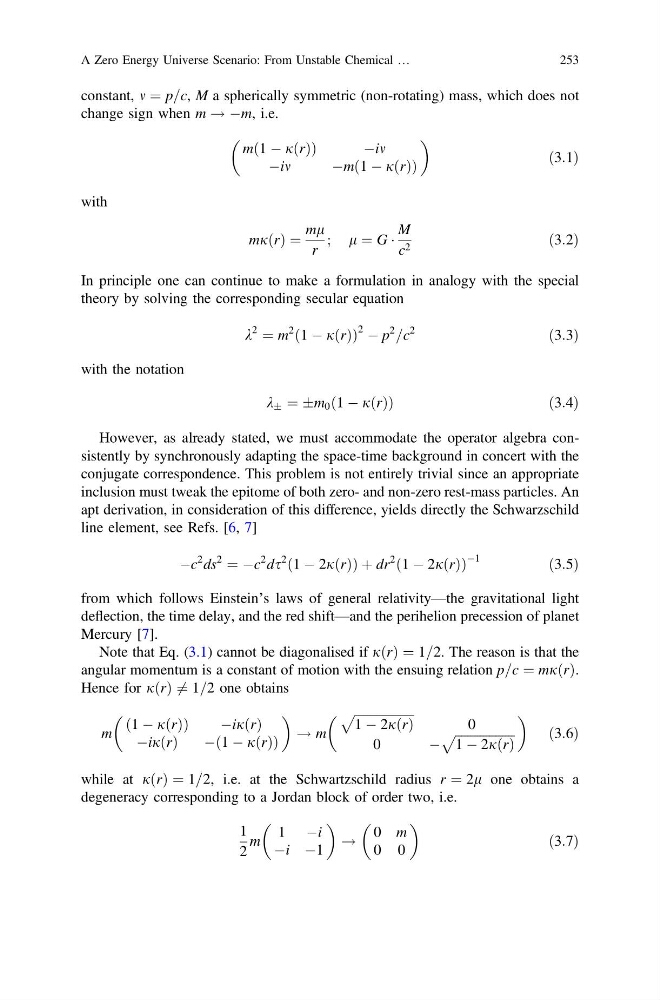
constant, m ¼ p=c, M a spherically symmetric (non-rotating) mass, which does not
change sign when m ! Àm, i.e.
m 1 À j r
ð Þ
ð
Þ
À im
Àim
Àm 1 À j r
ð Þ
ð
Þ
ð3:1Þ
with
mj r
ð Þ ¼
ml
r
; l ¼ G Á
M
c 2
ð3:2Þ
In principle one can continue to make a formulation in analogy with the special
theory by solving the corresponding secular equation
k
2
¼ m
2
ð1 À jðrÞÞ
2 À p
2
=c
2
ð3:3Þ
with the notation
k Æ ¼ Æm 0 ð1 À jðrÞÞ
ð3:4Þ
However, as already stated, we must accommodate the operator algebra consistently by synchronously adapting the space-time background in concert with the
conjugate correspondence. This problem is not entirely trivial since an appropriate
inclusion must tweak the epitome of both zero- and non-zero rest-mass particles. An
apt derivation, in consideration of this difference, yields directly the Schwarzschild
line element, see Refs. [6, 7]
Àc
2 ds
2
¼ Àc
2 ds
2
ð1 À 2jðrÞÞ þ dr
2
ð1 À 2jðrÞÞ
À1
ð3:5Þ
from which follows Einstein’s laws of general relativity—the gravitational light
deflection, the time delay, and the red shift—and the perihelion precession of planet
Mercury [7].
Note that Eq. (3.1) cannot be diagonalised if j r
ð Þ ¼ 1=2. The reason is that the
angular momentum is a constant of motion with the ensuing relation p=c ¼ mj r
ð Þ.
Hence for j r
ð Þ 6 ¼ 1=2 one obtains
m
1 À j r
ð Þ
ð
Þ
À ij r
ð Þ
Àij r
ð Þ
À 1 À j r
ð Þ
ð
Þ
! m
ffiffiffiffiffiffiffiffiffiffiffiffiffiffiffiffiffiffiffi
1 À 2j r
ð Þ
p
0
0
À
ffiffiffiffiffiffiffiffiffiffiffiffiffiffiffiffiffiffiffi
1 À 2j r
ð Þ
p
ð3:6Þ
while at j r
ð Þ ¼ 1=2, i.e. at the Schwartzschild radius r ¼ 2l one obtains a
degeneracy corresponding to a Jordan block of order two, i.e.
1
2
m
1 Ài
Ài À1
!
0 m
0 0
ð3:7Þ
A Zero Energy Universe Scenario: From Unstable Chemical …
253
change sign when m ! Àm, i.e.
m 1 À j r
ð Þ
ð
Þ
À im
Àim
Àm 1 À j r
ð Þ
ð
Þ
ð3:1Þ
with
mj r
ð Þ ¼
ml
r
; l ¼ G Á
M
c 2
ð3:2Þ
In principle one can continue to make a formulation in analogy with the special
theory by solving the corresponding secular equation
k
2
¼ m
2
ð1 À jðrÞÞ
2 À p
2
=c
2
ð3:3Þ
with the notation
k Æ ¼ Æm 0 ð1 À jðrÞÞ
ð3:4Þ
However, as already stated, we must accommodate the operator algebra consistently by synchronously adapting the space-time background in concert with the
conjugate correspondence. This problem is not entirely trivial since an appropriate
inclusion must tweak the epitome of both zero- and non-zero rest-mass particles. An
apt derivation, in consideration of this difference, yields directly the Schwarzschild
line element, see Refs. [6, 7]
Àc
2 ds
2
¼ Àc
2 ds
2
ð1 À 2jðrÞÞ þ dr
2
ð1 À 2jðrÞÞ
À1
ð3:5Þ
from which follows Einstein’s laws of general relativity—the gravitational light
deflection, the time delay, and the red shift—and the perihelion precession of planet
Mercury [7].
Note that Eq. (3.1) cannot be diagonalised if j r
ð Þ ¼ 1=2. The reason is that the
angular momentum is a constant of motion with the ensuing relation p=c ¼ mj r
ð Þ.
Hence for j r
ð Þ 6 ¼ 1=2 one obtains
m
1 À j r
ð Þ
ð
Þ
À ij r
ð Þ
Àij r
ð Þ
À 1 À j r
ð Þ
ð
Þ
! m
ffiffiffiffiffiffiffiffiffiffiffiffiffiffiffiffiffiffiffi
1 À 2j r
ð Þ
p
0
0
À
ffiffiffiffiffiffiffiffiffiffiffiffiffiffiffiffiffiffiffi
1 À 2j r
ð Þ
p
ð3:6Þ
while at j r
ð Þ ¼ 1=2, i.e. at the Schwartzschild radius r ¼ 2l one obtains a
degeneracy corresponding to a Jordan block of order two, i.e.
1
2
m
1 Ài
Ài À1
!
0 m
0 0
ð3:7Þ
A Zero Energy Universe Scenario: From Unstable Chemical …
253