

can currently detect modulated length changes in the range of 10
−18 m. Since
L p % 10
À35 m we would have to have n % 10
34 photons in the maximum confinement cavity to achieve a 10
−18 m effect (
ffiffiffiffiffiffiffiffi ffi
10 34
p
 10
À35 m % 10
À18 m). If we
assume a microwave cavity tuned for
k ¼ 0:1 m (x ¼ 3 Â 10
9 s
À1 ) the energy of
confined microwave photons would have to be about 3 × 10
9 J. This experiment is
beyond current technology.
However, all is not lost. Suppose that we imagine a thought experiment where it
is possible to increase the number of the confined photons to any desired level. The
spacetime based model of photons predicts that EM radiation should have a
maximum intensity limit for a maximum confinement experiment where spacetime
is simply not able to transmit a higher intensity. This would occur if the intensity
reached the condition which demanded that the spatial displacement of spacetime
(ΔL) equaled the reduced wavelength
k of the EM radiation causing the effect. In
the case of microwave radiation with a reduced wavelength of 0.1 m, this would
occur when DL ¼
k ¼ 0:1 m. This is demanding 100 % modulation of the spacetime volume in the maximum confinement resonant cavity (ignoring numerical
factors near 1).
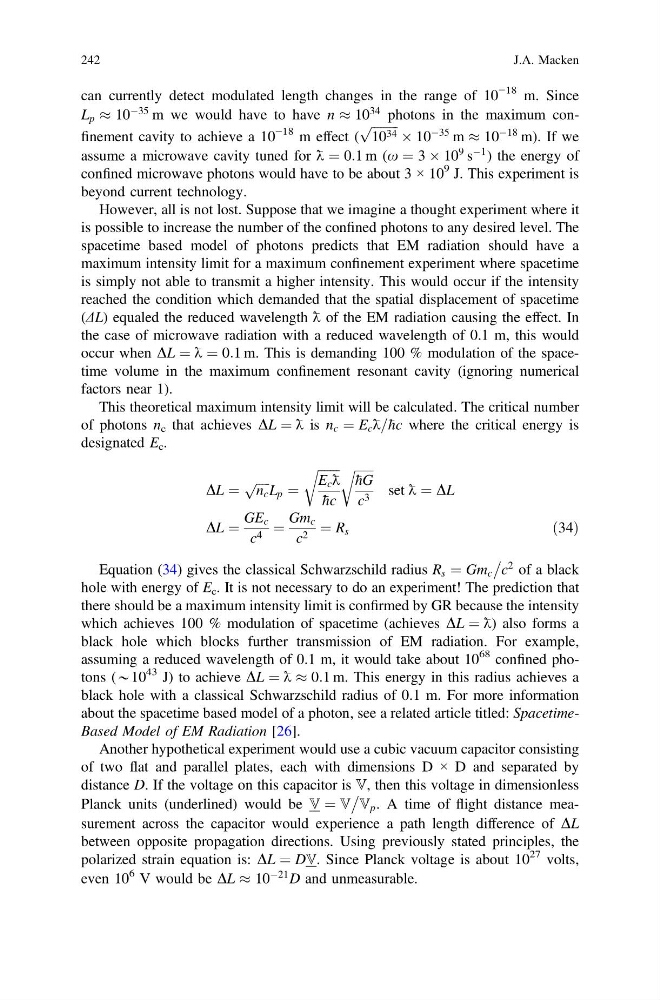
This theoretical maximum intensity limit will be calculated. The critical number
of photons n c that achieves DL ¼
k is n c ¼ E c
k= hc where the critical energy is
designated E c .
DL ¼
ffiffiffiffi ffi
n c
p
L p ¼
ffiffiffiffiffiffiffi
E c
k
hc
r
ffiffiffiffiffiffi
hG
c 3
r
set
k ¼ DL
DL ¼
GE c
c 4 ¼
Gm c
c 2 ¼ R s
ð34Þ
Equation (34) gives the classical Schwarzschild radius R s ¼ Gm c
c
2 of a black
hole with energy of E c . It is not necessary to do an experiment! The prediction that
there should be a maximum intensity limit is confirmed by GR because the intensity
which achieves 100 % modulation of spacetime (achieves DL ¼
k) also forms a
black hole which blocks further transmission of EM radiation. For example,
assuming a reduced wavelength of 0.1 m, it would take about 10
68 confined photons (*10
43 J) to achieve DL ¼
k % 0:1 m. This energy in this radius achieves a
black hole with a classical Schwarzschild radius of 0.1 m. For more information
about the spacetime based model of a photon, see a related article titled: SpacetimeBased Model of EM Radiation [26].
Another hypothetical experiment would use a cubic vacuum capacitor consisting
of two flat and parallel plates, each with dimensions D × D and separated by
distance D. If the voltage on this capacitor is V, then this voltage in dimensionless
Planck units (underlined) would be V ¼ V
V p . A time of flight distance measurement across the capacitor would experience a path length difference of DL
between opposite propagation directions. Using previously stated principles, the
polarized strain equation is: DL ¼ DV. Since Planck voltage is about 10
27 volts,
even 10
6 V would be DL % 10
À21 D and unmeasurable.
242
J.A. Macken
−18 m. Since
L p % 10
À35 m we would have to have n % 10
34 photons in the maximum confinement cavity to achieve a 10
−18 m effect (
ffiffiffiffiffiffiffiffi ffi
10 34
p
 10
À35 m % 10
À18 m). If we
assume a microwave cavity tuned for
k ¼ 0:1 m (x ¼ 3 Â 10
9 s
À1 ) the energy of
confined microwave photons would have to be about 3 × 10
9 J. This experiment is
beyond current technology.
However, all is not lost. Suppose that we imagine a thought experiment where it
is possible to increase the number of the confined photons to any desired level. The
spacetime based model of photons predicts that EM radiation should have a
maximum intensity limit for a maximum confinement experiment where spacetime
is simply not able to transmit a higher intensity. This would occur if the intensity
reached the condition which demanded that the spatial displacement of spacetime
(ΔL) equaled the reduced wavelength
k of the EM radiation causing the effect. In
the case of microwave radiation with a reduced wavelength of 0.1 m, this would
occur when DL ¼
k ¼ 0:1 m. This is demanding 100 % modulation of the spacetime volume in the maximum confinement resonant cavity (ignoring numerical
factors near 1).
This theoretical maximum intensity limit will be calculated. The critical number
of photons n c that achieves DL ¼
k is n c ¼ E c
k= hc where the critical energy is
designated E c .
DL ¼
ffiffiffiffi ffi
n c
p
L p ¼
ffiffiffiffiffiffiffi
E c
k
hc
r
ffiffiffiffiffiffi
hG
c 3
r
set
k ¼ DL
DL ¼
GE c
c 4 ¼
Gm c
c 2 ¼ R s
ð34Þ
Equation (34) gives the classical Schwarzschild radius R s ¼ Gm c
c
2 of a black
hole with energy of E c . It is not necessary to do an experiment! The prediction that
there should be a maximum intensity limit is confirmed by GR because the intensity
which achieves 100 % modulation of spacetime (achieves DL ¼
k) also forms a
black hole which blocks further transmission of EM radiation. For example,
assuming a reduced wavelength of 0.1 m, it would take about 10
68 confined photons (*10
43 J) to achieve DL ¼
k % 0:1 m. This energy in this radius achieves a
black hole with a classical Schwarzschild radius of 0.1 m. For more information
about the spacetime based model of a photon, see a related article titled: SpacetimeBased Model of EM Radiation [26].
Another hypothetical experiment would use a cubic vacuum capacitor consisting
of two flat and parallel plates, each with dimensions D × D and separated by
distance D. If the voltage on this capacitor is V, then this voltage in dimensionless
Planck units (underlined) would be V ¼ V
V p . A time of flight distance measurement across the capacitor would experience a path length difference of DL
between opposite propagation directions. Using previously stated principles, the
polarized strain equation is: DL ¼ DV. Since Planck voltage is about 10
27 volts,
even 10
6 V would be DL % 10
À21 D and unmeasurable.
242
J.A. Macken