

Michelson-Morley experiment using gravitational waves rather than light. Gravitational waves are undeniably propagating in the medium of spacetime and experience
impedance of c
3 /G. However, gravitational waves are always propagating at the
speed of light, from all frames of reference. A Michelson-Morley experiment using
gravitational waves would be unable to detect motion relative to the spacetime field.
Similarly, if photons are a quantized wave propagating in the spacetime field, they
also would be observed to always propagate at the speed of light. The explanation of
this paradox is that particles, fields and forces are also spacetime and compensate
(Lorentz transformations) to keep the locally measured speed of light constant.
Next we will attempt to quantify the magnitude of the distortion of spacetime
produced by photons to see if it is experimentally measurable. To simplify the
calculation and maximize the effect, we will imagine confining photons in the
smallest possible volume for a given wavelength. Circularly polarized photons can
exist in a cylindrical waveguide that is slightly larger than 1/2 wavelength in
diameter and further confined by two flat mirrors perpendicular to the cylindrical
axis and separated by 1/2 wavelength. This forms the smallest possible vacuum
resonant cavity which we will call “maximum confinement”. The maximum
oscillating electric field strength is at the center of the cavity and the electric field is
zero at all the surfaces. Even though the cavity is 1/2 λ long and 1/2 λ in diameter
with nonuniform electric and magnetic fields, a dimensional analysis plausibility
calculation can make the simplifying assumption that the excitation (stressed
spacetime) is uniform over a volume of
k
3 , and zero everywhere else. The energy of
n photons is E ¼ n hx and the energy density in
k
3 is U ¼ n hx
k
3
¼ n hx
4
c
3 .
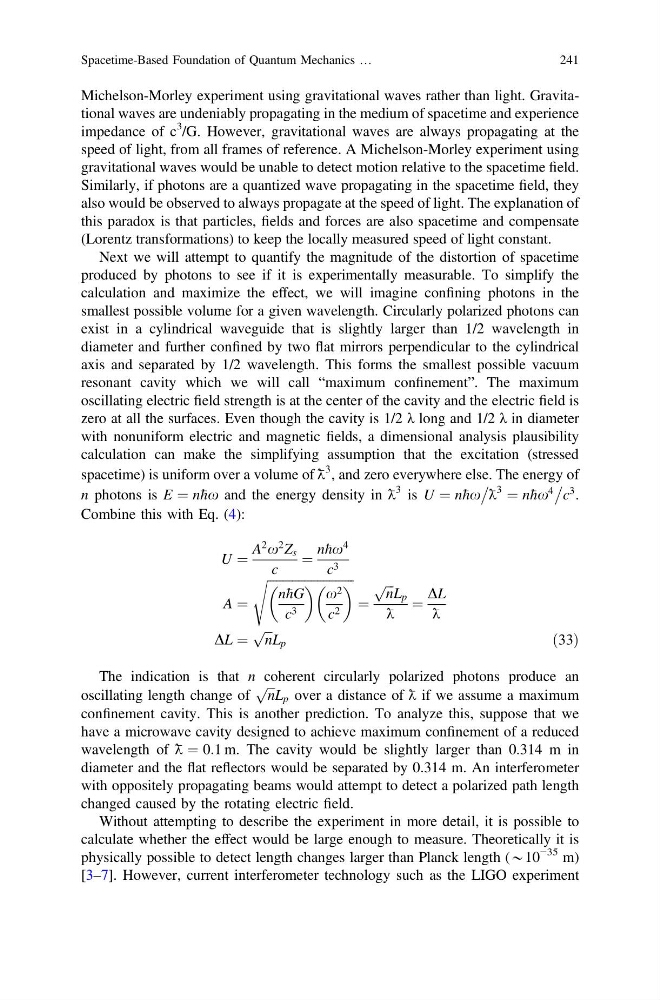
Combine this with Eq. (4):
U ¼
A
2
x
2 Z s
c
¼
n hx
4
c 3
A ¼
ffiffiffiffiffiffiffiffiffiffiffiffiffiffiffiffiffiffiffiffiffiffiffiffiffiffiffiffi
n hG
c 3
x 2
c 2
s
¼
ffiffi ffi
n
p
L p
k
¼
DL
k
DL ¼
ffiffi ffi
n
p
L p
ð33Þ
The indication is that n coherent circularly polarized photons produce an
oscillating length change of
ffiffi ffi
n
p
L p over a distance of
k if we assume a maximum
confinement cavity. This is another prediction. To analyze this, suppose that we
have a microwave cavity designed to achieve maximum confinement of a reduced
wavelength of
k ¼ 0:1 m. The cavity would be slightly larger than 0.314 m in
diameter and the flat reflectors would be separated by 0.314 m. An interferometer
with oppositely propagating beams would attempt to detect a polarized path length
changed caused by the rotating electric field.
Without attempting to describe the experiment in more detail, it is possible to
calculate whether the effect would be large enough to measure. Theoretically it is
physically possible to detect length changes larger than Planck length (*10
−35 m)
[3–7]. However, current interferometer technology such as the LIGO experiment
Spacetime-Based Foundation of Quantum Mechanics …
241
impedance of c
3 /G. However, gravitational waves are always propagating at the
speed of light, from all frames of reference. A Michelson-Morley experiment using
gravitational waves would be unable to detect motion relative to the spacetime field.
Similarly, if photons are a quantized wave propagating in the spacetime field, they
also would be observed to always propagate at the speed of light. The explanation of
this paradox is that particles, fields and forces are also spacetime and compensate
(Lorentz transformations) to keep the locally measured speed of light constant.
Next we will attempt to quantify the magnitude of the distortion of spacetime
produced by photons to see if it is experimentally measurable. To simplify the
calculation and maximize the effect, we will imagine confining photons in the
smallest possible volume for a given wavelength. Circularly polarized photons can
exist in a cylindrical waveguide that is slightly larger than 1/2 wavelength in
diameter and further confined by two flat mirrors perpendicular to the cylindrical
axis and separated by 1/2 wavelength. This forms the smallest possible vacuum
resonant cavity which we will call “maximum confinement”. The maximum
oscillating electric field strength is at the center of the cavity and the electric field is
zero at all the surfaces. Even though the cavity is 1/2 λ long and 1/2 λ in diameter
with nonuniform electric and magnetic fields, a dimensional analysis plausibility
calculation can make the simplifying assumption that the excitation (stressed
spacetime) is uniform over a volume of
k
3 , and zero everywhere else. The energy of
n photons is E ¼ n hx and the energy density in
k
3 is U ¼ n hx
k
3
¼ n hx
4
c
3 .
Combine this with Eq. (4):
U ¼
A
2
x
2 Z s
c
¼
n hx
4
c 3
A ¼
ffiffiffiffiffiffiffiffiffiffiffiffiffiffiffiffiffiffiffiffiffiffiffiffiffiffiffiffi
n hG
c 3
x 2
c 2
s
¼
ffiffi ffi
n
p
L p
k
¼
DL
k
DL ¼
ffiffi ffi
n
p
L p
ð33Þ
The indication is that n coherent circularly polarized photons produce an
oscillating length change of
ffiffi ffi
n
p
L p over a distance of
k if we assume a maximum
confinement cavity. This is another prediction. To analyze this, suppose that we
have a microwave cavity designed to achieve maximum confinement of a reduced
wavelength of
k ¼ 0:1 m. The cavity would be slightly larger than 0.314 m in
diameter and the flat reflectors would be separated by 0.314 m. An interferometer
with oppositely propagating beams would attempt to detect a polarized path length
changed caused by the rotating electric field.
Without attempting to describe the experiment in more detail, it is possible to
calculate whether the effect would be large enough to measure. Theoretically it is
physically possible to detect length changes larger than Planck length (*10
−35 m)
[3–7]. However, current interferometer technology such as the LIGO experiment
Spacetime-Based Foundation of Quantum Mechanics …
241