

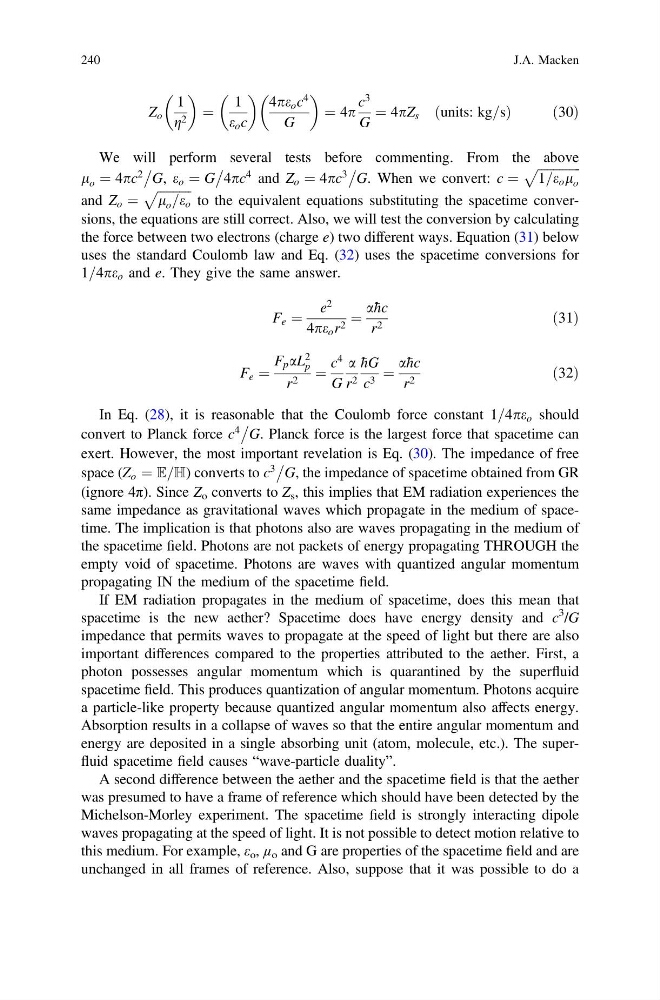
Z o
1
g 2
¼
1
e o c
4pe o c
4
G
¼ 4p
c
3
G
¼ 4pZ s units: kg=s
ð
Þ
ð 30Þ
We will perform several tests before commenting. From the above
l o ¼ 4pc
2
G, e o ¼ G
4pc
4 and Z o ¼ 4pc
3
G. When we convert: c ¼
ffiffiffiffiffiffiffiffiffiffiffiffiffi ffi
1=e o l o
p
and Z o ¼
ffiffiffiffiffiffiffiffiffiffiffi
l o =e o
p
to the equivalent equations substituting the spacetime conversions, the equations are still correct. Also, we will test the conversion by calculating
the force between two electrons (charge e) two different ways. Equation (31) below
uses the standard Coulomb law and Eq. (32) uses the spacetime conversions for
1=4pe o and e. They give the same answer.
F e ¼
e
2
4pe o r 2 ¼
a hc
r 2
ð31Þ
F e ¼
F p aL
2
p
r 2 ¼
c
4
G
a
r 2
hG
c 3 ¼
a hc
r 2
ð32Þ
In Eq. (28), it is reasonable that the Coulomb force constant 1=4pe o should
convert to Planck force c
4
G. Planck force is the largest force that spacetime can
exert. However, the most important revelation is Eq. (30). The impedance of free
space (Z o ¼ E=H) converts to c
3
G, the impedance of spacetime obtained from GR
(ignore 4π). Since Z o converts to Z s , this implies that EM radiation experiences the
same impedance as gravitational waves which propagate in the medium of spacetime. The implication is that photons also are waves propagating in the medium of
the spacetime field. Photons are not packets of energy propagating THROUGH the
empty void of spacetime. Photons are waves with quantized angular momentum
propagating IN the medium of the spacetime field.
If EM radiation propagates in the medium of spacetime, does this mean that
spacetime is the new aether? Spacetime does have energy density and c
3 /G
impedance that permits waves to propagate at the speed of light but there are also
important differences compared to the properties attributed to the aether. First, a
photon possesses angular momentum which is quarantined by the superfluid
spacetime field. This produces quantization of angular momentum. Photons acquire
a particle-like property because quantized angular momentum also affects energy.
Absorption results in a collapse of waves so that the entire angular momentum and
energy are deposited in a single absorbing unit (atom, molecule, etc.). The superfluid spacetime field causes “wave-particle duality”.
A second difference between the aether and the spacetime field is that the aether
was presumed to have a frame of reference which should have been detected by the
Michelson-Morley experiment. The spacetime field is strongly interacting dipole
waves propagating at the speed of light. It is not possible to detect motion relative to
this medium. For example, ε o , µ o and G are properties of the spacetime field and are
unchanged in all frames of reference. Also, suppose that it was possible to do a
240
J.A. Macken
1
g 2
¼
1
e o c
4pe o c
4
G
¼ 4p
c
3
G
¼ 4pZ s units: kg=s
ð
Þ
ð 30Þ
We will perform several tests before commenting. From the above
l o ¼ 4pc
2
G, e o ¼ G
4pc
4 and Z o ¼ 4pc
3
G. When we convert: c ¼
ffiffiffiffiffiffiffiffiffiffiffiffiffi ffi
1=e o l o
p
and Z o ¼
ffiffiffiffiffiffiffiffiffiffiffi
l o =e o
p
to the equivalent equations substituting the spacetime conversions, the equations are still correct. Also, we will test the conversion by calculating
the force between two electrons (charge e) two different ways. Equation (31) below
uses the standard Coulomb law and Eq. (32) uses the spacetime conversions for
1=4pe o and e. They give the same answer.
F e ¼
e
2
4pe o r 2 ¼
a hc
r 2
ð31Þ
F e ¼
F p aL
2
p
r 2 ¼
c
4
G
a
r 2
hG
c 3 ¼
a hc
r 2
ð32Þ
In Eq. (28), it is reasonable that the Coulomb force constant 1=4pe o should
convert to Planck force c
4
G. Planck force is the largest force that spacetime can
exert. However, the most important revelation is Eq. (30). The impedance of free
space (Z o ¼ E=H) converts to c
3
G, the impedance of spacetime obtained from GR
(ignore 4π). Since Z o converts to Z s , this implies that EM radiation experiences the
same impedance as gravitational waves which propagate in the medium of spacetime. The implication is that photons also are waves propagating in the medium of
the spacetime field. Photons are not packets of energy propagating THROUGH the
empty void of spacetime. Photons are waves with quantized angular momentum
propagating IN the medium of the spacetime field.
If EM radiation propagates in the medium of spacetime, does this mean that
spacetime is the new aether? Spacetime does have energy density and c
3 /G
impedance that permits waves to propagate at the speed of light but there are also
important differences compared to the properties attributed to the aether. First, a
photon possesses angular momentum which is quarantined by the superfluid
spacetime field. This produces quantization of angular momentum. Photons acquire
a particle-like property because quantized angular momentum also affects energy.
Absorption results in a collapse of waves so that the entire angular momentum and
energy are deposited in a single absorbing unit (atom, molecule, etc.). The superfluid spacetime field causes “wave-particle duality”.
A second difference between the aether and the spacetime field is that the aether
was presumed to have a frame of reference which should have been detected by the
Michelson-Morley experiment. The spacetime field is strongly interacting dipole
waves propagating at the speed of light. It is not possible to detect motion relative to
this medium. For example, ε o , µ o and G are properties of the spacetime field and are
unchanged in all frames of reference. Also, suppose that it was possible to do a
240
J.A. Macken