

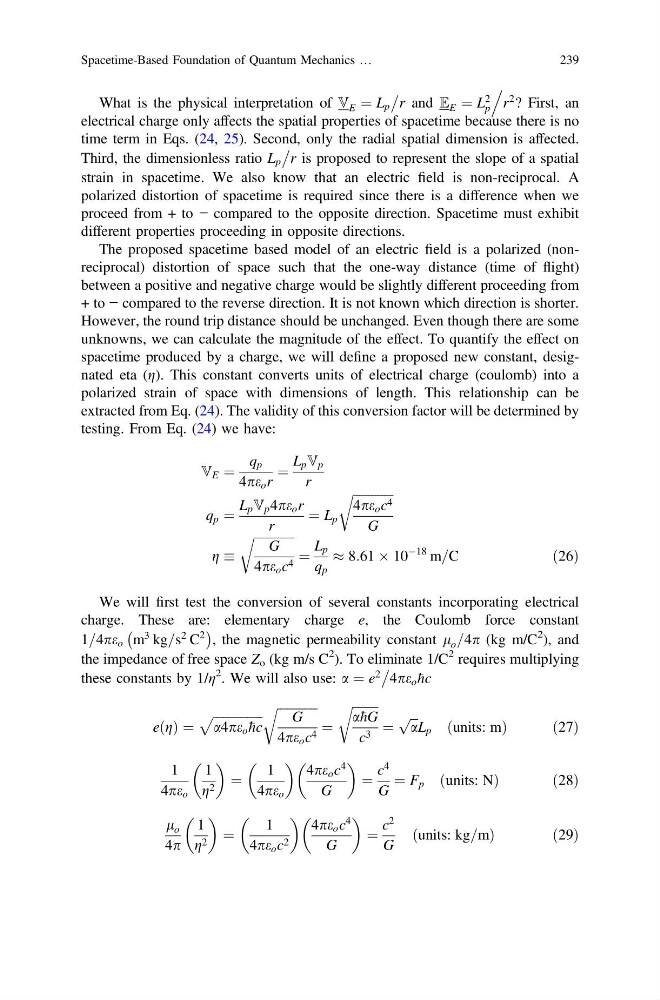
What is the physical interpretation of V E ¼ L p
r and E E ¼ L
2
p
.
r
2 ? First, an
electrical charge only affects the spatial properties of spacetime because there is no
time term in Eqs. (24, 25). Second, only the radial spatial dimension is affected.
Third, the dimensionless ratio L p
r is proposed to represent the slope of a spatial
strain in spacetime. We also know that an electric field is non-reciprocal. A
polarized distortion of spacetime is required since there is a difference when we
proceed from + to − compared to the opposite direction. Spacetime must exhibit
different properties proceeding in opposite directions.
The proposed spacetime based model of an electric field is a polarized (nonreciprocal) distortion of space such that the one-way distance (time of flight)
between a positive and negative charge would be slightly different proceeding from
+ to − compared to the reverse direction. It is not known which direction is shorter.
However, the round trip distance should be unchanged. Even though there are some
unknowns, we can calculate the magnitude of the effect. To quantify the effect on
spacetime produced by a charge, we will define a proposed new constant, designated eta (g). This constant converts units of electrical charge (coulomb) into a
polarized strain of space with dimensions of length. This relationship can be
extracted from Eq. (24). The validity of this conversion factor will be determined by
testing. From Eq. (24) we have:
V E ¼
q p
4pe o r
¼
L p V p
r
q p ¼
L p V p 4pe o r
r
¼ L p
ffiffiffiffiffiffiffiffiffiffiffiffiffi
4pe o c 4
G
r
g
ffiffiffiffiffiffiffiffiffiffiffiffiffi
G
4pe o c 4
r
¼
L p
q p
% 8:61 Â 10
À18 m=C
ð26Þ
We will first test the conversion of several constants incorporating electrical
charge. These are: elementary charge e, the Coulomb force constant
1=4pe o m
3 kg=s
2 C
2
À
Á
, the magnetic permeability constant l o =4p (kg m/C
2 ), and
the impedance of free space Z o (kg m/s C
2 ). To eliminate 1/C
2 requires multiplying
these constants by 1/η
2 . We will also use: a ¼ e
2
4pe o hc
e g
ð Þ ¼
ffiffiffiffiffiffiffiffiffiffiffiffiffiffiffiffi
a4pe o hc
p
ffiffiffiffiffiffiffiffiffiffiffiffiffi
G
4pe o c 4
r
¼
ffiffiffiffiffiffiffiffi ffi
a hG
c 3
r
¼
ffiffi ffi
a
p
L p units: m
ð
Þ
ð 27Þ
1
4pe o
1
g 2
¼
1
4pe o
4pe o c
4
G
¼
c
4
G
¼ F p units: N
ð
Þ
ð 28Þ
l o
4p
1
g 2
¼
1
4pe o c 2
4pe o c
4
G
¼
c
2
G
units: kg=m
ð
Þ
ð 29Þ
Spacetime-Based Foundation of Quantum Mechanics …
239
r and E E ¼ L
2
p
.
r
2 ? First, an
electrical charge only affects the spatial properties of spacetime because there is no
time term in Eqs. (24, 25). Second, only the radial spatial dimension is affected.
Third, the dimensionless ratio L p
r is proposed to represent the slope of a spatial
strain in spacetime. We also know that an electric field is non-reciprocal. A
polarized distortion of spacetime is required since there is a difference when we
proceed from + to − compared to the opposite direction. Spacetime must exhibit
different properties proceeding in opposite directions.
The proposed spacetime based model of an electric field is a polarized (nonreciprocal) distortion of space such that the one-way distance (time of flight)
between a positive and negative charge would be slightly different proceeding from
+ to − compared to the reverse direction. It is not known which direction is shorter.
However, the round trip distance should be unchanged. Even though there are some
unknowns, we can calculate the magnitude of the effect. To quantify the effect on
spacetime produced by a charge, we will define a proposed new constant, designated eta (g). This constant converts units of electrical charge (coulomb) into a
polarized strain of space with dimensions of length. This relationship can be
extracted from Eq. (24). The validity of this conversion factor will be determined by
testing. From Eq. (24) we have:
V E ¼
q p
4pe o r
¼
L p V p
r
q p ¼
L p V p 4pe o r
r
¼ L p
ffiffiffiffiffiffiffiffiffiffiffiffiffi
4pe o c 4
G
r
g
ffiffiffiffiffiffiffiffiffiffiffiffiffi
G
4pe o c 4
r
¼
L p
q p
% 8:61 Â 10
À18 m=C
ð26Þ
We will first test the conversion of several constants incorporating electrical
charge. These are: elementary charge e, the Coulomb force constant
1=4pe o m
3 kg=s
2 C
2
À
Á
, the magnetic permeability constant l o =4p (kg m/C
2 ), and
the impedance of free space Z o (kg m/s C
2 ). To eliminate 1/C
2 requires multiplying
these constants by 1/η
2 . We will also use: a ¼ e
2
4pe o hc
e g
ð Þ ¼
ffiffiffiffiffiffiffiffiffiffiffiffiffiffiffiffi
a4pe o hc
p
ffiffiffiffiffiffiffiffiffiffiffiffiffi
G
4pe o c 4
r
¼
ffiffiffiffiffiffiffiffi ffi
a hG
c 3
r
¼
ffiffi ffi
a
p
L p units: m
ð
Þ
ð 27Þ
1
4pe o
1
g 2
¼
1
4pe o
4pe o c
4
G
¼
c
4
G
¼ F p units: N
ð
Þ
ð 28Þ
l o
4p
1
g 2
¼
1
4pe o c 2
4pe o c
4
G
¼
c
2
G
units: kg=m
ð
Þ
ð 29Þ
Spacetime-Based Foundation of Quantum Mechanics …
239