

accelerated in a direction parallel to the cavity’s optical axis. Then we can designate
one mirror as the “front” mirror and one mirror as the “rear” mirror. During the time
that it takes for the light to propagate from the front to rear mirror, the optical cavity
has some change in velocity. The light striking the rear mirror exerts a slightly
larger force on the rear mirror than was exerted on the front mirror. This difference
is due to the different Doppler shifted frequencies at the two mirrors. When this
force difference is calculated, it exactly equals the inertial force that would be
expected for a mass of equal energy. This equivalence extends even to relativistic
conditions. In other words, photons are only massless when they are freely propagating. Confined photons have mass.
The model of a spacetime particle has a Planck amplitude wave propagating at the
speed of light but circulating within a spherical volume one Compton wavelength in
circumference. Even though there are no physical reflectors (other than the surrounding spacetime field), this fermion model meets the criteria of energy propagating at the speed of light but confined to a specific frame of reference. Therefore
accelerating the spacetime model of a fermion with internal energy E i exhibits the
same inertial force F as accelerating an equal energy of confined photons. The
conservation of momentum requires that there is an exact match between the inertia
of a particle and an equal amount of energy in the form of confined photons.
5 Charge, Electric Fields and Black Holes
So far, it has been shown that adopting the assumption that the universe is only
spacetime gives new insights into particles and forces. However, if the single
building block of everything in the universe is the energetic spacetime field, then
the implication is that all of the effects associated with electrical charge, electric
fields, etc. should also be able to be explained using only the properties of
spacetime. This is a severe test of the starting assumption.
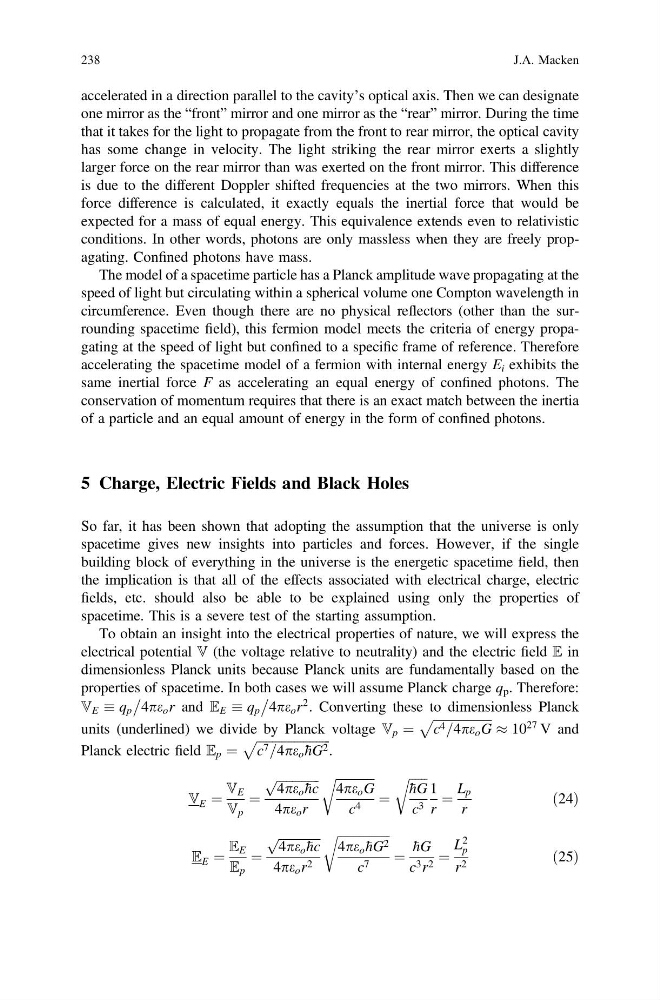
To obtain an insight into the electrical properties of nature, we will express the
electrical potential V (the voltage relative to neutrality) and the electric field E in
dimensionless Planck units because Planck units are fundamentally based on the
properties of spacetime. In both cases we will assume Planck charge q p . Therefore:
V E q p
4pe o r and E E q p
4pe o r
2 . Converting these to dimensionless Planck
units (underlined) we divide by Planck voltage V p ¼
ffiffiffiffiffiffiffiffiffiffiffiffiffiffiffiffiffiffiffi
c 4 =4pe o G
p
% 10
27 V and
Planck electric field E p ¼
ffiffiffiffiffiffiffiffiffiffiffiffiffiffiffiffiffiffiffiffiffiffiffi ffi
c 7 =4pe o hG 2
p
.
V E ¼
V E
V p
¼
ffiffiffiffiffiffiffiffiffiffiffiffiffi ffi
4pe o hc
p
4pe o r
ffiffiffiffiffiffiffiffiffiffiffiffi ffi
4pe o G
c 4
r
¼
ffiffiffiffiffiffi
hG
c 3
r
1
r
¼
L p
r
ð24Þ
E E ¼
E E
E p
¼
ffiffiffiffiffiffiffiffiffiffiffiffiffi ffi
4pe o hc
p
4pe o r 2
ffiffiffiffiffiffiffiffiffiffiffiffiffiffiffiffiffi
4pe o hG 2
c 7
r
¼
hG
c 3 r 2 ¼
L
2
p
r 2
ð25Þ
238
J.A. Macken
one mirror as the “front” mirror and one mirror as the “rear” mirror. During the time
that it takes for the light to propagate from the front to rear mirror, the optical cavity
has some change in velocity. The light striking the rear mirror exerts a slightly
larger force on the rear mirror than was exerted on the front mirror. This difference
is due to the different Doppler shifted frequencies at the two mirrors. When this
force difference is calculated, it exactly equals the inertial force that would be
expected for a mass of equal energy. This equivalence extends even to relativistic
conditions. In other words, photons are only massless when they are freely propagating. Confined photons have mass.
The model of a spacetime particle has a Planck amplitude wave propagating at the
speed of light but circulating within a spherical volume one Compton wavelength in
circumference. Even though there are no physical reflectors (other than the surrounding spacetime field), this fermion model meets the criteria of energy propagating at the speed of light but confined to a specific frame of reference. Therefore
accelerating the spacetime model of a fermion with internal energy E i exhibits the
same inertial force F as accelerating an equal energy of confined photons. The
conservation of momentum requires that there is an exact match between the inertia
of a particle and an equal amount of energy in the form of confined photons.
5 Charge, Electric Fields and Black Holes
So far, it has been shown that adopting the assumption that the universe is only
spacetime gives new insights into particles and forces. However, if the single
building block of everything in the universe is the energetic spacetime field, then
the implication is that all of the effects associated with electrical charge, electric
fields, etc. should also be able to be explained using only the properties of
spacetime. This is a severe test of the starting assumption.
To obtain an insight into the electrical properties of nature, we will express the
electrical potential V (the voltage relative to neutrality) and the electric field E in
dimensionless Planck units because Planck units are fundamentally based on the
properties of spacetime. In both cases we will assume Planck charge q p . Therefore:
V E q p
4pe o r and E E q p
4pe o r
2 . Converting these to dimensionless Planck
units (underlined) we divide by Planck voltage V p ¼
ffiffiffiffiffiffiffiffiffiffiffiffiffiffiffiffiffiffiffi
c 4 =4pe o G
p
% 10
27 V and
Planck electric field E p ¼
ffiffiffiffiffiffiffiffiffiffiffiffiffiffiffiffiffiffiffiffiffiffiffi ffi
c 7 =4pe o hG 2
p
.
V E ¼
V E
V p
¼
ffiffiffiffiffiffiffiffiffiffiffiffiffi ffi
4pe o hc
p
4pe o r
ffiffiffiffiffiffiffiffiffiffiffiffi ffi
4pe o G
c 4
r
¼
ffiffiffiffiffiffi
hG
c 3
r
1
r
¼
L p
r
ð24Þ
E E ¼
E E
E p
¼
ffiffiffiffiffiffiffiffiffiffiffiffiffi ffi
4pe o hc
p
4pe o r 2
ffiffiffiffiffiffiffiffiffiffiffiffiffiffiffiffiffi
4pe o hG 2
c 7
r
¼
hG
c 3 r 2 ¼
L
2
p
r 2
ð25Þ
238
J.A. Macken