

F G ¼
F G
F p
¼
kA
2
G x
2
c Z s a
cF p
¼
A
2
s
N
2 c
2
k
2
c
c
3
G
k
2
c
c
G
c 4 ¼
E
4
N 2
ð17Þ
F E ¼
F E
F p
¼
kA
2
E x
2
c Z s a
cF p
¼
A s
N
2 c
2
k
2
c
c
3
G
k
2
c
c
G
c 4 ¼
E
2
N 2
ð18Þ
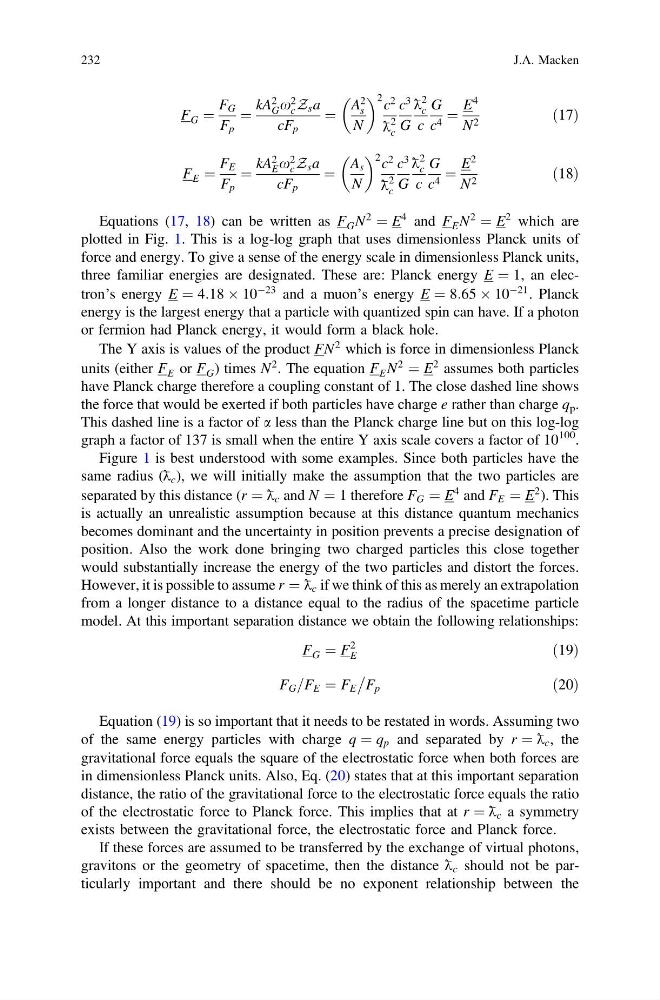
Equations (17, 18) can be written as F G N
2
¼ E
4 and F E N
2
¼ E
2 which are
plotted in Fig. 1. This is a log-log graph that uses dimensionless Planck units of
force and energy. To give a sense of the energy scale in dimensionless Planck units,
three familiar energies are designated. These are: Planck energy E ¼ 1, an electron’s energy E ¼ 4:18 Â 10
À23 and a muon’s energy E ¼ 8:65 Â 10
À21 . Planck
energy is the largest energy that a particle with quantized spin can have. If a photon
or fermion had Planck energy, it would form a black hole.
The Y axis is values of the product FN
2 which is force in dimensionless Planck
units (either F E or F G ) times N
2 . The equation F E N
2
¼ E
2 assumes both particles
have Planck charge therefore a coupling constant of 1. The close dashed line shows
the force that would be exerted if both particles have charge e rather than charge q p .
This dashed line is a factor of a less than the Planck charge line but on this log-log
graph a factor of 137 is small when the entire Y axis scale covers a factor of 10
100 .
Figure 1 is best understood with some examples. Since both particles have the
same radius ( k c ), we will initially make the assumption that the two particles are
separated by this distance (r ¼
k c and N ¼ 1 therefore F G ¼ E
4 and F E ¼ E
2 ). This
is actually an unrealistic assumption because at this distance quantum mechanics
becomes dominant and the uncertainty in position prevents a precise designation of
position. Also the work done bringing two charged particles this close together
would substantially increase the energy of the two particles and distort the forces.
However, it is possible to assume r ¼
k c if we think of this as merely an extrapolation
from a longer distance to a distance equal to the radius of the spacetime particle
model. At this important separation distance we obtain the following relationships:
F G ¼ F
2
E
ð19Þ
F G =F E ¼ F E
F p
ð20Þ
Equation (19) is so important that it needs to be restated in words. Assuming two
of the same energy particles with charge q ¼ q p and separated by r ¼
k c , the
gravitational force equals the square of the electrostatic force when both forces are
in dimensionless Planck units. Also, Eq. (20) states that at this important separation
distance, the ratio of the gravitational force to the electrostatic force equals the ratio
of the electrostatic force to Planck force. This implies that at r ¼
k c a symmetry
exists between the gravitational force, the electrostatic force and Planck force.
If these forces are assumed to be transferred by the exchange of virtual photons,
gravitons or the geometry of spacetime, then the distance
k c should not be particularly important and there should be no exponent relationship between the
232
J.A. Macken
F G
F p
¼
kA
2
G x
2
c Z s a
cF p
¼
A
2
s
N
2 c
2
k
2
c
c
3
G
k
2
c
c
G
c 4 ¼
E
4
N 2
ð17Þ
F E ¼
F E
F p
¼
kA
2
E x
2
c Z s a
cF p
¼
A s
N
2 c
2
k
2
c
c
3
G
k
2
c
c
G
c 4 ¼
E
2
N 2
ð18Þ
Equations (17, 18) can be written as F G N
2
¼ E
4 and F E N
2
¼ E
2 which are
plotted in Fig. 1. This is a log-log graph that uses dimensionless Planck units of
force and energy. To give a sense of the energy scale in dimensionless Planck units,
three familiar energies are designated. These are: Planck energy E ¼ 1, an electron’s energy E ¼ 4:18 Â 10
À23 and a muon’s energy E ¼ 8:65 Â 10
À21 . Planck
energy is the largest energy that a particle with quantized spin can have. If a photon
or fermion had Planck energy, it would form a black hole.
The Y axis is values of the product FN
2 which is force in dimensionless Planck
units (either F E or F G ) times N
2 . The equation F E N
2
¼ E
2 assumes both particles
have Planck charge therefore a coupling constant of 1. The close dashed line shows
the force that would be exerted if both particles have charge e rather than charge q p .
This dashed line is a factor of a less than the Planck charge line but on this log-log
graph a factor of 137 is small when the entire Y axis scale covers a factor of 10
100 .
Figure 1 is best understood with some examples. Since both particles have the
same radius ( k c ), we will initially make the assumption that the two particles are
separated by this distance (r ¼
k c and N ¼ 1 therefore F G ¼ E
4 and F E ¼ E
2 ). This
is actually an unrealistic assumption because at this distance quantum mechanics
becomes dominant and the uncertainty in position prevents a precise designation of
position. Also the work done bringing two charged particles this close together
would substantially increase the energy of the two particles and distort the forces.
However, it is possible to assume r ¼
k c if we think of this as merely an extrapolation
from a longer distance to a distance equal to the radius of the spacetime particle
model. At this important separation distance we obtain the following relationships:
F G ¼ F
2
E
ð19Þ
F G =F E ¼ F E
F p
ð20Þ
Equation (19) is so important that it needs to be restated in words. Assuming two
of the same energy particles with charge q ¼ q p and separated by r ¼
k c , the
gravitational force equals the square of the electrostatic force when both forces are
in dimensionless Planck units. Also, Eq. (20) states that at this important separation
distance, the ratio of the gravitational force to the electrostatic force equals the ratio
of the electrostatic force to Planck force. This implies that at r ¼
k c a symmetry
exists between the gravitational force, the electrostatic force and Planck force.
If these forces are assumed to be transferred by the exchange of virtual photons,
gravitons or the geometry of spacetime, then the distance
k c should not be particularly important and there should be no exponent relationship between the
232
J.A. Macken