

gravitational and electrostatic forces. The spacetime particle is stabilized by an
interaction with the surrounding spacetime field. This produces distortions in the
spacetime field which extend into the surrounding spacetime and scale as a function
of
k c . Details of these external distortions have not been discussed before, but they
give rise to curved spacetime, electric/magnetic fields and de Broglie waves all of
which scale with
k c . These are large subjects beyond the scope of this paper.
However, these and all the concepts presented in this paper are explained in greater
detail in the online book titled The Universe Is Only Spacetime [14].
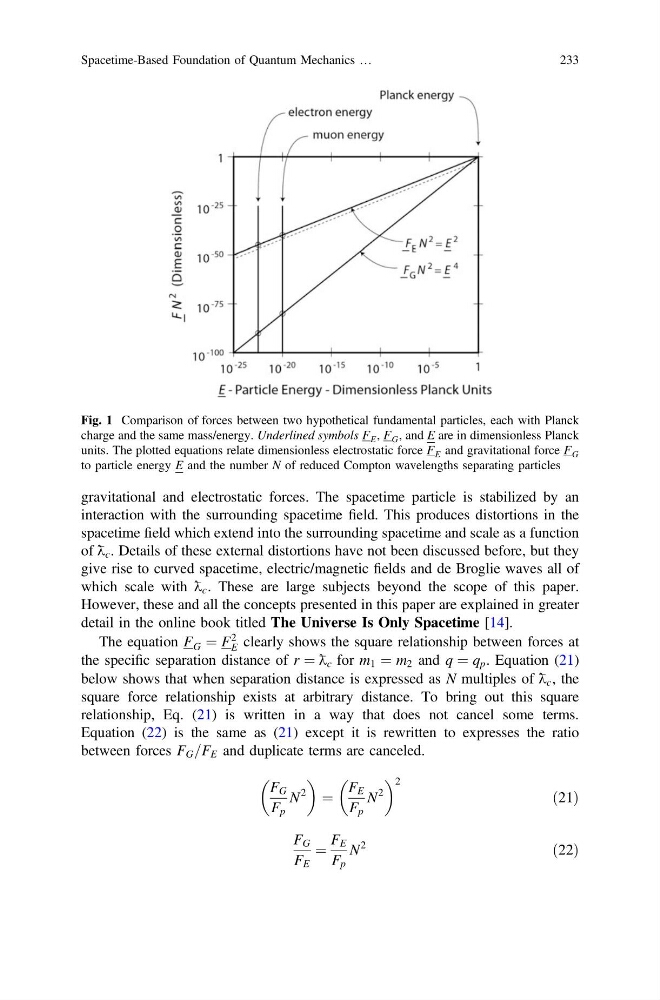
The equation F G ¼ F
2
E clearly shows the square relationship between forces at
the specific separation distance of r ¼
k c for m 1 ¼ m 2 and q ¼ q p . Equation (21)
below shows that when separation distance is expressed as N multiples of
k c , the
square force relationship exists at arbitrary distance. To bring out this square
relationship, Eq. (21) is written in a way that does not cancel some terms.
Equation (22) is the same as (21) except it is rewritten to expresses the ratio
between forces F G =F E and duplicate terms are canceled.
F G
F p
N
2
¼
F E
F p
N
2
2
ð21Þ
F G
F E
¼
F E
F p
N
2
ð22Þ
Fig. 1 Comparison of forces between two hypothetical fundamental particles, each with Planck
charge and the same mass/energy. Underlined symbols F E , F G , and E are in dimensionless Planck
units. The plotted equations relate dimensionless electrostatic force F E and gravitational force F G
to particle energy E and the number N of reduced Compton wavelengths separating particles
Spacetime-Based Foundation of Quantum Mechanics …
233
interaction with the surrounding spacetime field. This produces distortions in the
spacetime field which extend into the surrounding spacetime and scale as a function
of
k c . Details of these external distortions have not been discussed before, but they
give rise to curved spacetime, electric/magnetic fields and de Broglie waves all of
which scale with
k c . These are large subjects beyond the scope of this paper.
However, these and all the concepts presented in this paper are explained in greater
detail in the online book titled The Universe Is Only Spacetime [14].
The equation F G ¼ F
2
E clearly shows the square relationship between forces at
the specific separation distance of r ¼
k c for m 1 ¼ m 2 and q ¼ q p . Equation (21)
below shows that when separation distance is expressed as N multiples of
k c , the
square force relationship exists at arbitrary distance. To bring out this square
relationship, Eq. (21) is written in a way that does not cancel some terms.
Equation (22) is the same as (21) except it is rewritten to expresses the ratio
between forces F G =F E and duplicate terms are canceled.
F G
F p
N
2
¼
F E
F p
N
2
2
ð21Þ
F G
F E
¼
F E
F p
N
2
ð22Þ
Fig. 1 Comparison of forces between two hypothetical fundamental particles, each with Planck
charge and the same mass/energy. Underlined symbols F E , F G , and E are in dimensionless Planck
units. The plotted equations relate dimensionless electrostatic force F E and gravitational force F G
to particle energy E and the number N of reduced Compton wavelengths separating particles
Spacetime-Based Foundation of Quantum Mechanics …
233