

different strain amplitudes A s1 ¼ L p
k c1 and A s2 ¼ L p
k c2 as well as a composite
area a ¼ k k c1
k c2 :
F G ¼ k
A
2
s1 A
2
s2
N 1 N 2
c
2
k c1
k c2
c
3
G
k c1
k c2
c
¼ k
Gm 1 m 2
r 2
ð15Þ
F E ¼ k
A s1 A s2
N 1 N 2
c
2
k c1
k c2
c
3
G
k c1
k c2
c
¼ k
q
2
p
4pe o r 2
ð16Þ
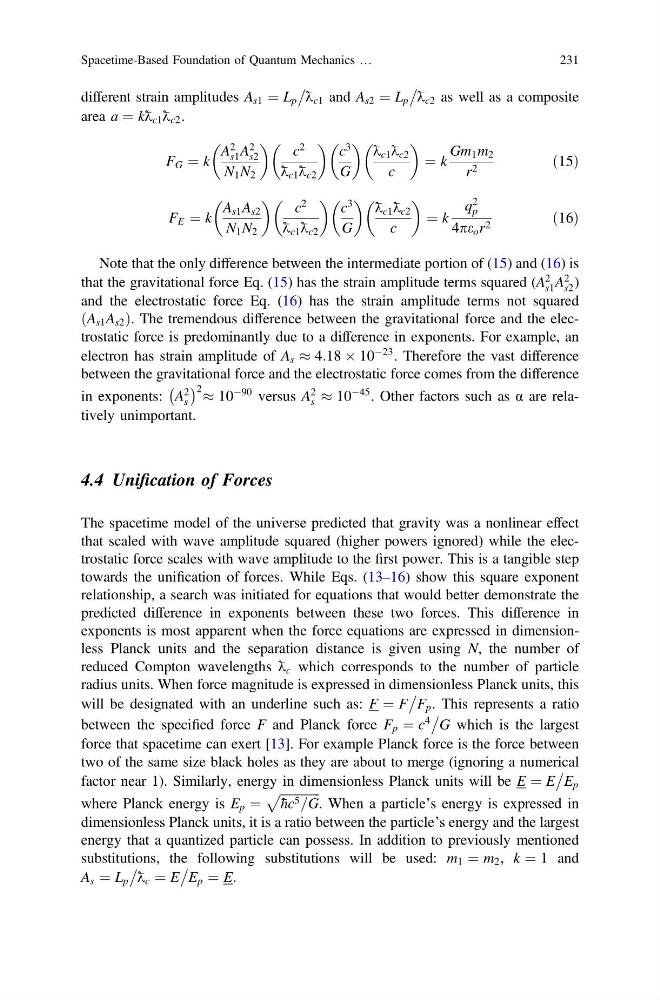
Note that the only difference between the intermediate portion of (15) and (16) is
that the gravitational force Eq. (15) has the strain amplitude terms squared (A
2
s1 A
2
s2 )
and the electrostatic force Eq. (16) has the strain amplitude terms not squared
A s1 A s2
ð
Þ. The tremendous difference between the gravitational force and the electrostatic force is predominantly due to a difference in exponents. For example, an
electron has strain amplitude of A s % 4:18 Â 10
À23 . Therefore the vast difference
between the gravitational force and the electrostatic force comes from the difference
in exponents: A
2
s
À Á 2 % 10
À90 versus A
2
s % 10
À45 . Other factors such as α are relatively unimportant.
4.4 Unification of Forces
The spacetime model of the universe predicted that gravity was a nonlinear effect
that scaled with wave amplitude squared (higher powers ignored) while the electrostatic force scales with wave amplitude to the first power. This is a tangible step
towards the unification of forces. While Eqs. (13–16) show this square exponent
relationship, a search was initiated for equations that would better demonstrate the
predicted difference in exponents between these two forces. This difference in
exponents is most apparent when the force equations are expressed in dimensionless Planck units and the separation distance is given using N, the number of
reduced Compton wavelengths
k c which corresponds to the number of particle
radius units. When force magnitude is expressed in dimensionless Planck units, this
will be designated with an underline such as: F ¼ F
F p . This represents a ratio
between the specified force F and Planck force F p ¼ c
4
G which is the largest
force that spacetime can exert [13]. For example Planck force is the force between
two of the same size black holes as they are about to merge (ignoring a numerical
factor near 1). Similarly, energy in dimensionless Planck units will be E ¼ E
E p
where Planck energy is E p ¼
ffiffiffiffiffiffiffiffiffiffiffiffi ffi
hc 5 =G
p
. When a particle’s energy is expressed in
dimensionless Planck units, it is a ratio between the particle’s energy and the largest
energy that a quantized particle can possess. In addition to previously mentioned
substitutions, the following substitutions will be used: m 1 ¼ m 2 , k ¼ 1 and
A s ¼ L p
k c ¼ E
E p ¼ E:
Spacetime-Based Foundation of Quantum Mechanics …
231
k c1 and A s2 ¼ L p
k c2 as well as a composite
area a ¼ k k c1
k c2 :
F G ¼ k
A
2
s1 A
2
s2
N 1 N 2
c
2
k c1
k c2
c
3
G
k c1
k c2
c
¼ k
Gm 1 m 2
r 2
ð15Þ
F E ¼ k
A s1 A s2
N 1 N 2
c
2
k c1
k c2
c
3
G
k c1
k c2
c
¼ k
q
2
p
4pe o r 2
ð16Þ
Note that the only difference between the intermediate portion of (15) and (16) is
that the gravitational force Eq. (15) has the strain amplitude terms squared (A
2
s1 A
2
s2 )
and the electrostatic force Eq. (16) has the strain amplitude terms not squared
A s1 A s2
ð
Þ. The tremendous difference between the gravitational force and the electrostatic force is predominantly due to a difference in exponents. For example, an
electron has strain amplitude of A s % 4:18 Â 10
À23 . Therefore the vast difference
between the gravitational force and the electrostatic force comes from the difference
in exponents: A
2
s
À Á 2 % 10
À90 versus A
2
s % 10
À45 . Other factors such as α are relatively unimportant.
4.4 Unification of Forces
The spacetime model of the universe predicted that gravity was a nonlinear effect
that scaled with wave amplitude squared (higher powers ignored) while the electrostatic force scales with wave amplitude to the first power. This is a tangible step
towards the unification of forces. While Eqs. (13–16) show this square exponent
relationship, a search was initiated for equations that would better demonstrate the
predicted difference in exponents between these two forces. This difference in
exponents is most apparent when the force equations are expressed in dimensionless Planck units and the separation distance is given using N, the number of
reduced Compton wavelengths
k c which corresponds to the number of particle
radius units. When force magnitude is expressed in dimensionless Planck units, this
will be designated with an underline such as: F ¼ F
F p . This represents a ratio
between the specified force F and Planck force F p ¼ c
4
G which is the largest
force that spacetime can exert [13]. For example Planck force is the force between
two of the same size black holes as they are about to merge (ignoring a numerical
factor near 1). Similarly, energy in dimensionless Planck units will be E ¼ E
E p
where Planck energy is E p ¼
ffiffiffiffiffiffiffiffiffiffiffiffi ffi
hc 5 =G
p
. When a particle’s energy is expressed in
dimensionless Planck units, it is a ratio between the particle’s energy and the largest
energy that a quantized particle can possess. In addition to previously mentioned
substitutions, the following substitutions will be used: m 1 ¼ m 2 , k ¼ 1 and
A s ¼ L p
k c ¼ E
E p ¼ E:
Spacetime-Based Foundation of Quantum Mechanics …
231