

4.3 Gravitational and Electrostatic Force Test
Next we will calculate the magnitude of the gravitational force between two of the
same spacetime particles, each with energy E i . For this calculation, we will use
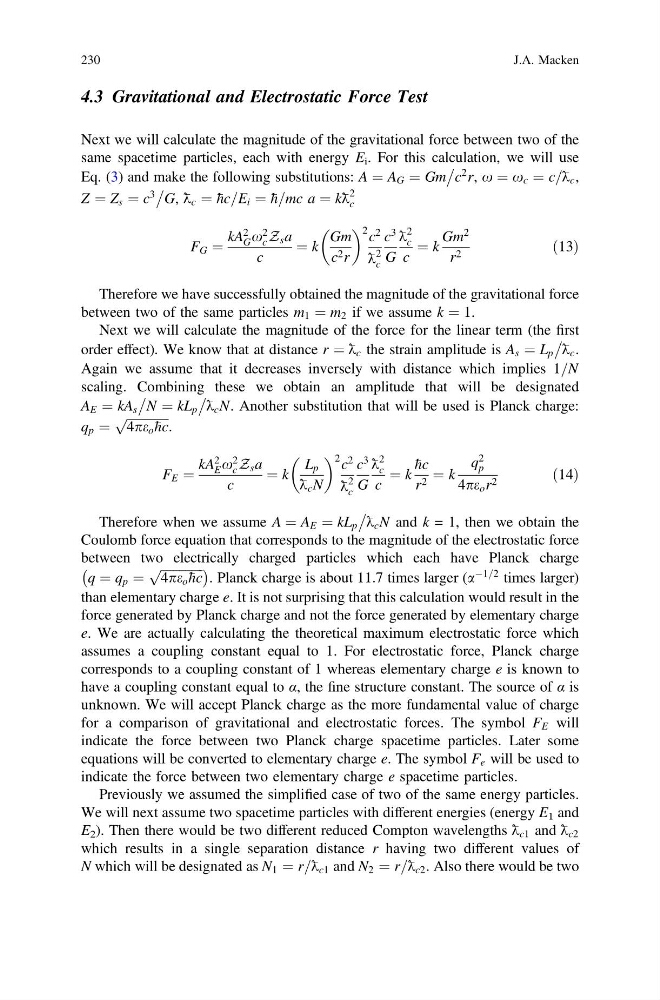
Eq. (3) and make the following substitutions: A ¼ A G ¼ Gm
c
2 r, x ¼ x c ¼ c= k c ,
Z ¼ Z s ¼ c
3
G,
k c ¼ hc=E i ¼ h=mc a ¼ k k
2
c
F G ¼
kA
2
G x
2
c Z s a
c
¼ k
Gm
c 2 r
2 c
2
k
2
c
c
3
G
k
2
c
c
¼ k
Gm
2
r 2
ð13Þ
Therefore we have successfully obtained the magnitude of the gravitational force
between two of the same particles m 1 ¼ m 2 if we assume k ¼ 1.
Next we will calculate the magnitude of the force for the linear term (the first
order effect). We know that at distance r ¼
k c the strain amplitude is A s ¼ L p
k c .
Again we assume that it decreases inversely with distance which implies 1=N
scaling. Combining these we obtain an amplitude that will be designated
A E ¼ kA s
N ¼ kL p
k c N. Another substitution that will be used is Planck charge:
q p ¼
ffiffiffiffiffiffiffiffiffiffiffiffiffi ffi
4pe o hc
p
:
F E ¼
kA
2
E x
2
c Z s a
c
¼ k
L p
k c N
2 c
2
k
2
c
c
3
G
k
2
c
c
¼ k
hc
r 2 ¼ k
q
2
p
4pe o r 2
ð14Þ
Therefore when we assume A ¼ A E ¼ kL p
k c N and k = 1, then we obtain the
Coulomb force equation that corresponds to the magnitude of the electrostatic force
between two electrically charged particles which each have Planck charge
q ¼ q p ¼
ffiffiffiffiffiffiffiffiffiffiffiffiffi ffi
4pe o hc
p
À
Á
. Planck charge is about 11.7 times larger (a
À1=2 times larger)
than elementary charge e. It is not surprising that this calculation would result in the
force generated by Planck charge and not the force generated by elementary charge
e. We are actually calculating the theoretical maximum electrostatic force which
assumes a coupling constant equal to 1. For electrostatic force, Planck charge
corresponds to a coupling constant of 1 whereas elementary charge e is known to
have a coupling constant equal to α, the fine structure constant. The source of α is
unknown. We will accept Planck charge as the more fundamental value of charge
for a comparison of gravitational and electrostatic forces. The symbol F E will
indicate the force between two Planck charge spacetime particles. Later some
equations will be converted to elementary charge e. The symbol F e will be used to
indicate the force between two elementary charge e spacetime particles.
Previously we assumed the simplified case of two of the same energy particles.
We will next assume two spacetime particles with different energies (energy E 1 and
E 2 ). Then there would be two different reduced Compton wavelengths
k c1 and
k c2
which results in a single separation distance r having two different values of
N which will be designated as N 1 ¼ r= k c1 and N 2 ¼ r= k c2 . Also there would be two
230
J.A. Macken
Next we will calculate the magnitude of the gravitational force between two of the
same spacetime particles, each with energy E i . For this calculation, we will use
Eq. (3) and make the following substitutions: A ¼ A G ¼ Gm
c
2 r, x ¼ x c ¼ c= k c ,
Z ¼ Z s ¼ c
3
G,
k c ¼ hc=E i ¼ h=mc a ¼ k k
2
c
F G ¼
kA
2
G x
2
c Z s a
c
¼ k
Gm
c 2 r
2 c
2
k
2
c
c
3
G
k
2
c
c
¼ k
Gm
2
r 2
ð13Þ
Therefore we have successfully obtained the magnitude of the gravitational force
between two of the same particles m 1 ¼ m 2 if we assume k ¼ 1.
Next we will calculate the magnitude of the force for the linear term (the first
order effect). We know that at distance r ¼
k c the strain amplitude is A s ¼ L p
k c .
Again we assume that it decreases inversely with distance which implies 1=N
scaling. Combining these we obtain an amplitude that will be designated
A E ¼ kA s
N ¼ kL p
k c N. Another substitution that will be used is Planck charge:
q p ¼
ffiffiffiffiffiffiffiffiffiffiffiffiffi ffi
4pe o hc
p
:
F E ¼
kA
2
E x
2
c Z s a
c
¼ k
L p
k c N
2 c
2
k
2
c
c
3
G
k
2
c
c
¼ k
hc
r 2 ¼ k
q
2
p
4pe o r 2
ð14Þ
Therefore when we assume A ¼ A E ¼ kL p
k c N and k = 1, then we obtain the
Coulomb force equation that corresponds to the magnitude of the electrostatic force
between two electrically charged particles which each have Planck charge
q ¼ q p ¼
ffiffiffiffiffiffiffiffiffiffiffiffiffi ffi
4pe o hc
p
À
Á
. Planck charge is about 11.7 times larger (a
À1=2 times larger)
than elementary charge e. It is not surprising that this calculation would result in the
force generated by Planck charge and not the force generated by elementary charge
e. We are actually calculating the theoretical maximum electrostatic force which
assumes a coupling constant equal to 1. For electrostatic force, Planck charge
corresponds to a coupling constant of 1 whereas elementary charge e is known to
have a coupling constant equal to α, the fine structure constant. The source of α is
unknown. We will accept Planck charge as the more fundamental value of charge
for a comparison of gravitational and electrostatic forces. The symbol F E will
indicate the force between two Planck charge spacetime particles. Later some
equations will be converted to elementary charge e. The symbol F e will be used to
indicate the force between two elementary charge e spacetime particles.
Previously we assumed the simplified case of two of the same energy particles.
We will next assume two spacetime particles with different energies (energy E 1 and
E 2 ). Then there would be two different reduced Compton wavelengths
k c1 and
k c2
which results in a single separation distance r having two different values of
N which will be designated as N 1 ¼ r= k c1 and N 2 ¼ r= k c2 . Also there would be two
230
J.A. Macken