

the particle’s electric field and a nonlinear component associated with the particle’s gravitational field. We will first examine the nonlinear (gravitational)
component.
A s sin xt
ð
Þ
2 ¼
1
2
A
2
s À
1
2
A
2
s sin 2xt
ð11Þ
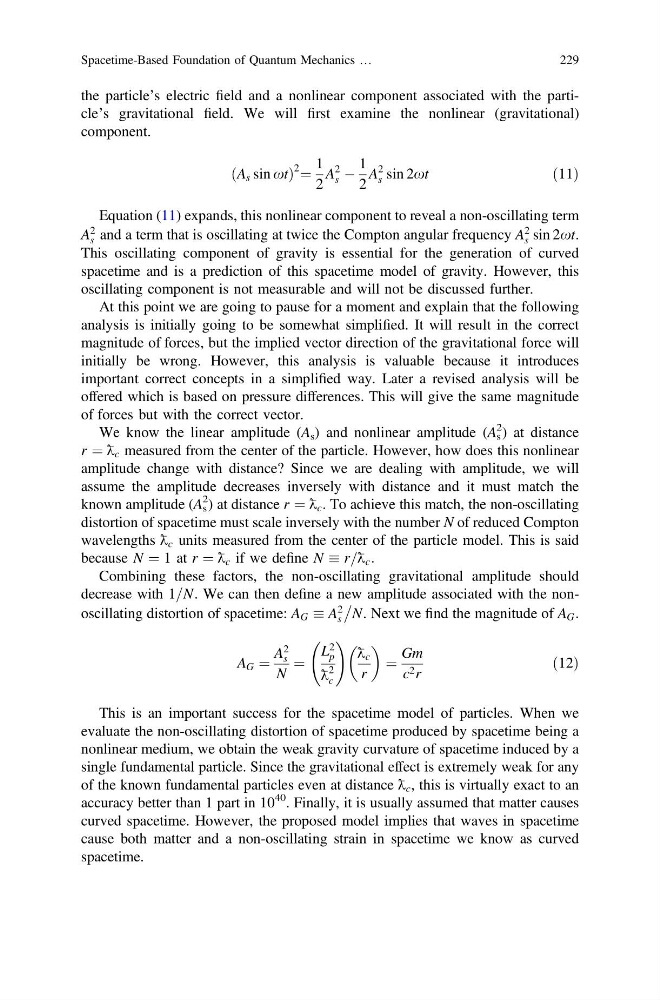
Equation (11) expands, this nonlinear component to reveal a non-oscillating term
A
2
s and a term that is oscillating at twice the Compton angular frequency A
2
s sin 2xt.
This oscillating component of gravity is essential for the generation of curved
spacetime and is a prediction of this spacetime model of gravity. However, this
oscillating component is not measurable and will not be discussed further.
At this point we are going to pause for a moment and explain that the following
analysis is initially going to be somewhat simplified. It will result in the correct
magnitude of forces, but the implied vector direction of the gravitational force will
initially be wrong. However, this analysis is valuable because it introduces
important correct concepts in a simplified way. Later a revised analysis will be
offered which is based on pressure differences. This will give the same magnitude
of forces but with the correct vector.
We know the linear amplitude (A s ) and nonlinear amplitude (A s
2 ) at distance
r ¼
k c measured from the center of the particle. However, how does this nonlinear
amplitude change with distance? Since we are dealing with amplitude, we will
assume the amplitude decreases inversely with distance and it must match the
known amplitude (A s
2 ) at distance r ¼
k c . To achieve this match, the non-oscillating
distortion of spacetime must scale inversely with the number N of reduced Compton
wavelengths
k c units measured from the center of the particle model. This is said
because N ¼ 1 at r ¼
k c if we define N r= k c :
Combining these factors, the non-oscillating gravitational amplitude should
decrease with 1=N. We can then define a new amplitude associated with the nonoscillating distortion of spacetime: A G A
2
s
N. Next we find the magnitude of A G :
A G ¼
A
2
s
N
¼
L
2
p
k
2
c
!
k c
r
¼
Gm
c 2 r
ð12Þ
This is an important success for the spacetime model of particles. When we
evaluate the non-oscillating distortion of spacetime produced by spacetime being a
nonlinear medium, we obtain the weak gravity curvature of spacetime induced by a
single fundamental particle. Since the gravitational effect is extremely weak for any
of the known fundamental particles even at distance
k c , this is virtually exact to an
accuracy better than 1 part in 10
40 . Finally, it is usually assumed that matter causes
curved spacetime. However, the proposed model implies that waves in spacetime
cause both matter and a non-oscillating strain in spacetime we know as curved
spacetime.
Spacetime-Based Foundation of Quantum Mechanics …
229
component.
A s sin xt
ð
Þ
2 ¼
1
2
A
2
s À
1
2
A
2
s sin 2xt
ð11Þ
Equation (11) expands, this nonlinear component to reveal a non-oscillating term
A
2
s and a term that is oscillating at twice the Compton angular frequency A
2
s sin 2xt.
This oscillating component of gravity is essential for the generation of curved
spacetime and is a prediction of this spacetime model of gravity. However, this
oscillating component is not measurable and will not be discussed further.
At this point we are going to pause for a moment and explain that the following
analysis is initially going to be somewhat simplified. It will result in the correct
magnitude of forces, but the implied vector direction of the gravitational force will
initially be wrong. However, this analysis is valuable because it introduces
important correct concepts in a simplified way. Later a revised analysis will be
offered which is based on pressure differences. This will give the same magnitude
of forces but with the correct vector.
We know the linear amplitude (A s ) and nonlinear amplitude (A s
2 ) at distance
r ¼
k c measured from the center of the particle. However, how does this nonlinear
amplitude change with distance? Since we are dealing with amplitude, we will
assume the amplitude decreases inversely with distance and it must match the
known amplitude (A s
2 ) at distance r ¼
k c . To achieve this match, the non-oscillating
distortion of spacetime must scale inversely with the number N of reduced Compton
wavelengths
k c units measured from the center of the particle model. This is said
because N ¼ 1 at r ¼
k c if we define N r= k c :
Combining these factors, the non-oscillating gravitational amplitude should
decrease with 1=N. We can then define a new amplitude associated with the nonoscillating distortion of spacetime: A G A
2
s
N. Next we find the magnitude of A G :
A G ¼
A
2
s
N
¼
L
2
p
k
2
c
!
k c
r
¼
Gm
c 2 r
ð12Þ
This is an important success for the spacetime model of particles. When we
evaluate the non-oscillating distortion of spacetime produced by spacetime being a
nonlinear medium, we obtain the weak gravity curvature of spacetime induced by a
single fundamental particle. Since the gravitational effect is extremely weak for any
of the known fundamental particles even at distance
k c , this is virtually exact to an
accuracy better than 1 part in 10
40 . Finally, it is usually assumed that matter causes
curved spacetime. However, the proposed model implies that waves in spacetime
cause both matter and a non-oscillating strain in spacetime we know as curved
spacetime.
Spacetime-Based Foundation of Quantum Mechanics …
229