

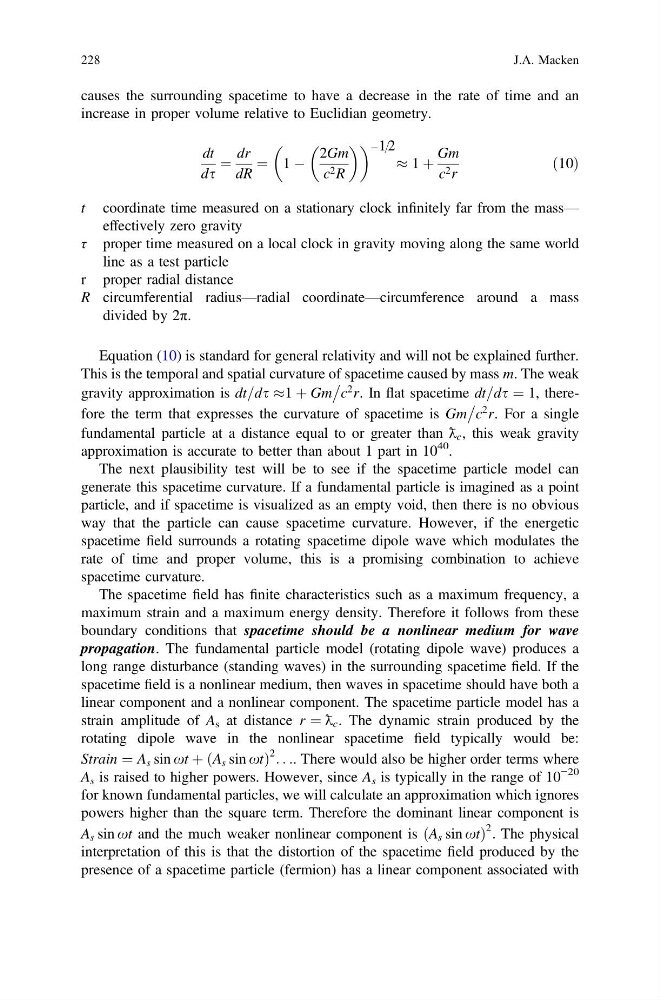
causes the surrounding spacetime to have a decrease in the rate of time and an
increase in proper volume relative to Euclidian geometry.
dt
ds
¼
dr
dR
¼ 1 À
2Gm
c 2 R
À1=2
% 1 þ
Gm
c 2 r
ð10Þ
t coordinate time measured on a stationary clock infinitely far from the mass—
effectively zero gravity
τ proper time measured on a local clock in gravity moving along the same world
line as a test particle
r proper radial distance
R circumferential radius—radial coordinate—circumference around a mass
divided by 2π.
Equation (10) is standard for general relativity and will not be explained further.
This is the temporal and spatial curvature of spacetime caused by mass m. The weak
gravity approximation is dt=ds %1 þ Gm
c
2 r. In flat spacetime dt=ds ¼ 1, therefore the term that expresses the curvature of spacetime is Gm
c
2 r. For a single
fundamental particle at a distance equal to or greater than
k c , this weak gravity
approximation is accurate to better than about 1 part in 10
40 .
The next plausibility test will be to see if the spacetime particle model can
generate this spacetime curvature. If a fundamental particle is imagined as a point
particle, and if spacetime is visualized as an empty void, then there is no obvious
way that the particle can cause spacetime curvature. However, if the energetic
spacetime field surrounds a rotating spacetime dipole wave which modulates the
rate of time and proper volume, this is a promising combination to achieve
spacetime curvature.
The spacetime field has finite characteristics such as a maximum frequency, a
maximum strain and a maximum energy density. Therefore it follows from these
boundary conditions that spacetime should be a nonlinear medium for wave
propagation. The fundamental particle model (rotating dipole wave) produces a
long range disturbance (standing waves) in the surrounding spacetime field. If the
spacetime field is a nonlinear medium, then waves in spacetime should have both a
linear component and a nonlinear component. The spacetime particle model has a
strain amplitude of A s at distance r ¼
k c . The dynamic strain produced by the
rotating dipole wave in the nonlinear spacetime field typically would be:
Strain ¼ A s sin xt þ A s sin xt
ð
Þ
2 . . .. There would also be higher order terms where
A s is raised to higher powers. However, since A s is typically in the range of 10
−20
for known fundamental particles, we will calculate an approximation which ignores
powers higher than the square term. Therefore the dominant linear component is
A s sin xt and the much weaker nonlinear component is A s sin xt
ð
Þ
2 . The physical
interpretation of this is that the distortion of the spacetime field produced by the
presence of a spacetime particle (fermion) has a linear component associated with
228
J.A. Macken
increase in proper volume relative to Euclidian geometry.
dt
ds
¼
dr
dR
¼ 1 À
2Gm
c 2 R
À1=2
% 1 þ
Gm
c 2 r
ð10Þ
t coordinate time measured on a stationary clock infinitely far from the mass—
effectively zero gravity
τ proper time measured on a local clock in gravity moving along the same world
line as a test particle
r proper radial distance
R circumferential radius—radial coordinate—circumference around a mass
divided by 2π.
Equation (10) is standard for general relativity and will not be explained further.
This is the temporal and spatial curvature of spacetime caused by mass m. The weak
gravity approximation is dt=ds %1 þ Gm
c
2 r. In flat spacetime dt=ds ¼ 1, therefore the term that expresses the curvature of spacetime is Gm
c
2 r. For a single
fundamental particle at a distance equal to or greater than
k c , this weak gravity
approximation is accurate to better than about 1 part in 10
40 .
The next plausibility test will be to see if the spacetime particle model can
generate this spacetime curvature. If a fundamental particle is imagined as a point
particle, and if spacetime is visualized as an empty void, then there is no obvious
way that the particle can cause spacetime curvature. However, if the energetic
spacetime field surrounds a rotating spacetime dipole wave which modulates the
rate of time and proper volume, this is a promising combination to achieve
spacetime curvature.
The spacetime field has finite characteristics such as a maximum frequency, a
maximum strain and a maximum energy density. Therefore it follows from these
boundary conditions that spacetime should be a nonlinear medium for wave
propagation. The fundamental particle model (rotating dipole wave) produces a
long range disturbance (standing waves) in the surrounding spacetime field. If the
spacetime field is a nonlinear medium, then waves in spacetime should have both a
linear component and a nonlinear component. The spacetime particle model has a
strain amplitude of A s at distance r ¼
k c . The dynamic strain produced by the
rotating dipole wave in the nonlinear spacetime field typically would be:
Strain ¼ A s sin xt þ A s sin xt
ð
Þ
2 . . .. There would also be higher order terms where
A s is raised to higher powers. However, since A s is typically in the range of 10
−20
for known fundamental particles, we will calculate an approximation which ignores
powers higher than the square term. Therefore the dominant linear component is
A s sin xt and the much weaker nonlinear component is A s sin xt
ð
Þ
2 . The physical
interpretation of this is that the distortion of the spacetime field produced by the
presence of a spacetime particle (fermion) has a linear component associated with
228
J.A. Macken