

5 Procedure for Determination of the Second Fundamental
Solution of the Dirac Equation and Anti-Wronscian
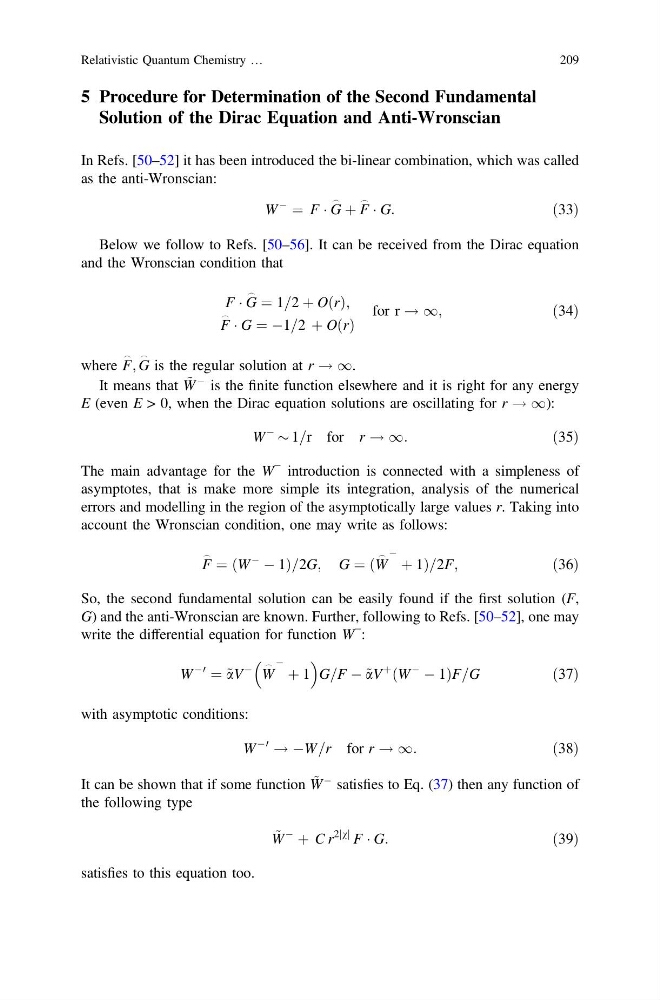
In Refs. [50–52] it has been introduced the bi-linear combination, which was called
as the anti-Wronscian:
W
À
¼ F Á G
_ þ F
_ Á G:
ð33Þ
Below we follow to Refs. [50–56]. It can be received from the Dirac equation
and the Wronscian condition that
F Á G
_ ¼ 1=2 þ O r
ð Þ;
F
_ Á G ¼ À1=2 þ O r
ð Þ
for r ! 1;
ð34Þ
where F
_ ; G
_
is the regular solution at r ! 1.
It means that ~
W
À is the finite function elsewhere and it is right for any energy
E (even E > 0, when the Dirac equation solutions are oscillating for r ! 1):
W
À
$ 1=r for r ! 1:
ð35Þ
The main advantage for the W
− introduction is connected with a simpleness of
asymptotes, that is make more simple its integration, analysis of the numerical
errors and modelling in the region of the asymptotically large values r. Taking into
account the Wronscian condition, one may write as follows:
F
_ ¼ ðW
À
À 1Þ=2G; G ¼ ðW
_ À þ 1Þ=2F;
ð36Þ
So, the second fundamental solution can be easily found if the first solution (F,
G) and the anti-Wronscian are known. Further, following to Refs. [50–52], one may
write the differential equation for function W
− :
W
À0
¼ ~ aV
À W
_ À þ 1
G=F À ~ aV
þ W
À
À 1
ð
Þ F=G
ð37Þ
with asymptotic conditions:
W
À0
! ÀW=r for r ! 1:
ð38Þ
It can be shown that if some function ~
W
À satisfies to Eq. (37) then any function of
the following type
~
W
À
þ C r
2 v
j j F Á G:
ð39Þ
satisfies to this equation too.
Relativistic Quantum Chemistry …
209
Solution of the Dirac Equation and Anti-Wronscian
In Refs. [50–52] it has been introduced the bi-linear combination, which was called
as the anti-Wronscian:
W
À
¼ F Á G
_ þ F
_ Á G:
ð33Þ
Below we follow to Refs. [50–56]. It can be received from the Dirac equation
and the Wronscian condition that
F Á G
_ ¼ 1=2 þ O r
ð Þ;
F
_ Á G ¼ À1=2 þ O r
ð Þ
for r ! 1;
ð34Þ
where F
_ ; G
_
is the regular solution at r ! 1.
It means that ~
W
À is the finite function elsewhere and it is right for any energy
E (even E > 0, when the Dirac equation solutions are oscillating for r ! 1):
W
À
$ 1=r for r ! 1:
ð35Þ
The main advantage for the W
− introduction is connected with a simpleness of
asymptotes, that is make more simple its integration, analysis of the numerical
errors and modelling in the region of the asymptotically large values r. Taking into
account the Wronscian condition, one may write as follows:
F
_ ¼ ðW
À
À 1Þ=2G; G ¼ ðW
_ À þ 1Þ=2F;
ð36Þ
So, the second fundamental solution can be easily found if the first solution (F,
G) and the anti-Wronscian are known. Further, following to Refs. [50–52], one may
write the differential equation for function W
− :
W
À0
¼ ~ aV
À W
_ À þ 1
G=F À ~ aV
þ W
À
À 1
ð
Þ F=G
ð37Þ
with asymptotic conditions:
W
À0
! ÀW=r for r ! 1:
ð38Þ
It can be shown that if some function ~
W
À satisfies to Eq. (37) then any function of
the following type
~
W
À
þ C r
2 v
j j F Á G:
ð39Þ
satisfies to this equation too.
Relativistic Quantum Chemistry …
209